There’s a smell of cardboard and chemicals in the strip lighted corridors of the white painted basement. Paintings swaddled in Bubble Wrap lean against wooden crates, warm air blows from ducts and a complex network of grey pipes runs beneath the ceiling.
We are in the internal organs of this building, in the collection stores of the Great North Museum. Half a million objects are protected in these temperature controlled rooms: insects, shells, eggs, herbarium specimens, stuffed birds, skulls and bones.
The visit has been organised as a thank you to wildlife recorders of the North Pennines who have added their observations to the 2.5m species records now held on computer.
Dan Gordon, keeper of biology, shows us where new finds awaiting preparation are kept: a large, white, chest freezer of the sort you might find in a garage. Encased in plastic bags like objects from a crime scene are a tawny owl, the dorsal fin of a sei whale, and a juvenile sparrowhawk that was hit by a car. Though their skulls are kept intact the birds are skinned, taking up less room that way.
These underground store rooms are lined with bays of grey cabinets; Dan turns a wheel and they trundle apart to reveal black boxes full of specimens. One large box holds about 50 cuckoos. Through the bags we can see their flattened bodies, the collection data written on tags. From Patterdale in Cumbria is “one of two that flew into a window”.
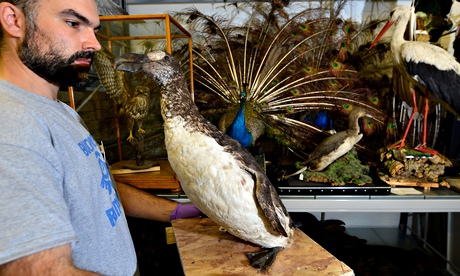
In these stores are reminders of what we’ve lost. Here are preserved corncrakes, birds once found all over the Newcastle area. Victorian taxidermy specimens stand mounted on wood plinths.
Most poignant of all are the stuffed specimens of extinct species. A pair of the New Zealand huia birds, the animals differing in their beak structure, the male with a short, crow-like bill, the female carrying a long arched beak; a sign they possibly worked cooperatively.
And there on a shelf is a familiar outline, its beak heavy and lined with down-curving grooves – the only known specimen of a juvenile great auk.
Twitter: @cottagegardener