A forecast of the warmest weekend this year is expected to underline the arrival of spring as forecasters predict temperatures could reach as high as 17C in eastern Scotland and 15C in London.
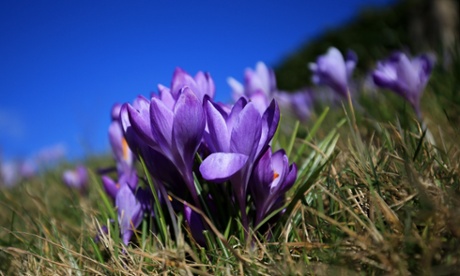
Harbingers of the change in season include reports of field of crocuses in Ayrshire and sightings of a basking lizard in Epping Forest.
Common lizard basking on March 3rd in #EppingForest @LondonNP @BestLondonParks #SignsOfSpring #MyWildLife pic.twitter.com/yLqmYHZ3qW
— christian moss (@christianmoss1) March 6, 2015
National Trust naturalist Matthew Oates urged the public to get outdoors to witness the joys of spring. “Saturday is going to be an especially exciting day, do not waste it shopping and cleaning the car, get out and enjoy the countryside because it will all be happening,” he said.
Oates also provided a spring spotting guide for species to look out for. “Tomorrow will be national bumblebee liftoff day as they emerge from hibernation. And when the sun comes through look out for brimstone butterflies – they need 12C or 13C and sunshine – so they should be kicking off, along with the other four species of butterfly which hibernate – comma, peacock, small tortoiseshell and red admiral.
Peacock #butterfly in Peterborough yesterday and this Dotted Border #moth at kitchen window #SignsOfSpring #wildlife pic.twitter.com/YklYzNARnk
— Brian Stone (@brianhstone) March 6, 2015
“As the water warms up watch out for migrating toads, and frogs and frogspawn. Flower-wise, celandines and primroses will be coming out and the first of the wild daffodils in places likes Dunsford Woods in Devon are starting early.”
The Woodland Trust, which runs the project Nature’s Calendar, a survey of the times of recurring natural phenomena, is trying to gauge the speed of the arrival of this year’s spring.
Spokesman Chris Hickman said: “This year we are trying to track how fast spring is arriving by recording the time and location of five species: flowering hawthorn, frogspawn, orange tip butterfly, seven-spot ladybirds and oak leafing.”
He said so far it appeared to be later than last year, judging by sightings of frogspawn (down 20%) and ladybirds (down 10%).
But he predicted a “spurt of activity” this weekend if temperatures increased as forecast. “Historically we have seen that if there is a noticeable period of warmth you do see a spike in records. But we are tracking spring from January to May, so while there may be a spike this weekend it could even out over time,” he said.
“People have been saying ‘spring is later this year’. But actually this is now what’s become the average for spring. Some of the earlier spring events such as snowdrops and hazel flowering have been on time.”
Lovely #SciArt! @timberpress @SussexWildlife Freshly-laid frog spawn at Woods Mill nature reserve #signsofspring pic.twitter.com/gaL3sjUwQZ
— Anandi A. Premlall (@AAPremlall) March 6, 2015
But he said it depended on location. “Spring in theory should begin in the south-west and work its way north. So if you see a butterfly now in Cornwall that would be more expected than one in Yorkshire. Similarly with frogspawn.”
@ayrshire #SignsOfSpring in Corsehill Park Ayr today @bbcweather .co.UK @BBCScotWeather @SeanBattySTV pic.twitter.com/bH7c8IluUI"
— The Real Anne O'Hare (@RealAnneOHare) March 5, 2015
Hickman pointed out long-term records showed spring was arriving sooner. “In the last few decades, spring events like flowering are arriving two weeks earlier,” he said.
Sue Carter, head gardener at Lacock Abbey in Wiltshire, agrees. Speaking to the BBC Radio 4’s Today programme, she said: “Over the last 50 years, it seems to have got about a fortnight earlier. When the Queen Mum used to come and see the crocuses here in the 50s, then it was the middle of March – that was the key date. Now it’s the end of February, beginning of March.”
New season rhubarb just in from Co. Wexford! #SignsofSpring pic.twitter.com/1RkdG9SVW1
— Colin Jephson (@ardkeengrocer) March 6, 2015