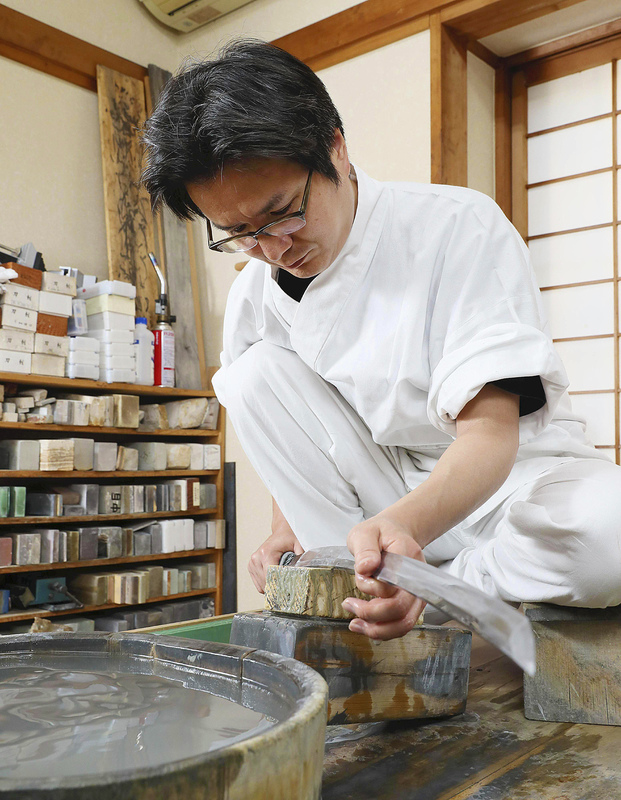
Despite soaring interest in Japanese swords, particularly among young women who play popular online games featuring swords, natural whetstones that are essential to polishing the blades are on the verge of extinction as artificial versions become more common.
Natural whetstones were once mined at nearly 200 sites throughout the country. However, only a few such mines remain active today. Professional sharpeners of the swords are concerned because they claim artificial whetstones fail to bring out the natural brilliance of swords.
Joji Tamaki, 45, who sharpens and polishes Japanese swords in Sakyo Ward, Kyoto, said, "The price of rare whetstones has risen 20 times in the past five years."
Sharpeners polish swords forged by swordsmiths, bringing out wavy, wood grain-like patterns on the surface of the blade to elevate the weapons into works of art.
Natural whetstone is indispensable for polishing swords. It is made from sedimentary rock and is fine-grained, crucial to making a sword shine, the final step in the sharpening process.
A variety of natural whetstone called Uchigumori produced in Kyoto Prefecture that is especially fine-grained has long been valued as superior for sharpening.
But natural whetstone is now in danger of disappearing from the market.
According to the Foundation of Japanese Sword Culture For the Purpose of Public Interest, based in Tokyo, the number of mines producing natural whetstone was nearly 200 in the Meiji era (1868-1912). However, only a few mines remain, including in Kameoka, Kyoto Prefecture, and Nagasaki Prefecture. The main miner in Kyoto stopped mining Uchigumori a few years ago, and only one company in Kameoka now harvests the special stone.
Behind the trend is the decline of the mining industry itself. Starting in the period of high economic growth around the 1960s, fewer people began entering the mining industry due to harsh labor conditions, mine collapses and mine dust. In addition, from the 1960s to '70s the technology to create artificial whetstone came into widespread use. Artificial whetstone is made by bonding together the grains of hard minerals such as aluminium oxide and diamond. While natural whetstone creates sharper and longer-lived cutting edges, artificial types are sufficient for household and industrial use and thus began to replace relatively expensive natural types.
However, artificial whetstone is too strong to use for sharpening swords -- it erases the dark blue glint and leaves a mirror-like reflection that damages the look of the sword. Sword sharpeners say that if natural whetstone disappears, the attractiveness of Japanese swords will be lost.
In response, moves are under way to secure natural whetstone. For example, a shop specializing in polishing and whetting tools in Tokyo has obtained the mining rights to a closed mine in Kyoto Prefecture in an attempt to excavate Uchigumori.
Upholding the tradition
Whetstone mining still occurs in Kameoka, Kyoto Prefecture. One whetstone mine there can be reached by a 15-minute drive from the foot of a mountain, followed by a 1-kilometer hike up a steep trail. Electric lights illuminate the interior of the mine, revealing piles of large rocks and open pits from past operations.
The mine is managed by Yozo Tsuchihashi, 68, the fourth-generation owner of whetstone mining firm Totoriya, a Kameoka-based company established in 1877. Because the properties of rocks differ by geologic strata, Totoriya's miners rely on intuition honed through years of experience to find whetstone veins. They sometimes use dynamite to reach veins, according to Tsuchihashi.
Kameoka, a city long known for producing whetstone, was once home to more than 100 whetstone workshops. However, today only Totoriya operates in the city, with the remaining whetstone businesses having closed mainly due to the widespread use of artificial whetstones.
Although Tsuchihashi once considered shuttering his business, he decided instead to launch a company website and seek ways to expand sales channels at home and abroad. He said that even cooks from overseas visit his business to buy whetstones after learning the benefits of natural whetstones.
"If someone doesn't assume the role of supporting Japanese blades, the traditional culture will die out," said Tsuchihashi.
More female fans of blades
Japanese swords as they appear today were first crafted in the latter half of the Heian period (8th-12th century) and are characterized by being single-edged and curved. There are said to be about 2.5 million of them in Japan, including those registered by prefectural governments as artworks. However, many remain uncared for.
In recent years, online games featuring Japanese swords have become a big hit, and more women are visiting museums that display historical swords. The term "token joshi" (sword women) has been coined to describe such female sword fans.
A special exhibition currently under way at the Kyoto National Museum in Higashiyama Ward, Kyoto -- organized by The Yomiuri Shimbun and other entities -- also attracts many women each day.
Read more from The Japan News at https://japannews.yomiuri.co.jp/