The idea of a European Defence Union is gaining ground across Europe. But so long as Nato continues to dominate Europe's security, the prospect of building its own effective defence union will remain elusive. To become sovereign in defence matters (and more generally), Europe must terminate Nato -- a prospect as unlikely as it is necessary.
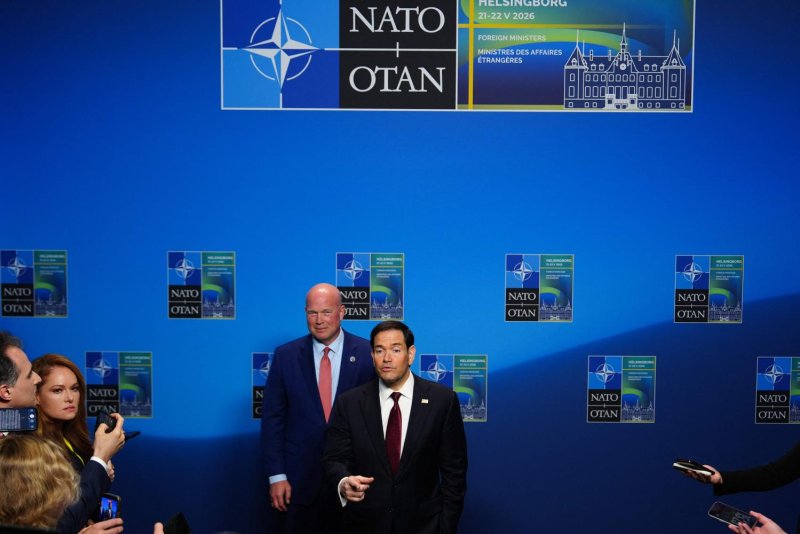
Mark Rutte, the former Dutch prime minister who is now Nato's secretary general, recently let slip a truth that drew gasps from across Europe. He described the alliance not merely as Europe's defensive shield but as " … a platform for the United States to project power on the world stage", and that "making use of key assets here in Europe" is "crucial also for the success of this American‑Israeli campaign" in Iran.
Mr Rutte is right. Nato is a forward base for wars Europe did not choose, against adversaries Europe does not have, in the service of the global ambitions of a power increasingly at odds with Europe's interests and values. European leaders always knew that the North Atlantic alliance was a marriage of nonequals, but they accepted this in return for the promise of security.
Now that the US commitment to European security is in doubt, Mr Rutte is cutting a lonely figure by continuing to celebrate an arrangement that keeps Europe tethered to the American imperium. Even among Europe's Atlanticists, faith that Nato will automatically revert to its default settings once Donald Trump leaves office is waning (albeit in ultra-slow motion).
Permanent acquiescence to US whims does not a European defence strategy make. At the same time, even the most conservative Europeans recognise that Nato without the US would be like a bicycle without a rider. That is why calls for a European Defence Union, most likely a coalition of the willing founded via the European Union's enhanced cooperation procedure and extending to Norway and the United Kingdom, are multiplying.
But therein lies the problem. So long as Nato continues, a viable European alternative is impossible.
A properly functioning European Defence Union requires clear answers to four hard questions: Who places the orders for Europe's weapons? Who issues the common debt necessary to pay for them? How is the resulting expenditure distributed among member states' national champions in the defence industry? Last but certainly not least, who will order Europeans in uniform to kill and be killed?
Sensible answers to these questions cannot be intergovernmental, nor can Nato provide them. The prerequisite for Europe to build its defence union is the political union that the architects of its monetary union eschewed.
Some claim that the current existential threats Europe is facing, especially after Russia's invasion of Ukraine, can create the momentum towards political union that the euro crisis and then the pandemic failed to generate. Right or wrong, one thing is clear: a functional defence union requires political union, and Nato's continued existence is inimical to it.
For the Cold War generation, subordinating Europe's defence to US priorities made sense. American and Western European elites were aligned by a genuine, existential fear of the Soviet Union and by a financial mechanism that, in the 1950s and 1960s, turned Europe into the recycler of America's surpluses. Even after US surpluses gave way to massive deficits, Europe exported its surplus dollars back to the US: Americans bought German cars and French luxury bags while Europeans used those dollars to buy American debt, equities, and real estate.
Meanwhile, the Berlin Wall came down. The Soviet Union became a museum piece, and Boris Yeltsin's Russia wanted nothing more than to join the West, including Nato. The US no longer feared Russia. What the US did fear was too close a relationship between Germany and Russia, lest its hegemony over Europe be challenged.
German industry ran on Russian gas. But German exports ran on American deficits, giving the US the leverage it needed to ensure Germany's acquiescence to its two-pronged policy, preventing Russia's integration into Europe. It deliberately impoverished Russian society, and it expanded Nato eastwards, thus forging the perfect conditions for a strongman like Vladimir Putin to rise.
As Nato marched eastwards, new ruling elites -- in the Baltics, but also in Poland and now Finland -- discovered that they could punch far above their weight within the EU by becoming America's most fervent agents of hyper‑expansion. Suddenly, Europe added to its North‑South faultline (separating surplus Germany and Holland from deficit Greece, Italy, and Spain) a new divide between eastern hyperscalers and western moderates, each yanking the EU in different directions.
Even if the US had no interest in dividing Europe in order to rule it, Nato amplified the centrifugal forces that rendered Europe's political union -- and by extension any effective defence union -- impossible to forge. That is why Europe must exit Nato -- not because Russia is friendly (it is not), and not because America is evil (it is merely imperial). Rather, Europe must leave Nato because an alliance that serves as a platform for the US to project power on the world stage will forever benefit enough European players in its midst to frustrate Europe's consolidation and sovereignty.
I once heard the Irish novelist Edna O'Brien say that "the ruin of a heart is a slow and stealthy thing, parading as duty". So, too, the ruin of a continent. Every time a European leader flies to Washington and genuflects before the Resolute Desk, the damage worsens -- slowly, stealthily, and parading as duty. ©2026 Project Syndicate
Yanis Varoufakis, a former finance minister of Greece, is leader of the MeRA25 Party and Professor of Economics at the University of Athens.