Washington state is about to sail into a gale of Edward Sheriff Curtis _ the Northwest-based photographer born 150 years ago, who famously depicted Native Americans from over 80 tribes and nations in romantic, sepia-toned prints.
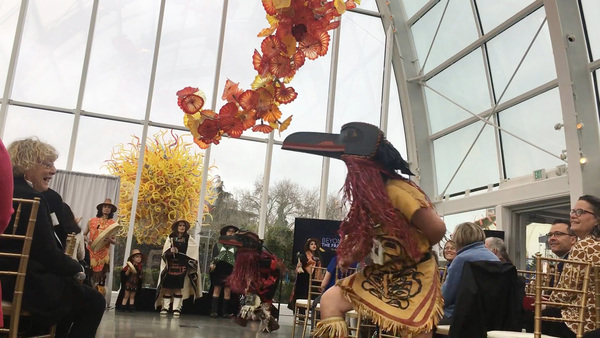
Over the next 11 months, more than 20 local institutions (Suquamish Museum, Seattle Art Museum, Seattle Public Library, Hugo House, and many others) will host a series of events and exhibitions under the umbrella of "Beyond the Frame _ To Be Native," which will revisit Curtis' actual work alongside Native American perspectives and art. The initiative was launched on Curtis' birthday _ Feb. 16 _ with an opening event at Chihuly Garden and Glass.
Curtis left a complicated legacy. His photos were often exoticizing, trying to transmogrify his subjects into a "noble savage"/pre-haircuts-and-Christian-boarding-school fantasy that was loosely based on an obsolete reality and definitely based on what would hook his fans and funders, including J.P. Morgan.
Curtis retouched photos to erase "modern" objects (in one infamous case, he scrubbed an alarm clock from a photo in a lodge), encouraged portrait subjects to wear nose rings and traditional clothes that weren't exactly in daily wardrobe rotation and generally portrayed them as living in a world where, in the words of biographer Timothy Egan, "the present was all of decline, the future practically nonexistent, the past glorious."
The project is fundamentally twofold: recognize the legacy of Curtis, but also leverage it to bring Native voices back to the heart of the conversation.
Jodee Fenton, with Seattle Public Library's special collections, said the idea for a Curtis retrospective bubbled up in 2015, with open meetings for anyone who wanted to pitch in.
"You can't look at Curtis images without seeing a really great artist at work," Fenton said. "When you look at the portraits, it feels like you could talk to that person right now. They seem so alive and present."
Then Lydia Sigo, archivist for the Suquamish Museum, showed up with some grim, black-and-white photographs of Suquamish children _ taken by a Native photographer _ in 1909.
Fenton was familiar with Curtis' pretty, gauzy, sepia-toned version of 1909. But Sigo's grittier photos showed another side of Native life that year: children lined up with suitcases to go to government-mandated boarding school.
From that moment, Fenton said, she knew the 150th Curtis anniversary would have to be more than a simple retrospective _ it had to attempt reckoning and reconciliation.
How did Curtis become the visual curator for what the United States would view as "Native," and how far did he stray from the truth to feed a preconceived notion of what "Native" means?
"He was doing the best he could at the time, and I appreciate what he's done," said Jeff Smith, a member of the Makah tribe and Northwest Indian Program Director with the American Friends Service Committee. (Smith is also a member of the "Beyond the Frame" advisory group.)
Part of Curtis' legacy was hurtful, Smith said, "and helped freeze some of those stereotypes in people's minds _ the 'noble savage,' the 'wild Indian.' I've gone into classrooms with students who asked if I live in a tepee."
But on balance, he added, Curtis left a valuable, if sometimes flawed, body of work.
"It's always a choice how you set up a camera, where you point it," he said. "Just like your editor making a choice about what's newsworthy."