Australian night time political summary
Here is what we know after the day in parliament:
- Australian planes have begun flying over Iraq in support of the US, but RAAF personnel have stopped short of air strikes.
- The first tranche of national security law reforms passed the parliament, including greater access for security agencies to computer networks and tough new penalties for journalists and whistleblowers. Greens Adam Bandt, Indi independent Cathy McGowan and Denison independent Andrew Wilkie voted against. After speaking against the laws, Labor’s Melissa Parke abstained.
- Tony Abbott again outlined his discomfort with the burqa but said government had no role in telling people what to wear.
-
The government could be preparing to drop controversial welfare changes such as taking under 30s off the dole for six months.
-
Deputy commissioner Andrew Colvin was appointed commissioner of the Australian Federal Police.
Thanks so much to my brains trust, Daniel Hurst and Bridie Jabour as well as Mike Bowers for his pictures and his long memory of political history.
Good night.
Before our summary, here are some photos from Mike Bowers to end the day.
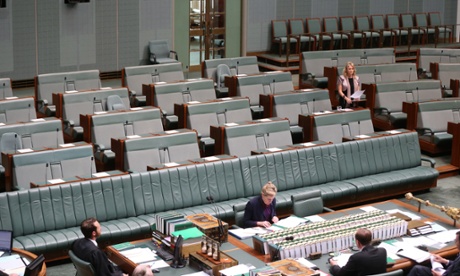
Labor’s Melissa Parke spoke against the national security laws, though she had no support from her colleagues. Labor supported the governments security bill.
Dissent is lonely.
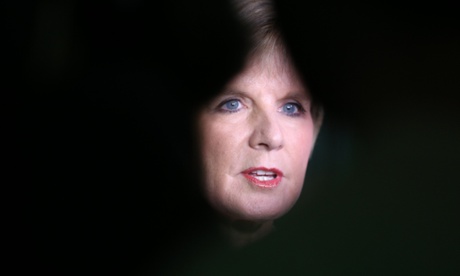
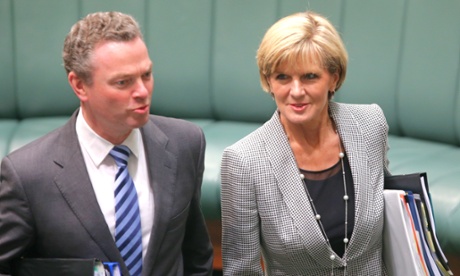
And foreign minister Julie Bishop was everywhere today. She met with actor Chris Hemsworth, was the central performer at parliament and late this afternoon, she attended the launch of a report on the Australia-United States partnership. Here she is, shot through the scrum of television cameras by Mike Bowers.
Bridie Jabour has been following the government’s contentious welfare changes from the budget. These are the measures which take unemployed people under 30 off the dole for months at a time and change the way the pension is indexed. Labor, Greens and Palmer United are opposed.
The bills are being debated in the Senate.
Given there is only one more day in this sitting week (parliament rises on Thursday afternoon), it needs to happen soonish. While the bills are listed on the daily program today, we are told there is unlikely to be a vote tonight as there is no time. The senate adjourns at 8pm.
At his press conference today, Tony Abbott said the government was flagging a restructure of the bills but it should not be seen as walking away from its policies.
We stand by all of the budget measures. We accept that some budget measures do need to pass the Senate and we obviously want to put them to the Senate in the form which is most calculated to get passage of the relevant legislation.
In flagging the possible restructuring of the social services legislation, we’re not walking away from anything, we support all of the budget measures and [while] some of them are supported by other parties, some of them are still subject to negotiation with other parties and with the crossbench. We don’t walk away from anything.
Here is part of Daniel Hurst’s story on the attorney-general’s defence of the more contentious provisions of the national security changes.
Australia’s attorney general has dismissed as “nonsense” the idea that new intelligence secrecy laws could be invoked to save governments from political embarrassment.
George Brandis, in an address to the National Press Club in Canberra on Wednesday, sought to counter concerns about the disclosure offences inhibiting press freedom.
Brandis was asked how the community could be assured the special intelligence operations would not be declared to save a government from embarrassment.
These are of their very nature, covert operations. They are unusual operations. They require, unusually, the fiat of the attorney general. That’s one of the safeguards built into the special intelligence operations regime. The idea that these could simply be rubber-stamped to cover up or gloss over anything that Asio might choose to do is nonsense. There are various statutory tests that the attorney general of the day has to apply to be satisfied to certify or authorise or give his fiat to a special intelligence operation.
First with the moos is MP for Wannon Dan Tehan and chair of the parliamentary joint committee on intelligence and security. So many jokes and so little time.
Keep it nice people.
Great to welcome dairy to parliament - doesn't get fresher than this! #ausdairy #ADICvision @AusDairyFarmers pic.twitter.com/ACaak2EWhV
— Dan Tehan (@DanTehanWannon) October 1, 2014
Trade minister Andrew Robb released the latest figures for foreign investment in Australia: $2.5 trillion in 2013 – up 11.3 per cent on the previous year.
And the biggest investors? China? Japan? Nope.
The United States and United Kingdom continue to be the countries that hold the largest stock of foreign investment (nearly 50 per cent) in Australia. And they are also the top destinations for Australian investments abroad (nearly 45 per cent).
The senate has just postponed a vote on photography in the senate - due at 4pm - to the end of the year.
Photography of MPs in the lower house is allowed whether they are speaking or not. When you walk into the green chamber, you must know you are on a stage.
In the red chamber, traditionally more sedate and hidebound, photographers can only take pictures of the person speaking.
That great libertarian, the aforementioned Liberal Democrat David Leyonhjelm, objected and now the vote has been shoved aside.
In the senate earlier today, Liberal Democrat senator David Leyonhjelm stood up for the smokers of Australia on the grounds that this 18% of the population are overly burdened by tax.
Here’s a little basic maths: if you spend $5,000 a year on tobacco, it’s a bigger proportion of your income if you earn $30,000 per annum than if you earn $100,000 per annum. In the trade, that’s what’s known as a “regressive tax”.
And if – along with South Park’s Mr Mackey – we can agree that “drugs are bad, mmmkay”, it’s probably also fair to say that “regressive taxes are bad, mmmkay.”
Calling regressive taxes ‘sin taxes’ doesn’t hide the scale of the problem. Smokers are typically poor, which makes this vast tax-take all the more perverse. It means, for example, that social planners who want to redistribute money from the rich to the poor need to increase both welfare payments and income tax rates to achieve their goals.
Libertarian Leyonhjelm, who supports the legalisation of cannabis, argues that smokers should not be punished for their choice.
Tweet early, tweet often.
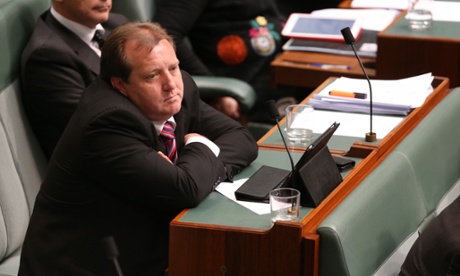
Minister wants a farmer.
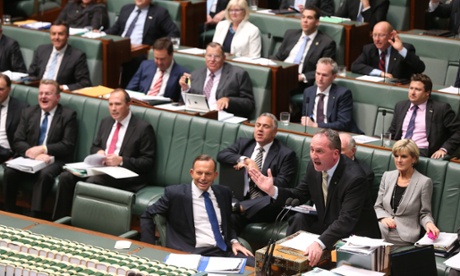
Chris Bowen now on his feet, speaking to a matter of public importance:
The Government undermining the retirement savings of working Australians through its adverse changes to superannuation.
Christopher Pyne asks for a ruling on Labor’s Rob Mitchell who appears to have tweeted while in the Speaker’s chair.
LNP MP says "why should we listen to industries". Arrogance personified
— Rob Mitchell (@RobMitchellMP) October 1, 2014
Pyne says it’s a reflection on the chair. Mitchell is a deputy speaker. (There are a number.)
General chaos is ensuing while Barnaby Joyce does a stand up on the previous sins on the Labor government on live export.
He wants to find a farmer on the opposition benches.
QT is over.
Shorten asks Abbott: Will the PM commit to join with Labor and vote against Cory Bernardi’s divisive legislation (to change section 18C of the Racial Discrimination Act)?
Abbott says while the government had committed to changing 18C after the Bolt case - “a prosecution that should never have been brought” - he’s “moved on” since then.
It is important to preserve national unity... this government has no plans to change section 18C and the private members bill in question is something that is highly unlikely to proceed under the normal rules that govern the introduction of private members bills into this Parliament.
Abbott does not commit the government to a position on the Bernardi bill.
Warren Truss says the first round of the $1bn Stronger Regions Fund is opening for rural communities. This is the one that replaces Labor’s regional development fund.
Government question to health minister Peter Dutton on the Medicare copayment yet to pass the senate.
We’ve said for concession card holders and for those people under the age of16, that once you get to 10 services within a year, so a maximum of $70, you don’t have to pay any more than that within a 12-month period.
Dutton said he will detail other copayment options in coming weeks.
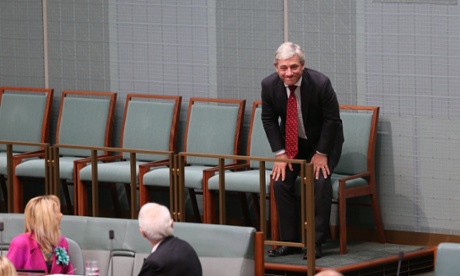
When Bercow is introduced, Labor asks if he can take over the Speaker’s chair.
Updated
Abbott gets back to the new 64. It was Labor’s Andrew Leigh who said 70 is the new 64.
Greg Hunt gets a government question on savings related to the removal of the carbon tax.
Labor to Abbott: Will the PM abandon his plan to make Australians work until they are 70 to get a pension?
Abbott quotes a Labor member.
In terms of life expectancy, 70 is the new 64. In terms of health 74 is the new 64...who said that?
Mark Dreyfus is thrown out by Madame Speaker.
Lips zipped.
Labor to Abbott: Will the PM abandon his $5.8 billion in cuts to universities that will mean young Australians will pay $100,000 for a uni degree?
What we are proposing to do is to liberate our universities to be the very best they can be.
The government is having another crack at the east west link in Melbourne, a joint federal-state funded road project which Victorian Labor has opposed.
Infrastructure minister Jamie Briggs follows Christopher Pyne in calling the Victorian opposition leader Andrew Daniels, as opposed to Daniel Andrews, which is his real name.
I <3 my budget
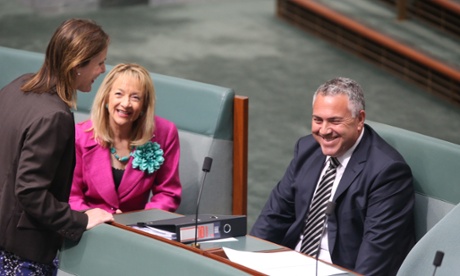
Labor asks Abbott: Will the PM abandon his unfair GP tax?
The government supports the budget measures we put forward, says Abbott.
(These questions are about setting out some markers ahead of any walking away from budget commitments, as flagged this morning.)
Team Australia II
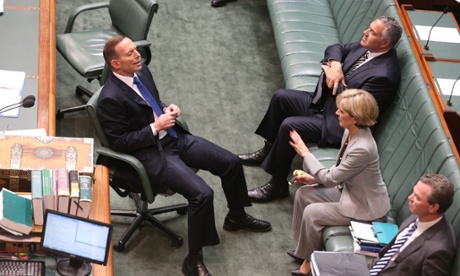
Deputy prime minister Warren Truss riffs on the infrastructure of the 21st century.
A government question to Joe Hockey on fixing Labor’s debt and deficit disaster.
Then Labor to Abbott: Will you abandon your cuts to veterans’ pensions?
There are no cuts, says Abbott.
(There is a cut to the rate of increase on veterans’ pensions.)
Bob Katter asks a question on a farmland campaigner who has had information about “government political figures” stolen from her home. He wants to know if there is a police investigation.
Julie Bishop, as AG representative in the lower house, says she will look into it and get an answer.
Tony Abbott is asked a whether he will abandon his plan to cut the indexation of the aged pension? No, says Abbott.
Immigration minister Scott Morrison, who will not be getting a grand new homeland security style uber portfolio, is up talking refugees.
He is channelling John Howard on refugees.
Under these provisions we have introduced we are claiming back for Australia how we decide who is a refugee and who is not. In this legislation we enshrine in that law what it is to be a refugee, what protection involves and what protection does not involve. Now I know those opposite and other places would like to see those decisions made in Brussels or wherever else, or Geneva, that will not be the case under this government because as the former PM John Howard said, we will decide and we should decide who comes to this country and not allow the interpretations of others outside this place decide what our international obligations are.
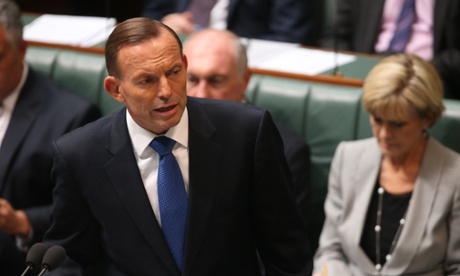
Shorten to Abbott: Is the PM firmly committed to all of the budget measures that were outlined in the budget and does the PM remain firmly committed to progress all of those measures?
Yes.
Justice minister Michael Keenan is repeating his comments on the charge that terror raids were conducted in time for the legislative debate in parliament. He says it is untrue.
Speaker Bronwyn Bishop welcomes the speaker of the house of commons John Bercow to the parliament.
Some wag yells:
He’s down here on work experience.
There is a government question on Isis.
Now Shorten asks Abbott about the new ideas that the Treasurer is working on to inflict new pain on the Australian people? (This is a nod to the story that the government was backing away from the budget.)
The only miserable failure are members opposite to fail to deliver a surplus in 6 years of government.
Julie Bishop looks and sounds angry.
What I need to point out to some opposite is that we have taken very specific advice, military and health experts have advised us that evacuating a patient with Ebola is complex.
She details the complexity in offering workers, given the difficulty in combatting the disease. Australia cannot help until there is a “credible evacuation plan” for any Australian health care workers.
First question from Tanya Plibersek to Julie Bishop on Australia’s assistance for ebola after the first case was diagnosed in the US.
When will the Government act to support skilled and experienced Australians who are willing an able to help fight the Ebola outbreak in Africa?
Bill Shorten on Iraq now:
Labor’s support for Australia’s involvement in Iraq is underpinned by 4 principles.
Firstly, we do not support the deployment of ground combat units to directly engage infighting ISIL.
Secondly, Australian operations should be confined to Iraq.
Thirdly, our involvement should continue only until the Iraqi Government is in a position to take full responsibility for the security of their people and their nation.
Fourth, if the Iraqi Government and its forces engage in unacceptable conduct or adopt unacceptable policies we should withdraw our support.
Abbott:
In these difficult times, the cooperation, even friendship, now growing between former rivals and the growing realisation even in the Middle East that there is no such thing as good terrorism should be of some comfort.
Tony Abbott:
We have not yet made a final decision to commit our forces to combat but Australian aircraft from today will start flying over Iraq in support of allied operations. Ours are support operations, not strike missions. Australian air strikes await final clearances from the Iraqi Government and a further decision by our own. But from today our refueler and our Wedgetail will operate over Iraq in support of US and other coalition aircraft.
Updated
Approval for airstrikes has yet to be given.
The prime minister begins with a statement on the “apocalyptic death cult” Isis. He is reminding of the contingent sent to the Middle East.
Australian aircraft will start flying today. NOT AIR STRIKES but a refueller and a Wedgetail aircraft in support of the US.
Tony Abbott up now.
Question time in the house and the senate coming up.
There seems to be some feeling that the PM will make a statement to the house before question time. #justsaying
One last Brandis post, because Sophie Morris of The Saturday Paper asked an interesting question on the attorney-general’s journey from small L liberal to capital C conservative after dealing with intelligence issues. She makes the point he once said ‘the more intelligence I read, the more conservative I become’. Morris wanted him to expand on that journey, which he did not do. But he offered this observation,
The disposition, the philosophy with which a lawmaker approaches a task like this does matter, it does matter. I don’t want to be overly partisan but frankly I think the side of politics which has it in its DNA to keep government small and to keep freedom large can be better trusted to handle these matters without overreaching than the side of politics which believes that expansion of the power of the state is the solution to every problem.
Know that your AG is tightening the security screws with the appropriate small l liberal approach.
Bernard Keane from Crikey contrasts the very real deaths of women and children as a result of domestic violence with the “existential threat” of terrorism that has killed very few. Where is the extra funding for domestic violence, he asks?
I think you’re foolishly conflating two completely unrelated issues.
And stops there. Pressed further by the moderator for a longer answer, Brandis says:
(Domestic violence) is something that this government has been very active to deal with but the conflation of that important social issue with the question of protecting the community from terrorism is a foolish conflation of two entirely unrelated issues.
Updated
Our own Daniel Hurst asked Brandis if there will be any curb on what agencies can access in terms of metadata without a warrant and secondly, whether you were willing to consider any change to the approval process to access metadata?
I want to assure you that the legislation will merely mandate that to be done which is currently being done and will not involve the vesting of additional powers.
With all the national security debate, you may have forgotten there is budget stuff. Bridie Jabour is all over this:
In the frenzy of reporting on a possible parliamentary burqa ban the prime minister has mentioned the social services bills are likely to be amended.
The bills are being debated in parliament right now and contain most of the welfare reforms announced in May’s budget.
It’s possible the measure to take unemployed people under-30 off income support for months at a time is going to be scrapped.
Abbott said:
We stand by all of the budget measures. We accept that some budget measures do need to pass the Senate and we obviously want to put them to the Senate in the form which is most calculated to get passage of the relevant legislation.
In flagging the possible restructuring of the social services legislation, we’re not walking away from anything, we support all of the budget measures but we accept that some of them are supported by other parties. Some of them are still subject to negotiation with other parties and with the crossbench. We don’t walk away from anything.
George Brandis has knocked the idea of a homeland security mega-agency on the head, following similar sentiments expressed by foreign minister Julie Bishop in The Australian on Tuesday. This proposal has been discussed inside government and came into the public debate on Tuesday with Bishop’s emphatic repudiation that it would not happen and was not being discussed.
This morning Mark Kenny and James Massola at Fairfax followed up Dennis Shanahan’s story, coming to the conclusion that the proposal’s survival - or not - was more a matter of leadership tensions. Here is a little of their story:
Sources across the Abbott government have confirmed there had been internal consideration of a possible homeland security ministry – largely based on the US model – that could have been handed to Mr Morrison, rather than Defence Minister David Johnston.
It is an idea that past governments have rejected on at least two occasions.
Sensitivity to the mooted pre-positioning reveals previously unknown anxieties within the Abbott cabinet over the future succession of several potential contenders – a field that contains Mr Morrison, Treasurer Joe Hockey, Foreign Affairs Minister Julie Bishop and former leader Malcolm Turnbull.
Brandis has just told my colleagues at the National Press Club:
I agree with my colleague Julie Bishop who was reported yesterday as saying that if the institutional arrangements were to be changed then obviously those who would seek to change them would need to persuade -to demonstrate that they’re not working. The point of my speech, one of the points on which I touched in my speech was to demonstrate to you how effectively our current national security arrangements are working, people should be confident in them.
George Brandis is prosecuting the case for the overhaul in national security laws. With the first tranche successfully through the house this morning, he is now speaking on the second tranche, the so-called foreign fighters bill.
This bill will:
-
Expand detention without charge powers
-
Restrict freedom of movement and association with control orders and prohibited contact orders
-
impose life imprisonment for people who fight, or even prepare to fight, overseas in a foreign country
-
prohibiting travel to a region, or even an entire country, unless a person can demonstrate a legitimate reason for being there.
As a lawyer, I have a bred in the bone respect for due process and the rule of law...but as the minister, I am determined to do what the community expects.
Brandis believes the national security reforms gets the balance between freedom and safety right.
Attorney general George Brandis is talking about the need to be “vigilant but unafraid” in the current national security climate. You will remember that in the post 9/11 era, John Howard’s phrase was “alert but not alarmed”. Just the other day, Tony Abbott urged Australians to “be aware but reassured”.
Discuss.
Foreign minister Julie Bishop has been hanging out with Thor. Not so much bilateral relations as other worldly.
Discussing @AusChildhood Safeguarding Children Program w Ambassador #chrishemsworth pic.twitter.com/pXwT2WCccr
— Julie Bishop (@JulieBishopMP) October 1, 2014
Tony Abbott made this point on the national security environment:
We wouldn’t for a moment target particular communities or particular religions because not only is it wrong but it is un-Australian. We have always extended a warm and generous welcome to people from all countries, all cultures or faiths. That is never going to change and what impresses me the longer the current security issue lasts, is the enthusiasm that just about every single Australian has for our country and for our freedoms.
The burqa story is off and running after a story this morning by James Massola and Latika Bourke at Fairfax, indicating Peta Credlin was sympathetic to a ban. Here is a taste:
Prime Minister Tony Abbott’s most senior adviser, Peta Credlin, has told Liberal National MP George Christensen she is sympathetic to a burqa ban in Parliament House on security grounds, but warned him not to inflame community tensions while debating the head wear.
Fairfax Media can reveal that Ms Credlin, who is considered one of the most influential figures in the Abbott government, spoke to Mr Christensen about the prospect of a ban last week soon after the MP said that: “Team Australia needs to make this decision [to ban the burqa]” in public spaces.
This follows calls from Cory Bernardi and PUP senator Jacqui Lambie to ban the burqa in parliament. This is what Abbott said earlier - thanks to the most excellent Bridie Jabour:
I have said before that I find it a fairly confronting form of attire. Frankly, I wish it was not worn but we are a free country, we are a free society and it is not the business of Government to tell people what they should and shouldn’t wear.
We can all have an opinion, we can all have a preference but in the end it is up to the citizens of Australia to decide what they should wear. It is a little different obviously in a situation where people’s identity is important.
Abbott said people could be required to show their faces in buildings such as courts and that was “perfectly appropriate”.
Asked specifically for his opinion on a burqa ban in parliament house, Abbott responded:
This is a secure building and it is important that people be able to be identified, it is important that people be able to be recognised as the people for whom a pass as been issued. In the end it is a matter for the presiding officers and for the security controller of the building.
Lunch time Australian politics
- The first tranche of national security legislation, expanding agency powers to access computer networks and penalising journalists and whistleblowers, passed the parliament.
- Tasmanian independent Andrew Wilkie, Greens Adam Bandt and Indi independent Cathy McGowan voted against the national security legislation. Labor’s Melissa Parke abstained.
- Tony Abbott is expected to make a statement to parliament today on the deployment of Australian troops in Iraq and possibly Syria.
- Deputy commissioner Andrew Colvin has been appointed to head the AFP, replacing Tony Negus.
-
Tony Abbott said he wished the burqa was not worn but it was not the government’s place to tell people what to wear. He said it was a matter for police and security officers to decide whether it is allowed in the parliament.
National security no 1 has passed in the parliament
Andrew Wilkie’s amendment lose with only the support of himself, McGowan and Bandt.
National Security Legislation Amendment Bill (No. 1) 2014 has just passed the parliament.
The house is now dividing on Andrew Wilkie’s amendments on the national security bill.
Daniel Hurst has kindly provided the top of his story which documents the debate so far.
The Labor MP Melissa Parke has emerged as a sole voice of dissent among the major parties as the Australian parliament moved to approve a vast expansion of the powers of spy agencies and criminalise reporting on special intelligence operations.
Parke told the House of Representatives the bill could have a chilling effect on journalism and she warned of the dangers of trading freedom for security.
“I do not support a number of key elements in this bill,” she said.
“Contrary to the reductive argument that says we’re making a straight trade of less freedom for more safety the reality is likely to be and indeed has proved to be many times in the past that constraining our fundamental liberties achieves nothing more than making us less free and in fact does ourselves more harm by licensing the abuse of powers.”
The only MPs to vote against the second reading of the bill in the lower house on Wednesday were the Greens deputy leader Adam Bandt and the independent MPs Andrew Wilkie and Cathy McGowan. It appears Parke abstained on the vote.
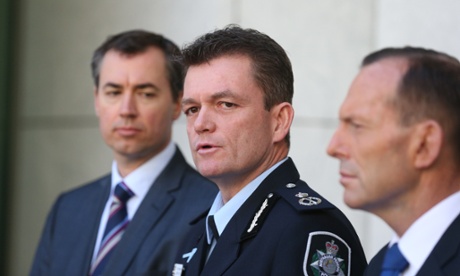
The new head of the Australian Federal Police.
That’s it from Abbott. Back to Andrew Wilkie, who is speaking to his amendments.
Tony Abbott reaffirms the government budget strategy (see the first post), he stands by all the budget measures, essentially rejecting reports that the Coalition will walk away from the budget.
Tony Abbott will be dealing with the current deployment to the Middle East shortly in parliament. (He may be making an announcement on the Australian deployment.)
He is asked about the government’s examination of the legalities of taking part in action in Syria.
We haven’t ruled out Syria, he says, but the legalities of dealing with Syria are different from Iraq.
Abbott cautions people about “making mountains out of molehills”, asking whether a woman wearing a burqa has even entered the parliament before.
He has said there are issues with identifying people in a secure building like parliament.
National security is too important to be made sport of.
He repeats his comments about not targeting communities.
Tony Abbott is asked about calls to ban the burqa in parliament house.
Abbott repeats he finds the burqa confronting ... and “quite frankly I wish it was not worn” but makes the point people are free to wear what they like.
The house is dividing again on Adam Bandt’s amendments.
Andrew Colvin is saying what an honour it is to be appointed head of the AFP.
The challenges of the security environment are obvious but less obvious is the other work the AFP does, says Colvin. He commits to support AFP officers.
Colvin to head AFP
Andrew Colvin, deputy commissioner for the Australian Federal Police, has been appointed to head up the AFP by Tony Abbott.
The prime minister has just announced the appointment at parliament house. He is with justice minister Michael Keenan, who says Colvin takes over at a “critical time”.
Now we know why Keenan had to rush out of the house.
Updated
Notwithstanding his loss, Adam Bandt says the expanded definition of computer puts everyone at risk. Can’t you just amend that little bit?
Bandt says a single warrant applies not just to one computer, but a network of computers and a network of networks. Which is everyone, Bandt argues. Bandt wants to limit the number of individual devices to 20. That is, such as a house, with say, five phones, five tablets, a couple of computers etc. One household.
Stuart Robert says Bandt’s fears are “completely and utterly unwarranted”. He says the Greens are trying to “muddy the waters”.
Again, the Greens amendments are voted down, given only three are opposing. Now count is recorded.
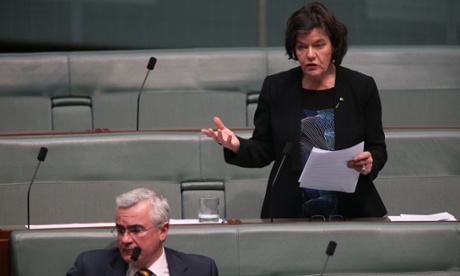
The house is voting on Adam Bandt’s amendments.
Watch the ship of state list to one side.
Team Australia.
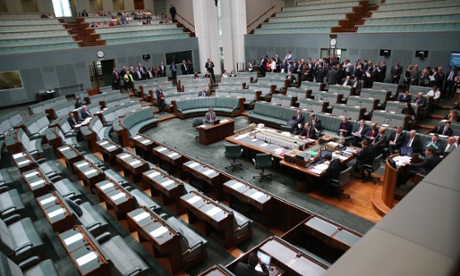
Stuart Robert, assistant defence minister, says the Greens’ amendment will place lives at risk.
He gives the example where an SIO may be extraordinarily covert, like infiltrating a known terrorist organisation, then a journalist puts that all over the front page and puts that agent’s life at risk.
The Greens think that is fine. It’s not fine.
We require the media to shine a light where they think the line has been crossed, says Bandt.
His amendments do not remove the changes that would punish people for putting lives at risk but it does protect whistleblowing and reporting.
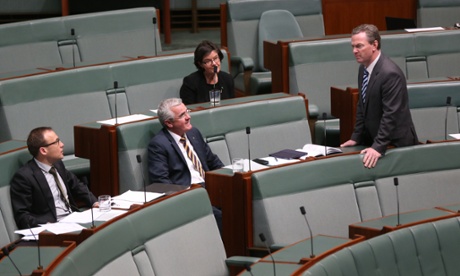
Christopher Pyne has been chatting to the three dissenters.
Adam Bandt is using reportage of the East Timor bugging and the reporting (by the Guardian) of the bugging of the Indonesian president as examples of stories that the public need to know.
The government is saying we are going to treat every good journalist like a criminal.
What about East Timor bugging case, says Bandt?
We don’t deal in hypotheticals, says Robert.
The minister says journalists well and truly understand the limits and gives an example of “embedding” with military operations.
Adam Bandt to move amendments now.
Adam Bandt gets heated with justice minister Michael Keenan, saying the minister’s failure to answer his question means the government does not care about individual liberties.
Keenan counters Asio collects information that it believes is relevant in the course of its inquiries. If its not relevant, it destroys the evidence.
But he does not go to the point as to individual phones and tablets.
Bandt tries again: if there is a special operation in place, how will a journalist know it is a special operation?
If it turns out to be an SIO, how will the journo know in the first place.
Justice minister Keenan suddenly has to leave the chamber. Assistant defence minister Stuart Robert to answer.
Robert can’t think of an instance in his experience, where a journalist did not know a covert operation was happening.
This is just not something that occurs with professional journalism in this country.
Parliament moves one step closer to passing first tranche of national security laws
The lower house has voted on the second reading of the first tranche of the national security laws. Bandt, Wilkie and McGowan were the only members who opposed the bill.
Labor member Melissa Parke did not appear to be in the chamber, abstaining on the second reading vote.
There are a few more procedures to occur, including attempted amendments by Adam Bandt and Andrew Wilkie, before the bill actually passes.
Bandt asks again: “someone who is a completely innocent member of the public who happens to have their phone or tablet on the same network, will that innocent member of the public have their phone or device surveilled simply because they are on the same network as a suspect?”
Keenan says Asio must only access data that “appears to be relevant to the collection of intelligence”. He is not answering the question directly.
Adam Bandt wants to know whether somebody’s phone or tablet can be surveilled even though they are not suspected of doing anything wrong.
No count recorded because there was less than five members opposing: Bandt, Wilkie, McGowan.
Katter and Palmer were no-shows. Parke did not oppose and we are checking whether she abstained. Crossing the floor is against Labor caucus rules.
House voting now. We know that Cathy McGowan, Andrew Wilkie and Adam Bandt will vote against. Clive Palmer has waved it through the senate, so he probably won’t show up.
The big question is for Labor’s Melissa Parke who did not flag her intention though spoke strongly against the bill.
Justice minister Michael Keenan is describing the bill as important because it improves the “manifestly inadequate penalties” for identification of officers and endangering lives.
He thanks Labor for it’s bipartisan approach even though it is not shared by all members. (I’m looking at you, Ms Parke!)
He says whistleblowers can still make disclosures for suspected wrongdoing, including to the Australian Federal Police and the Inspector General of Security and Intelligence.
This is about providing a necessary and proportionate limitation on the disclosure of information, says Keenan.
Keenan says Wilkie and McGowan’s assertion that the bill has been rushed through is wrong. There was the Joint Committee on Intelligence and Security which held two inquiries. (Which means the bill is not as a result of the current threat of Isis.)
Full and proper consultation was undertaken.
He turns to Melissa Parke.
I understand the member for Fremantle has strong views...but this is a very important myth to dispel.
He says the idea the government directs timing of the operations. He says it’s an insult to the police and the intelligence agencies.
If we tried to do that, they would not accept it.
They do not respond to the government’s political agenda.
The Sydney raids were undertaken because of the intelligence that a random act of violence was going to happen over the next few days, says Keenan.
The idea that agencies were sitting around and would let something happen, or begin an operation to suit the legislation is:
completely and utterly wrong and quite frankly the member for Fremantle should repudiate any such ludicrous suggestion.
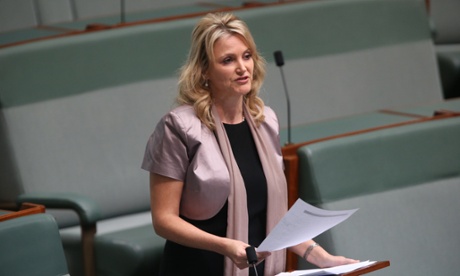
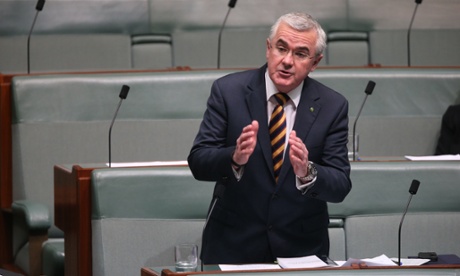
That’s it! No one else to speak. Justice minister Michael Keenan up now to dot the i’s and cross the t’s.
Melissa Parke says the computer warrant changes are the equivalent to signing off on one search warrant for a house, that allows a search of many more houses.
Parke says the government’s interest in freedom can be seen in its decision to abolish the independent national security legislation monitor, which has been vacant since April.
She says there is a lot of talk about complacency when it comes to national security threats - “I don’t see it” - but the complacency is actually the lack of effective oversight of changes that seek to reset our laws and values.
Labor’s dissenting MP for Fremantle Melissa Parke is quoting Tony Abbott in an IPA speech, when he said the Liberal Party was the “party of freedom”.
Parke is talking about the delicate balance between freedom and safety.
She says constraining fundamental liberties usually does nothing than constraining freedom rather than making us safer.
Parke says the proposed first bill is not a response to Isis given it was developed before the current threat- contrary to some media reports - and says the recent raids show there are adequate powers already.
It’s hard not to have the sense there is too much fierce agreement.
Parke is particularly concerned at the effect on whistleblowers, particularly where there is no danger other than “political embarrassment”.
She contrasts the open access of media to terror raids with the secrecy around asylum seekers.
You want pictures? How many?
Essentially Cathy McGowan says there has not been adequate debate and scrutiny of the bill. She says the atmosphere is one of fear, with undercurrents of terror and racism.
It makes me scared and the people I live with scared.
McGowan says her constituents in small country towns are not travelling to Melbourne for football matches or travelling overseas.
This is not a time to rush through legislation but a time for a considered approach, a time when we should be our best selves, as the prime minister said.
This is a time for Team Australia to play for the whole team, not just a small select group.
Indi independent Cathy McGowan speaks on national security. She will not be supporting the national security bill.
Andrew Wilkie is saying we have very good security agencies but sometimes they or the people who lead them err and they need to be accountable.
What better example, says Wilkie, of a case that needs reporting than the bugging of East Timor not for national security but for a commercial reason.
We do need to look for ways to make this country safer, but we do not make this country safer ...when we see governments rushing through legislation that contains problematic sections and ... not moving on issues that need fixing, says Wilkie.
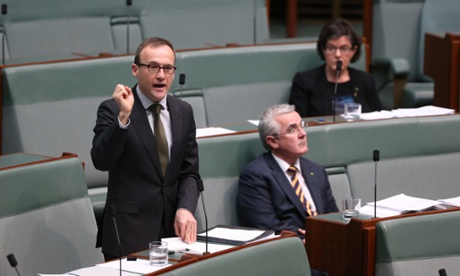
Andrew Wilkie says the laws will take another step towards a “police state”, giving security agencies the right to use force and ministers the political oversight of operations.
What if we have a bad minister?
Wilkie says there is no parliamentary oversight of intelligence operations. Ministers provide the only ‘political oversight’.
There is no oversight by the people’s house.
He makes the point parliamentary committees only have administrative oversight.
Tasmanian independent Andrew Wilkie gives the major parties a bollocking, noting how few members of Labor, Liberal and National parties are in the house for the debate. Fremantle Labor MP Melissa Parke is the only other Labor member speaking. The government only have the justice minister Michael Keenan speaking.
Wilkie says the parties have misunderstood the role of the parliament which is to scrutinise legislation.
You will remember Wilkie is a former intelligence officer who resigned due to the Howard government’s justification of the 2003 Iraq war.
Where is the scrutiny?
Wilkie says he accepts there is a need to modernise national security legislation to make it “technology neutral” but he makes the point that none of the recent raids needed any extra powers.
There is no rush.
He says the section 35, relating to the whistleblower/journalist provisions, does not need an extra penalty.
Security agencies have been given an open cheque for penalties, says Wilkie, and it has been signed and counter-signed by the Coalition and Labor.
The chamber is near empty.
Adam Bandt says we should not be rushing legislation through this place, thinking somehow the “hothouse of fear” is the time to make sober decisions on national security.
We have a government desperate to hide behind a uniform as we have seen them do before ... using any excuse they have to take away legitimate freedoms.
The bill does not make Australians any safer and we certainly not rushing them through. Bandt is critical of Labor’s approach, trying to make itself a “small target”.
More worryingly, says Bandt, this provision will have a chilling effect so every journalist and editor will wonder if they will go to jail if they report on an operation.
It allows the government to access computers and tablets even if you are not a suspect, says Bandt, simply because you happen to be on the same network as a suspect.
If you have done nothing wrong, why should the government be able to access your computer?
This legislation redefines what counts as a computer, says Bandt. It is not one computer, it is a network. For example, computers at a university might be one network, where thousands of computers can be accessed. The agencies only needs one warrant to access the entire network.
George Brandis said there was no arbitrary limit on how many computers can be accessed under one warrant.
Adam Bandt says if the laws pass, security agencies could inadvertently kill an innocent bystander and the media could not report it. The whistleblower could not tell others about such an incident. Both would go to jail.
He says there have been lots of incidents where Australians only discover things when whistleblowers and journalists tell people. We would never have found out the Australian government bugged the East Timorese.
This new category of special operations are decided by the AG and are limitless in number, says Bandt.
Mark Dreyfus warns Labor’s support should not be taken for granted.
Adam Bandt up next.
The changes....
Because it is so important, here is the overview from the explanatory memoranda of what this national security bill actually does. It is worth having a pick through to understand the reach of the bill.
The bill will:
· updating ASIO Act employment provisions to more closely align them with the APS standards, providing for the secondment of staff to and from ASIO and facilitating the transfer of ASIO employees to APS agencies while protecting their identity
· improving ASIO’s intelligence-collection powers by:
- enabling it to obtain intelligence from a number of computers (including a computer network) under a single computer access warrant, including computers at a specified location or those which are associated with a specified person
- amending the current limitation on disruption of a target computer
- allowing ASIO to use third party computers and communications in transit to gain access to a target computer under a computer access warrant
- modernising provisions related to surveillance devices to better align them with the Surveillance Devices Act 2004 and improving their functionality and operation
- establishing an identified person warrant for ASIO to utilise multiple warrant powers against an identified person of security concern
- enabling warrants to be varied by the Attorney-General where minor changes in circumstances or administrative errors are identified
- facilitating the Director-General of Security (Director-General) to authorise a class of persons able to execute warrants rather than listing individuals
- clarifying that the search warrant, computer access, surveillance devices and identified person warrant provisions authorise access to third party premises to execute a warrant, and
- clarifying that force which is necessary and reasonable to do things specified in the warrant may be used at any time during the execution of a warrant, not just on entry
· introducing an evidentiary certificate regime in relation to special intelligence operations and specific classes of warrants issued under Division 2 of Part III of the ASIO Act to protect the identity of employees, sources and sensitive operational capabilities
· providing limited protection from criminal and civil liability for ASIO employees and affiliates, in relation to authorised special intelligence operations, subject to appropriate safeguards and accountability arrangements
· confirming ASIO’s ability to co-operate with the private sector
· enabling breaches of section 92 of the ASIO Act (publishing the identity of an ASIO employee or affiliate) to be referred to law enforcement for investigation when it is not otherwise relevant to security
· enabling the Minister responsible for ASIS to authorise the production of intelligence on an Australian person who is, or is likely to be, involved in activities that pose a risk to, or are likely to pose a risk to, the operational security of ASIS
· enhancing the ability of ASIS, without a Ministerial authorisation, to co-operate with ASIO when undertaking less intrusive activities to collect intelligence relevant to ASIO’s functions on an Australian person or persons overseas in accordance with ASIO’s requirements
· enhancing the ability for ASIS to train staff members of a limited number of approved agencies that are authorised to carry weapons in the use of weapons and self-defence and ensuring that ASIS is not restricted in limited circumstances from using a weapon or self-defence technique in a controlled environment (such as a gun club or rifle range or martial arts club)
· clarifying the DIGO’s authority to provide assistance to Commonwealth, State and Territory authorities (and certain non-government bodies and foreign governments approved by the Minister for Defence)
· extending the protection available to a person who does an act preparatory to, in support of, or otherwise directly connected with, an overseas activity of an IS Act agency to an act done outside Australia, and
· enhancing protections for information and records acquired or prepared by or for an intelligence agency in connection with the performance of its functions by:
- updating sections 39, 39A and 40 in the IS Act, and increasing the penalties for existing unauthorised communication of information offences in the ASIO Act and the IS Act from two to ten years, to better reflect the culpability inherent in such wrongful conduct
- extending the existing unauthorised communication offences in the IS Act to the Defence Intelligence Organisation (DIO) and the Office of National Assessments (ONA)
- creating a new offence in the ASIO Act and the IS Act, punishable by a maximum of three years imprisonment, where a person intentionally deals with a record in an unauthorised way (for example, by copying, transcription, retention or removal), and
- creating a new offence in the ASIO Act and the IS Act, punishable by a maximum of three years’ imprisonment, in relation to persons who intentionally make a new record of information or matter without authorisation.
Labor’s Mark Dreyfus will not abandon “the full protection and rights” that makes it what it is.
He says we should be very clear about the “content and intent” of the regulations we are debating today.
Dreyfus is saying the laws need to be debated, knowing that they will be in place well after the “current threat” has passed.
Dreyfus acknowledges the concerns of journalists.
Special intelligence operations (SIO) are necessarily undercover and “may have to break the law”. SIOs, which are approved by the attorney general, are a small proportion of Asio’s work.
The danger intelligence officers face if they are uncovered is obvious, says Dreyfus.
Labor understands the concerns and the media are right to defend their role.
The bill has been amended that no one (journalists) can breach the law unless they are aware it is a SIO.
We would never support - as the Greens said - jailing journalists for national security reporting.
But where journalists know of the danger of an operation, we expect them to act responsibly.
Labor will support the bill as amended but will continue to monitor the scheme.
Justice minister Michael Keenan is currently giving his second reading speech on the first national security tranche, followed by Labor’s Mark Dreyfus.
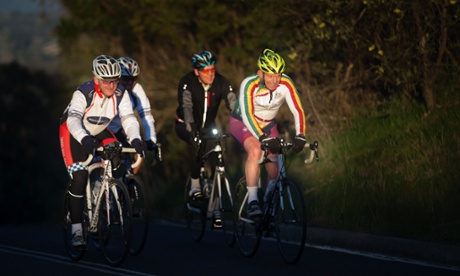
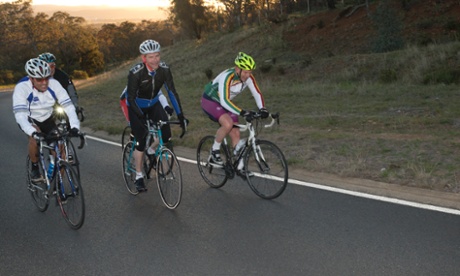
The prime minister was out early - as usual - on a beautiful spring morning. Unless mine eyes deceive me, I think one of his pelaton is Australian columnist Nick Cater.
The National Security Legislation Amendment (No. 1) is on the agenda this morning. It has passed through the senate and now has to pass the house, which on the numbers, will not be an issue.
This is the so-called first tranche and you can read more of the detail here from Paul Farrell.
It introduces five-year penalties for journalists and whistleblowers for disclosure only or up to 10 years for publication for the disclosure of information about “special intelligence operations”.
Updated
Good morning political playmates,
It being Wednesday - hump day - the parliament opens at 9am with many items on the political plate. We awoke to a splash in the Fin from Laura Tingle and Phil Coorey that the Abbott government has raised the white flag on the more contentious budget measures, leading to unbidden images of Joe Hockey on the mat, yelling “UNCLE!” But Joe has run out of his corner this morning, straight at Chris Uhlmann on ABC AM, saying the report was all wrong. The government was pressing on, he said, quoting the favourite focus group adjectives: calmly, methodically, purposefully. Here is a taste of the Tingle/Coorey story:
The Abbott government has raised the white flag on up to $30 billion of four-year budget savings, deciding to push the remaining few measures which have Senate support through the Parliament before recasting its budget strategy in December.
The Senate standoff, a slump in iron ore prices, the soft economic outlook and a potential multibillion-dollar bill for a new military commitment in the Middle East have put a cloud over the government’s forecast that the budget deficit will shrink from $48.5 billion to $30 billion deficit this financial year and over the shape of its structural savings into future years.
The government has started work on a new, alternate round of savings – to be unveiled in the mid-year review of the budget in December – although sources concede the options are very limited.
When pressed, Hockey could not explain how he would get the more difficult bits, such as the Medicare co-payment or higher education deregulation, though the senate. But he was not for turning.
The other news around is the senate’s Great Big Inquiry into Campbell Newman. This was Clive Palmer’s long held fantasy after he fell out with Newman when Palmer was a member of the LNP. The Queensland Newman government will be the subject of an inquiry leading up to the state election in March 2015, which looks into a number of things including the judiciary, the use of commonwealth funding and human rights, plus the magic clause of anything else the committee wants to investigate. It will also investigate coal seam gas approvals, including under previous governments including that led by Labor’s Anna Bligh. This morning’s debate is how the inquiry will operate, whether it will be able to compel witnesses and if not, what will it achieve?
Greens senator Larissa Waters, who worked on the move with the PUP senators, said she negotiated the deal because the Newman government had been a disaster for the environment. She said the inquiry will also allow the committee to look into Palmer’s “mega coal mine” in the Galilee Basin and his nickel refinery on the edge of the Great Barrier Reef.
Deputy Queensland premier Jeff Seeney said this morning that Palmer was:
motivated by revenge because he didn’t get a sweetheart deal from the Queensland government. The real question is why the Labor party would support that? The losers are Queensland mining families.
Of course Labor supported the inquiry because a) it will cause a world of trouble for a Liberal government, b) they will need PUP’s support for future deals, c) as Stephen Conroy pointed out, the Abbott government has prosecuted what he described as political vendettas, including two royal commissions into trade unions and the home insulation scheme.
Much more on the political agenda - not least of which is the national security tranche number one to pass the lower house - so stay with us as we navigate this brave new world.
Join our conversation below or join as @gabriellechan and @mpbowers on Twitter.