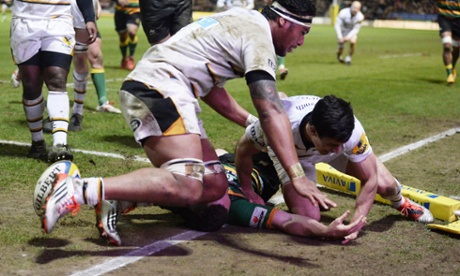
Rugby has always been a hazardous sport. No one who plays it, at any level, steps onto the field without at least a pulse of fear throbbing somewhere in their circuitry. There’s fear of making a fool of yourself, fear of letting down your team-mates, and, perhaps the most primeval of them all, fear of the battle that awaits, of the collisions and pain – fear, in short, of injury. Will this game be the one? Wrestling with that notion is what renders the sport so elemental, so compelling to play, so compelling to watch.
But there’s a new fear sweeping through rugby – at the highest levels, anyway. Fear of putting a foot wrong. Fear of health and safety. Fear of the accidental. And this is not what the sport was ever supposed to be about.
Nathan Hughes is the latest to have fallen victim. A knee to the head of an opponent, who is knocked out by it. It sounds bad, and the decision to send him off can no doubt be justified by reference to the latest manual of laws and directives. But it is equally clear, as well, that it was an accident – and the only way to avoid accidents in a sport like rugby is not to play.
Those angry types who believe in rules and their indiscriminate enforcement rebuff the no-harm-intended defence by pointing out that the word intention does not feature anywhere in the law book. Well, it should. Intention is everything, the difference between an accident and a crime.
It is a peculiar type of insanity that one minute enjoins players to be wholly committed – indeed to be physical, intense, ferocious and all those other big words trotted out in praise of the best matches – then throws the book at them the next when, as must happen occasionally in such an environment, an ugly outcome arises. Starting at the contingency of the outcome – and this should in no way belittle what looks to be a worrying condition for George North – and working backwards is to administer justice by lottery.
James Haskell was shown a yellow card in England’s match against France for just the kind of offence that deserves such a punishment, the cynical attempt to cheat by a player beaten. He wore it as the best rugby people do – and, God knows, so did England, who conceded the pushover try that cost them the Six Nations while he was away.
But never has Haskell been sharper, more direct or over the ball than when he said the following this week: “I think they’ve changed the wording of the laws now, something to do with being reckless. But rugby is reckless. The whole game is reckless. If you’re going to worry about that, I don’t really know what we should be doing. Maybe we should all be wearing foam suits and playing touch.”
If only Hughes’s case was an isolated one. When Finn Russell was banned for being jumped into by Dan Biggar during Scotland’s Six Nations match against Wales, the latest laws surrounding the aerial challenge were subjected to a thorough debate, as they were when Jared Payne was sent off in Ulster’s Heineken Cup match against Saracens last season. But those were just two high-profile examples of a phenomenon that blights rugby matches every week.
So, too, the paranoia among law-makers and enforcers concerning the tip tackle. This is perhaps the area that best illustrates the hypocrisy of a sport that celebrates, even demands, the “Big Hit”, that chest-high smash to knock a player off his feet, then spits in apoplexy when the centres of gravity are just slightly misaligned and the same player is flipped round on to his head. Or when the tackle is just a few inches too high, and the same player receives an arm to the face.
No one is suggesting foul play shouldn’t be punished. Gareth Davies was rightly sent off the very same evening for a head-butt in the Scarlets-Edinburgh game (not that it was much more dangerous than a kiss), and Nick Williams was very lucky to escape with just a yellow card at Ravenhill that fateful Friday for his forearm to the head of Rhys Patchell, which was probably intended to harm – although it is not always easy to tell. He has since been banned for the rest of the season. Many punishments, though, are for incidents that are built in to the nature of the sport.
One thing we can say for sure is that high tackles and tip tackles, for example, will happen, regardless of a player’s discipline. They are the inevitable consequence of a sport that encourages aggressive hits to the upper body. Rather than increase the sanctions for those who transgress, the law-makers would do better to address the cause – for example, by lowering the threshold for a high tackle from below shoulder height to below chest. This would reduce the incidence of dangerous tackles far more effectively than demanding that all those whose offensive hits go slightly wrong be dealt with severely. And it would reduce it not by making saints of sinners, but by increasing the buffer between the legal and dangerous, making the sport safer – if that is what the law-makers want.
But rugby, as Haskell will tell you, is not safe. As an activity, it is not quite in the dangerous category, as some forms of extreme sport might be, but it is a good few degrees further along the spectrum of peril than a walk in the park – and well it should be. That’s part of its appeal. Yet this new danger to the modern player, of incapacitation by law book, is almost as sickening as some of the worst types of injury by collision. Constantly worrying about putting a foot wrong is not what the rugby player is for.
We should be talking about an exciting weekend of rugby ahead (wait a few more words, and we will), but it seems as if one of those ties, Wasps’ adventure to the South of France to take on Toulon, will be compromised by the absence of the visitor’s best player.
Rugby is becoming scared of itself. Accidents happen, particularly on a patch of turf hosting 30 behemoths running every which way, smashing into each other. Players should not be punished for things they didn’t mean to do (and we haven’t even mentioned the plight of those poor, hapless props who are sent to the sin-bin for not being as good at scrummaging as their opponents).
The mantra “intention is irrelevant” should be dismissed as the fallacy it is, more appropriate to a medieval system of justice, where being seen to do the right thing matters more to the judiciary than the individuals being tried.
When it comes to red cards and bans, intention is the only thing. Hughes’s intention was to slow down by flexing his knee. He ended up sent off and banned for it because of the accident that followed. This is not the sort of hazard a rugby player is meant to fear.
• This is an extract taken from the Breakdown, the Guardian’s weekly rugby union email. Sign up here. Paul Rees is away.