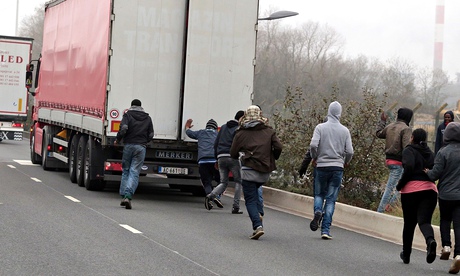
Courtesy of Natacha Bouchart, the mayor of Calais, Britain’s rightwing press has had a field day. Speaking before the home affairs select committee in London yesterday, Bouchart also gave the immigration-obsessed Westminster village a run for its money. Even by Ukip standards, her comments were inflammatory. Nigel Farage must have thought that the French politician was the most effective recruiter ever for his cause. The media used a rather loose translation of her words to make them sound more dramatic than they actually were.
Still, to imply crudely that asylum seekers want to migrate en masse to Britain because the measures put in place by the government are “aspirational”, and therefore that migrants are “prepared to die” for UK benefits, is a travesty.
It is untrue that all migrants hope to make it to Britain, and only a small fraction of the migrant population ends up on this side of the Channel. According to Eurostat figures, France welcomed 1,500 asylum seekers per week in 2013; Germany received 2,400, Sweden 1,000 and Britain only 600. On average, the EU had 860 asylum seekers per million inhabitants, France 985 and Britain 465. However Sweden had 5,680, Belgium 1,885 and Germany 1,575. In short, Britain has been welcoming far fewer asylum seekers than some of its European partners. So much for the British El Dorado.
A national debate on immigration less infected by rightwing scaremongering and xenophobia would surely have spotted those facts, wouldn’t it? The trouble is that the reality on the ground is less newsworthy: Britain is just one of many places in Europe where migrants try their luck, after spending all of their savings and putting their health and lives at risk in the hope of reaching a wealthy and peaceful European destination.
Britain happens to treat migrants marginally more humanely than France and other European countries. Politicians in this country should celebrate that fact, instead of moaning about it. There is no room for British complacency, though: to give a very modest living income (£37 a week for a single adult, so about £5 a day), provide medical support and abide by international conventions for asylum seekers is nothing to brag about. It is simply complying with basic humanitarian standards. When democracies start behaving otherwise, they are no longer democracies.
What is more, migrants do not come to our shores to take a pleasant break from their working lives. The large majority of them have fled their countries because of wars and persecutions; they are homeless and penniless. Most of the asylum seekers in Calais, living in abject conditions, come from Libya, Afghanistan, Iraq and Syria. In those areas, American and European military interventions have resulted in making the local populations less safe and less prosperous. Those who lament the increase in asylum seekers’ applications fail to understand that there is a correlation between those rising figures and the hopeless manner in which European governments manage crisis resolution in zones of conflict.
Bouchart is a member of the UMP, the main rightwing party in France. She is therefore in line with her party’s hardline stance on immigration. In 2002, under pressure from the Blair government, Nicolas Sarkozy, then the interior minister, closed the Sangatte refugee camp near Calais in an attempt to dissuade asylum seekers from crossing the Channel. Twelve years on, this short-sighted decision has spectacularly backfired. More than 2,000 migrants are now permanently based in Calais in inhumane conditions. They are undeterred and desperate to find asylum in Europe, despite the rising hostility they experience from the local population. Yet people in this poor working-class town are not to blame. Governments on both sides of the Channel and the cynical European commission, for failing to sort this shameful mess in a rational and humane manner, are certainly culpable.