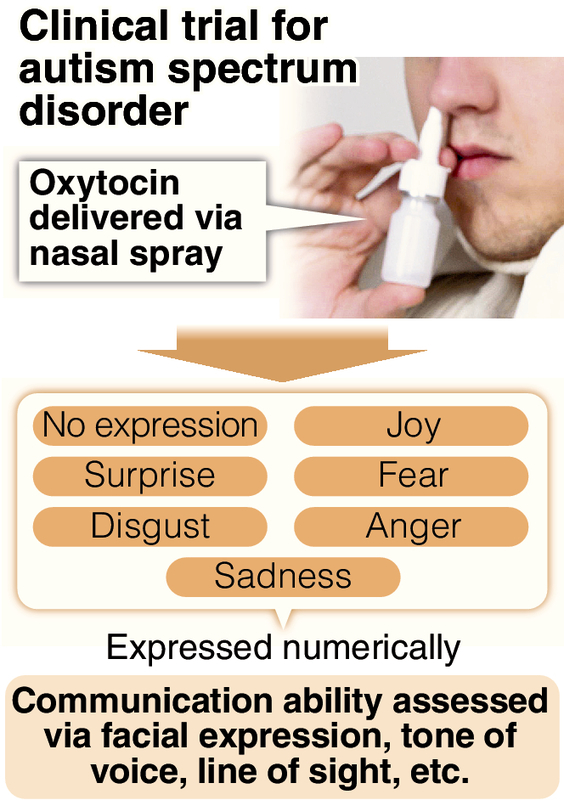
A physician-led clinical trial has been launched to study a new nasal spray medicine that could help improve the communication ability of patients with autism spectrum disorder (ASD), who often have difficulty with interpersonal relationships. The trial is being conducted by a team that includes Prof. Hidenori Yamasue, a specialist in psychiatry at the Hamamatsu University School of Medicine. This would be the first drug to address poor communication ability, a core symptom of ASD. The team said it hopes to have a product ready for the market in about five years.
ASD is a developmental disorder that has also been known by names including Asperger's syndrome and autistic disorder. It causes a variety of symptoms, with patients often having trouble communicating with others in venues such as school and work, which can make it feel difficult for them to handle everyday life.
Previous drugs for ASD have sought to treat secondary symptoms such as anxiety, depression and agitation.
Yamasue and his team are focusing on oxytocin, the so-called "happiness hormone" that is found in higher levels in women than in men. Studies have found that oxytocin's effects on the brain include higher levels of cooperativeness. Based on this research, the team pursued further studies and worked with Teijin Pharma Ltd. to develop a spray that can be absorbed via the nose.
Oxytocin is already used around the world in drugs to help induce labor and promote breast milk secretion, and the safety of the spray to be used in this trial has already been confirmed. About 150 male patients aged 18 to 54 are being recruited at about 10 university hospitals nationwide. After the subjects inhale oxytocin via the spray, their facial expressions, tone of voice, eye movements, and other indications of emotion will be checked in an interview format. These findings will then be expressed numerically and analyzed.
A clinical trial on 60 male patients using a spray that is now marketed overseas observed more vivid facial expressions, increased engagement in conversations and other results.
"How frequently and at what dose oxytocin should be used has not been established," Yamasue said. "It would be dangerous to leave it up to patients and their families."
Tadafumi Kato, deputy director of the RIKEN Brain Science Institute and a specialist in psychiatry, said: "Expectations are high, all the more so because there are no drugs that can treat the core symptoms. There are almost no physician-led clinical trials in the field of psychiatry, so the study is also significant for this reason."
Read more from The Japan News at https://japannews.yomiuri.co.jp/