Astronomers using Nasa’s Hubble Space Telescope have discovered a new type of cosmic object that is believed to be a “failed galaxy”.
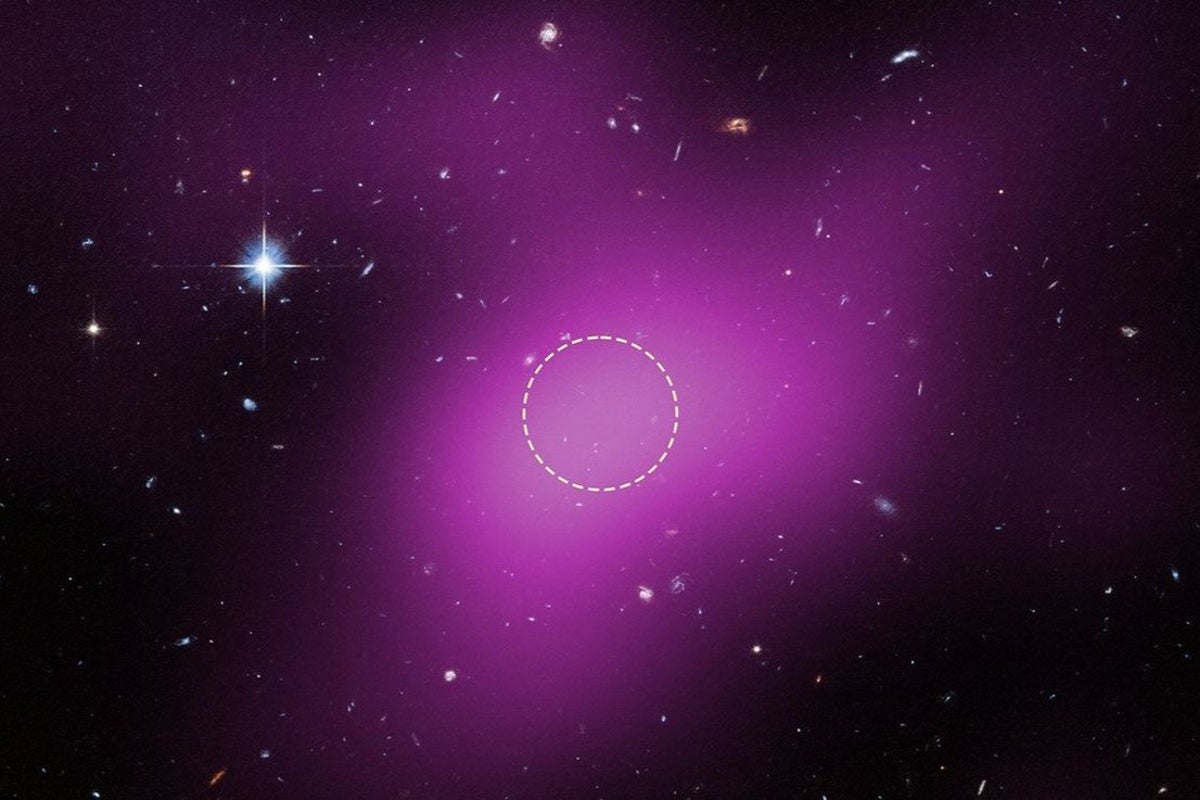
Dubbed ‘Cloud-9’, the astronomical curiosity is a cloud of dark matter 14 million light-years from Earth that contains no stars.
It is the first time that such an object has ever been detected, and could improve scientists’ understanding of the early universe and the nature of dark matter.
“This is a tale of a failed galaxy,” said Alejandro Benitez-Llambay from the Milano-Bicocca University in Italy, who is the program’s principal investigator.
“In science, we usually learn more from the failures than from the successes. In this case, seeing no stars is what proves the theory right. It tells us that we have found in the local universe a primordial building block of a galaxy that hasn’t formed.”
The object is called a Reionization-Limited H I Cloud, or RELHIC, which has been theorised for years as what a remnant from an early galaxy formation would be like.
ESA researcher Rachael Beaton said that they expected our galactic neighbours to contain “a few abandoned houses” like this.
The surprise discovery offers a unique insight into the physics of dark matter and is expected to result in more failed galaxies being uncovered in the future.
Dark matter makes up approximately 85 per cent of all matter in the universe, but it is impossible to see with telescopes because it does not emit, absorb or reflect light.
The lack of stars in the Cloud-9 formation allows scientists to look at a pure dark matter “halo” without any light interfering with the observation.
“This cloud is a window into the dark universe,” said Andrew Fox from the Association of Universities for Research in Astronomy/ Space Telescope Science Institute at the European Space Agency (ESA).
“We know from theory that most of the mass in the universe is expected to be dark matter, but it’s difficult to detect this dark material because it doesn’t emit light. Cloud-9 gives us a rare look at a dark-matter-dominated cloud.”