The day's events
-
Orion launched without a hitch from Cape Canaveral in Florida at 12:05 GMT on top of a Delta IV Heavy rocket, after several aborted countdowns on Thursday.
-
It attained low Earth orbit at 12:30 GMT eventually reaching 3,600 miles at its apogee, further than any crew capsule since Apollo 17 in December 1972.
-
Along the way it passed through the lower Van Allen Belt, testing the ability of its systems to withstand radiation.
-
The crew module separated from the service module at around 15:30pm GMT.
- At around 16:20 GMT, Orion re-entered the atmosphere at 20,000mph, its heat shield reaching temperatures of around 2,200C.
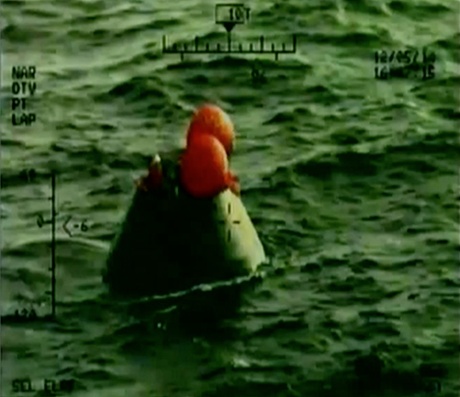
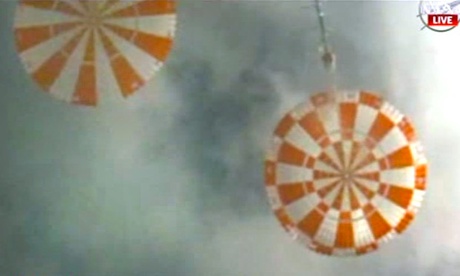
- Its 11 pilot, drogue and main parachutes deployed successfully, slowing the craft to around 20mph by the time it splashed down in the waters of the Pacific at around 16:30 GMT.
- Nasa declared the flight “picture perfect” from start to finish.
Updated
As Nasa continues its analysis of today’s “textbook” Orion flight, it seems like the right point to bring this blog to a close.
This is hopefully the beginning of a road that will take humans to Mars. It is, however, going to be a rocky road with many obstacles in the way. Some of these will be technical, some political, others financial.
Let us wish all concerned luck, and look forward to the next Orion test flight, which is slated for 2017/2018.
Watch out for post-mission updates on NASA TV at 1.30pm ET (6.30pm GMT).
“Today was a great day for America"- #Orion Flight Dir Mike Sarafin At 1:30pm ET: NASA TV airs post-mission updates pic.twitter.com/63OfBh9Aef
— NASA (@NASA) December 5, 2014
I’ve just been chatting to the space writer Brian Harvey, a close follower of the world’s space programmes. He told me, “This is a good day for Nasa, a great and welcome boost that will silence its critics for a while.”
But in common with many others I have spoken to, he remains fearful about the medium/long-term prospects of this programme. The problem is that there is not enough money in the Nasa budget to design missions for the Orion capsule, nor the Space Launch System (SLS), its associated rocket.
He tells me that some cynics refer to the SLS as the Senate Launched System because Nasa has been mandated by the US Senate to build this super rocket. This happened because President Obama cancelled a previous rocket system, known as the Constellation programme, which was designed to return astronauts to the moon.
When certain senators realised this meant heavy redundancies in their states, they insisted on Nasa building a newer, slightly less expensive launch system. This is what is now called the SLS.
According to Harvey, Nasa and its contractors are struggling to come up with a mission that uses Orion and/or the SLS that they can afford. “Without a mission, the programme is vulnerable to cancellation after the administration changes in January 2017,” says Harvey.
So is a manned Mars mission in the mid-2030s realistic?
“Yes, it is if Nasa really puts its mind to it. But,” says Harvey, “when they get there, they may be greeted and invited in for tea by the Chinese.”
He says that the Chinese are developing a strong, steady space programme with real political intent behind it. Although the Chinese have not yet committed to a Mars mission, Harvey says, “We haven’t seen half what China is going to do in space yet.”
Updated
Amazing visuals of #Orion's return from @NASAArmstrong Ikhana aircraft. pic.twitter.com/psYbvyxvxP
— Orion Spacecraft (@NASA_Orion) December 5, 2014
A lonely rover tweets …
Congrats #Orion! We're one step closer to bootprints next to these rover tracks. #JourneyToMars pic.twitter.com/1l51sQwpMh
— Curiosity Rover (@MarsCuriosity) December 5, 2014
Incidentally, the photograph in that tweet is an old one of an earlier exercise recovering Orion.
USS Anchorage picking up the #Orion module pic.twitter.com/A2br92sLES
— Dr Paul Coxon (@paulcoxon) December 5, 2014
Nasa reports that the vehicle is airtight and its cooling systems are working perfectly.
Updated
The Science Museum’s Doug Millard, deputy keeper of technology and engineering, writes that “Human Spaceflight Enters a New Era” but also strikes a note of caution. He writes that the lack of political underpinning to the Orion programme and the resulting lack of money mean that the “momentum of successive missions will be hard to maintain.”
Updated
For those (like me) puzzled by Nasa’s reference to ‘a golden spike’, wikipedia might have the answer.
The “Golden Spike” (also known as “The Last Spike”) is the ceremonial final spike driven by Leland Stanford to join the rails of the First Transcontinental Railroad across the United States connecting the Central Pacific and Union Pacific railroads on May 10, 1869, at Promontory Summit, Utah Territory. The term “Last Spike” has been used to refer to one driven at the usually ceremonial completion of any new railroad construction projects, particularly those in which construction is undertaken from two disparate origins towards a meeting point.
A smoke flare and green dye released into the ocean guide the recovery teams to the spacecraft.
A gentle landing for a mighty rocket! Way to go #Orion! pic.twitter.com/6GOp9sU2Bs
— NASA Goddard Images (@NASAGoddardPix) December 5, 2014
Con i paracadute per un rientro morbido..RT @NASAGoddardPix: A gentle landing for a mighty rocket! Way to go #Orion! http://t.co/sUYivXulqC
— ESA_Italia (@ESA_Italia) December 5, 2014
“Orion’s maiden flight from start to finish was picture perfect,” says NASA, “The most perfect flight you can ever imagine.”
Orion has “driven a golden spike as it crosses a bridge into the future,” says Nasa.
Four hours and 20 minutes after launch. Five airbags inflate to ensure the capsule remains upright in the water.
Back on Earth
Splashdown!
This looks like a textbook mission as the Orion capsule drifts under its main parachutes towards splashdown in the Pacific.
4,000 feet. Three main chutes deployed successfully.
Wow - those three giant parachutes do make this look a lot like a returning Apollo Moon mission.
Main chutes deployed.
Less than four minutes to splashdown. Forward bay and drogue parachutes deployed.
First parachutes are deployed. Passing 15,000 feet.
At 60,000 feet Orion goes subsonic. Now 35,000 feet. Forward bay cover is about to be jettisoned.
35,000 feet and descending...
Orion is now travelling sub-sonically.
View from Orion cameras on the live feed show that it is a bumpy ride. Thrusters keeping control. Flight dynamics say it is coming ‘right down the line.’
Time to splashdown 7 minutes. We’re tracking “right down the middle”, which I think means we’re on target.
Signal re-acquired!
Orion is back in contact.
Now Orion goes quiet due to “loss of telemetry” in the extreme conditions of re-entry. It’s one of the tensest times of any mission. Mission controllers can only wait and hope that the craft survives.
Telemetry has been lost - as expected. No anomalies noted before the blackout.
Now the temperature of the heat shield will rapidly build to more than 2000C. Spashdown in 9 minutes.
Updated
Re-entry
Orion has hit the Earth’s atmosphere at 20,000mph, 84% of the velocity a spacecraft would be travelling on re-entry after a trip back from the moon. The craft is at an altitude of about 470,000 feet. The next 9 minutes 45 seconds are critical.
Orion will hit the atmosphere at a velocity of 20,000 mph. When it splashes down about 10 minutes later, it will be travelling at just 20 mph. The conditions will be so intense around the capsule during some of this decent that contact with the capsule could be temporarily lost. Although expected, it will still be nerve-wracking. No engineer likes to lose contact with their spacecraft.
Orion is now just 500 miles above the Earth.
#Orion's cameras are turned off as it enters intense radiation of the lower Van Allen Belt.
— Orion Spacecraft (@NASA_Orion) December 5, 2014
12 minutes to re-entry.
22 minutes to splashdown.
There’s going to be a complex choreography of parachute releases at precise points during the descent so that Orion slows down just enough, but not too much – presumably to avoid drifting off target.
Updated
The “raise burn” of the thrusters has completed, orienting Orion for re-entry.
Updated
We’re 21 minutes from re-entry now. Before then in about four minutes’ time, Orion will fire its thrusters for about 10 seconds to orient it for re-entry. Orion’s parachute system is installed in the craft’s forward bay, protected by a cover that will be jettisoned after re-entry.
Updated
Here is what has to happen for Orion to safely parachute to Earth.
20% of the heat shield will be burned away during re-entry as it reaches a temperature of around 2,200C – or around twice as hot as lava. But that’s only half as hot as it would get if it were returning from the moon, because the farther out you are to start, the hotter you get as you re-enter the atmosphere. After its 11 parachutes have deployed and dramatically slowed it, the capsule will hit the water at around 20mph.
Around 58 minutes to splashdown at a height of 3,200 miles above the Earth.
Separation from service module
Orion is now flying free for the first time having separated from the service module.
Updated
#Orion’s predicted splashdown point at 23.61º N, 116.46º W #OrionLaunch pic.twitter.com/9mjDam20dP
— Observing Space (@ObservingSpace) December 5, 2014
The heat shield will reach around 2,200C during re-entry into the Earth’s atmosphere.
The Nasa voiceover guy has corrected his earlier statement about the splashdown location – it will in fact be 275 miles west of Baja California in Mexico.
Updated
Separation of the crew module from the service module in just 10 minutes.
#Orion's now in position for separation from its service module & #DeltaIVHeavy second stage. http://t.co/6XtjOi1yJo pic.twitter.com/AFYpcKpa8u
— NASA (@NASA) December 5, 2014
A human crew returning to Earth on Orion would experience a G force of 8.2g – somewhat unpleasant. For comparison, astronauts returning to Earth in a Soyuz capsule pull about 4.5g. For those who don’t know, “g” is the gravitational force experienced by someone at sea level.
One hour 17 minutes to splashdown.
Three hours and six minutes into the flight.
Orion reaches its apogee
Orion has reached its peak altitude or apogee at 3,600 statute miles above Australia, travelling south-west to north-east.
Updated
About 25 minutes to go before the crew module separates from the service module.
“All of Orion’s systems have been operating to perfection so far,” says the Nasa TV voiceover guy.
Splashdown will be in the Pacific, 600 miles west of Baja California, Mexico.
Updated
Orion will re-enter the atmosphere at a staggering 20,000mph – though this is slower than the Apollo capsules, which re-entered at 24,000mph.
The heat shield is the largest ever made, 16 feet (around 5 metres) across. It’s made of fibreglass phenolic honeycomb 1.6 inches (about 4cm) at its thickest. Here’s a Nasa video with more details.
Updated
We’re about 20 minutes from peak altitude and about 40 minutes from separation of the crew module, when Orion will fire its thrusters to turn 180 degrees so that its heat shield faces Earth.
Updated
The rocket is two and half hours into its flight, 2,744 miles above the Earth and 900 miles from peak altitude. Nasa reports that the craft’s avionics and shielding experienced “zero effects” from radiation as it passed through the Van Allen belt.
Updated
The flight test cameras are back on and functioning normally, showing more awesome views of the Earth.
.@USNavy ships that will help recover #Orion have deployed near splashdown site. Watch: http://t.co/6XtjOi1yJo pic.twitter.com/7U9DwLoBOT
— NASA (@NASA) December 5, 2014
Upper stage burn successful. #Orion is climbing to its max altitude right now: http://t.co/i2ILzNQu7f
— Lockheed Martin (@LockheedMartin) December 5, 2014
Nasa reports that Orion has passed through the lower Van Allen belt and remains on course as it flies through space. Flight controllers are maintaining contact with the craft through its telemetry systems.
Splashdown in the Pacific is due at 11.30 EST (16:30 GMT).
Sunrise in the Landing Zone seen by the Ikhana UAV. #Orion #EFT1 http://t.co/AoDHu7fDLK pic.twitter.com/UZEYVkNCHR
— Spaceflight101 LIVE (@S101_Live) December 5, 2014
Flight test cameras have been powered down while the craft passes through the Van Allen radiation belt. This is a cloud of energetic charged particles, held by the Earth’s magnetic field, that extends from an altitude of about 1,000 to 60,000 kilometres above the surface. An important part of this mission’s research is to see how well equipment onboard tolerates radiation like that it will experience on the long journey to Mars.
Updated
The boss and his wife watch the launch.

Updated
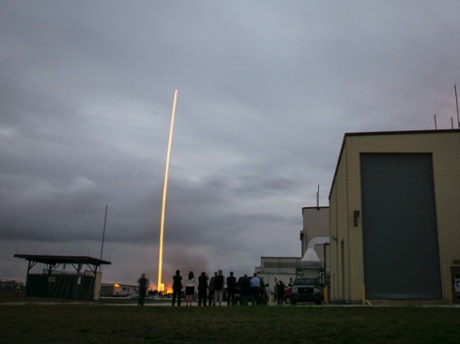
Orion streaks heavenwards in this long-exposure shot of the launch.
Re-ignition has taken place
Orion is now boosting away from low-Earth orbit.
5 minutes away from the re-ignition of the Delta IV rocket to push Orion up out of low Earth orbit. It will reach 3,600 miles altitude, further than any person-rated capsule since the final Apollo 17 moon flight in December 1972.
The view from Orion
Updated
What next for Orion?
The first humans who will set foot on Mars are alive on Earth today. That’s the message from Charles Bolden, Nasa’s Chief Administrator.
The Orion spacecraft is billed as the first step in the journey to Mars. It is not designed to ferry astronauts into Earth orbit. Nasa have outsourced that job to private companies, such as Elon Musk’s Space X and his Dragon capsule.
Instead, Orion will go further than any manned capsule since the Apollo craft of the 1960s and 70s.
The next test launch of Orion is scheduled to take place in 2017. This will send it around the far side of the Moon and back again. It will also be the first launch of the Nasa’s newer, more powerful rocket system: the Space Launch System (SLS).
At a towering 122 metres tall, the SLS rocket will be 50 metres taller than the Delta IV Heavy that launched the capsule today. It will also be 11 metres taller than the mighty Saturn V that took the Apollo astronauts to the Moon.
Any mission to Mars is unlikely to take place until the mid-2030s. To do this, Nasa will need addition funds to build a deep space habitat to which Orion will dock. This is because Orion is not large enough for the four-person crew to live for nine months as they voyage to Mars.
To keep their own costs down, Nasa will almost certainly have to rely on international collaboration. Already, the European Space Agency is building a critical module of the Orion spacecraft for the 2017 test launch.
The first missions to Mars will likely not land on the planet, they could simply fly-by or orbit. A mission to the surface of Mars would require technology to be developed that can land through Mars’s thin atmosphere and – perhaps most importantly – take off again.
“Everyone wants to go to Mars,” said Rex Walheim, a Nasa astronaut who flew on the final Space Shuttle flight in 2011.
Updated
Over at Comment is Free, Joe Pappalardo claims Orion is Nasa’s last throw of the dice in the face of tightening budgets and increasingly adventurous competition from private space companies:
The Orion launch has been a triumph of engineering, hiccups and delays aside. But the Empire may not love the sequel. SpaceX is planning a historic launch of its own next year – the rocket is called the Falcon Heavy. Yes, Musk named his rocket after the Millennium Falcon of Star Wars, and he promises it will take twice as much payload into space as the one Nasa launched on Friday, and at one-third the cost. So far his claims about SpaceX have come true, and soon he’ll be fighting, with the lobbyists and the politicians who play favorites, for satellite contracts worth hundreds of billions of dollars.
Updated
The Orion capsule and the attached Delta IV upper stage rocket are now over the southern Pacific, having launched eastwards from Cape Canaveral earlier today.
It is currently downlinking video from the on-board test cameras. Some of this footage may be released this afternoon.
Updated
Missed this morning’s launch? Watch it as many times as you want on Nasa Kennedy’s YouTube channel.
Updated
Even if there are no astronauts in Orion today, there is a lot riding on the mission. Dr David Baker, a former Nasa engineer who now edits Spaceflight, the magazine of the British Interplanetary Society, has sent in this comment:
With a new Republican Congress looking at Nasa’s budget early next year, the agency needs this one to go well to get essential funds and to enhance confidence. But the next launch of an Orion will not take place for four more years when it flies unmanned on the first Space Launch System (SLS) rocket and it is still uncertain as to when the crewed launch will take place. The second SLS flight is expected around 2021 but Nasa spokespeople are now heavily “policed” by their PR machine and it is noticeable that in the last three press conferences they have bucked confirmation that it will take place by then. We shall see.
Updated
Prepared by Observer Tech Monthly for all you space geeks, here’s a pictorial foretaste of events scheduled for 2015 – including the European Space Agency’s LISA pathfinder spacecraft, Nasa’s plans to send plant seeds to the moon and an exploration of Pluto and its moons by Nasa’s New Horizons spacecraft.
Updated
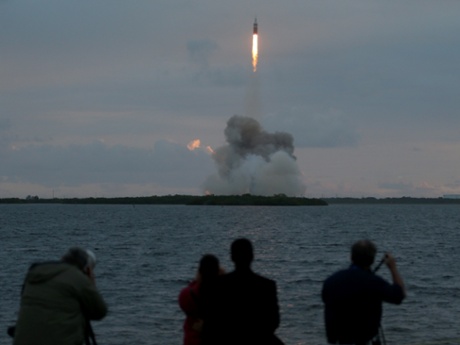
There is often an alarming moment just before a Delta IV rocket lifts off. At the moment the engines ignite, it looks as if the outside of the rocket catches fire. The phenomenon was clearly seen in this morning’s launch. The explanation is given by Jason Davis on his blog for The Planetary Society:
Just before the Delta IV ignition sequence starts, valves open that control the flow of liquid hydrogen to the engines. Some of that hydrogen seeps out of the engine bells and lingers around the rocket. When the engines roar to life, the excess hydrogen ignites, creating a fireball that chars the booster cores. Occasionally, the insulation on the booster cores smoulders as the rocket lifts off.
Updated
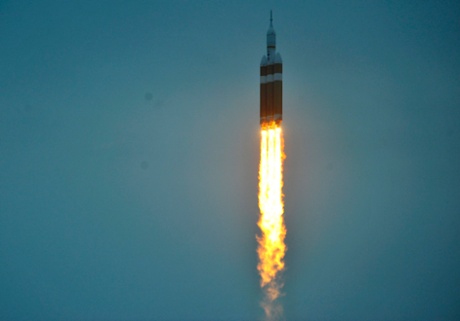
More pictures are coming in of the launch.
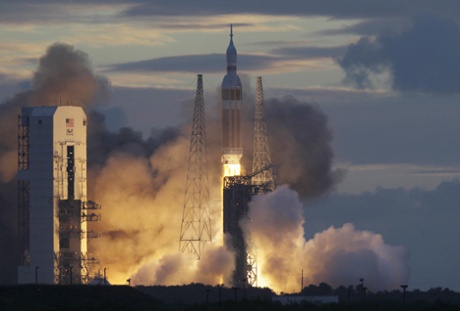
Orion is now in low-Earth orbit. The Delta rocket upper stage will burn again in about 90 minutes to loft Orion to an altitude of 3,600 miles. From there it will fall back to Earth, re-entering the atmosphere at 20,000mph later today.
Updated
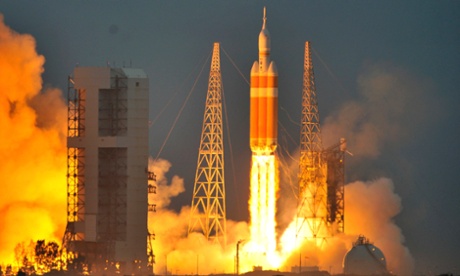
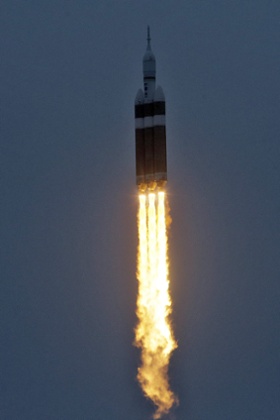
Here’s our full news story on the launch.
Nasa successfully launched its new Orion spacecraft on a mission that the US space agency hopes will foreshadow the first human expedition to Mars.
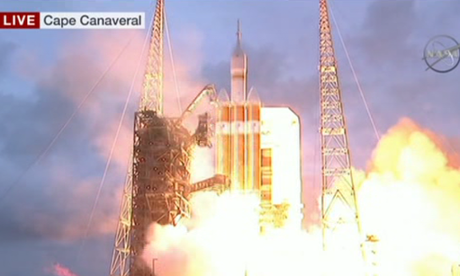
At 7.05am ET (12.05pm GMT) on Friday a dense bloom of fire and smoke shrouded the launchpad in Cape Canaveral, Florida, as the unmanned Orion capsule rose into clear skies on the Delta IV heavy rocket.
Nasa had to to postpone an initial launch on Thursday after a boat entered the launch area, strong winds forced automatic aborts, and two valves failed to close properly.
Friday’s launch went smoothly, and cameras mounted on the rocket beamed back stunning pictures of the earth.
The mission could have huge implications, despite its brief four-and-a-half-hour duration. Orion will fly farther than any spacecraft made for astronauts has in decades, about 3,600 miles (5,800km) above the Earth’s surface, and is a test case for a capsule that Nasa hopes will one day land on Mars.
As its second orbit comes closer to the planet, the Orion capsule will separate and re-enter the atmosphere, eventually splashing down into the Pacific off the coast of southern California, from where it will be recovered.
The mission will test how Orion fares in the extreme conditions of space travel. Nasa has designed the capsule to take up to six astronauts into deep space, and its 16ft-wide heat shield and sophisticated service module are among the features whose durability will be inspected upon return.
The capsule must not only survive launch and orbit, but temperatures of about 2,200C (4,000F) as it returns through Earth’s atmosphere. Nasa will also test an emergency abort function developed to save astronauts in the event of a malfunction during launch.
Nasa has planned a second unmanned flight for 2018, and a manned mission to travel around the moon for the 2020s. Eventually, the agency hopes to send astronauts on an Orion mission through deep space to an asteroid and Mars in the 2030s.
Budget issues and uncertainty have plagued Nasa’s plans for the future, although recent presidents have consistently urged the agency to aim high. In 2010 Barack Obama, who cancelled a $10bn programme to return Americans to the moon, said he supported a mission of greater ambition: “By the mid 2030s I believe we can send humans to orbit, Mars and return them safely to Earth.”
Updated
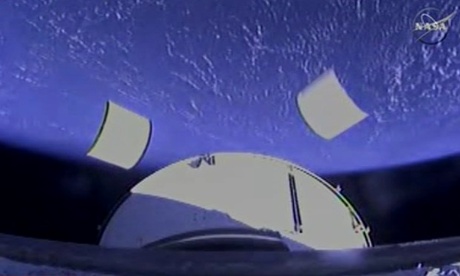
The upper stage of the Delta rocket is still firing to get the capsule into orbit. Everything working “perfectly” says Nasa.
Updated
Almost 10 minutes into the flight. Orion is now travelling at 15,000 miles per hour. This is almost enough to put it into orbit.
Updated
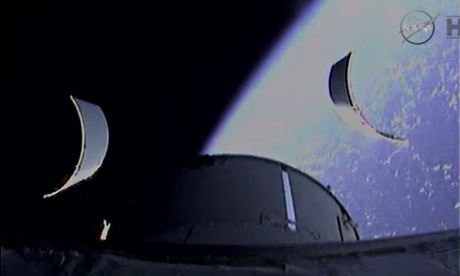
Orion is now 127 miles in altitude. Earth looks beautiful from up there.
NASA report ‘everything going extremely well’
There go the fairings!
Booster separation complete. Everything looking good.
Updated
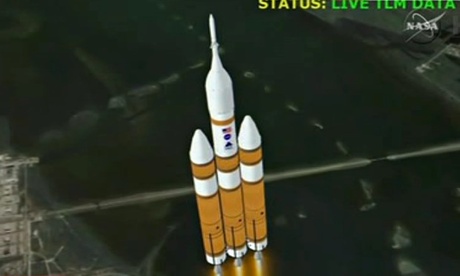
Can see the curve of the Earth and the glow of the atmosphere beautifully from the camera on the rocket.
Updated
Launch
Engine start.
Lift off!
Orion is go.
Updated
T-1 minute - everything still go.
T-2 minutes - everything remains go for launch.
If you’re having trouble with buffering on the livestream, watch here.
Clear to launch just given. 5 minutes to lift-off. Countdown will recommence at T-4 minutes.
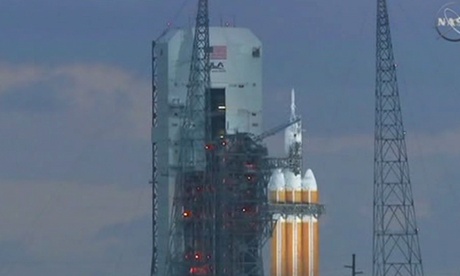
#Orion is going to internal power. Flight computers updated with wind info. 8 min to launch. pic.twitter.com/ORPKEPLBQD
— Orion Spacecraft (@NASA_Orion) December 5, 2014
#Orion program management team listen to the pre-launch poll. pic.twitter.com/ejudQTqKQ2
— Orion Spacecraft (@NASA_Orion) December 5, 2014
12 minutes to scheduled launch.
The winds that scuppered the launch yesterday were gusting at more than 20 knots. This is the equivalent speed of Usain Bolt running the hundred metres sprint. Although the wind is close to these speeds again today, they are below the safety cut-off. However, the wind is expected to pick up in the later stages of the launch window.
The Orion Multiple Purpose Crew Vehicle is designed to carry astronauts on missions into deep space lasting up to six months.
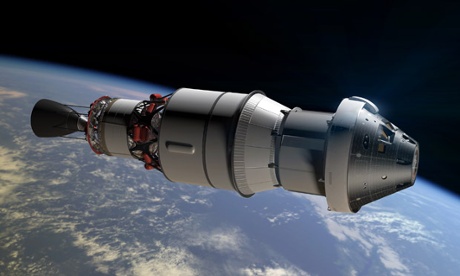
Engineers are reporting that the valves probably failed to close properly yesterday because of the extreme cold of the fuel. Liquid hydrogen exists at a temperature of around –250C.
To keep the valves flexible and moving, they are being opened and closed at regular intervals in the run-up to today’s launch.
Updated
Orion has no issues; weather has cleared. We are go for launch.
— Orion Spacecraft (@NASA_Orion) December 5, 2014
The vapour that can be seen venting from the rocket is the oxygen and hydrogen boiling out of the fuel tank. This is the reason the tanks need to be continually filled (“trickle mode”) until just before launch.
Updated
Nasa reports that there was a shower to the west but everything is still go for 12:05 GMT launch as far as the weather is concerned. Wind is gusty but within safety limits.
Updated
Technically everything is go for launch at 12:05 GMT. The only issue at present is the weather. Nasa is holding a weather briefing now.
Updated
Orion’s main fuel tanks are now full. Liquid hydrogen and oxygen have been pumped in during the last few hours. The pumps are now in “trickle mode”, reports Nasa.
This is necessary because the low-temperature fuel will gradually boil off. So the fuel lines must remain attached and the valves must remain open so that the tanks can be continually topped up.
A few minutes before launch, the valves will be closed tightly and the fuel lines will be retracted, sealing the tank. This is where things went wrong yesterday. Without the valves closing correctly, fuel could spill out, potentially causing a disaster.
Let’s hope the issue has been solved during the night, and the 12:05 GMT launch proceeds smoothly today.
Updated
The stage is set …
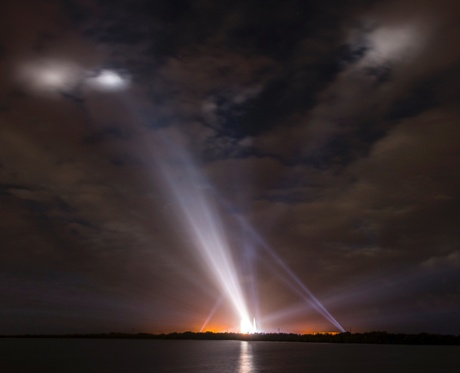
It is not yet dawn in Florida, and it has been raining, but the crowds are already starting to gather for today’s launch.
Thursday's launch attempt
Welcome to our live coverage of Nasa’s second attempt to launch the Orion spacecraft. Here are some quick facts to bring you up to speed.
- Orion is the first new crew capsule to be built by Nasa for a generation. It is the successor to the space shuttle.
- Nasa has been unable to launch its own astronauts into space since the retirement of the space shuttle in 2011.
- This test flight is the start of a “new chapter in human space exploration”, said Nasa.
- The first launch attempt was yesterday. It was scuppered – or “scrubbed” in Nasa parlance – by a combination of factors.
- First, a boat entered the restricted zone off the coast near Cape Canaveral, Florida.
- Second, gusts of wind kept triggering an automatic sensor that halted the countdown.
- Finally, and most seriously, valves in the rocket engine failed to close in order to seal off the fuel tanks.
- Today’s launch attempt will take place sometime between 12:05 GMT and 14:44 GMT.
Updated