
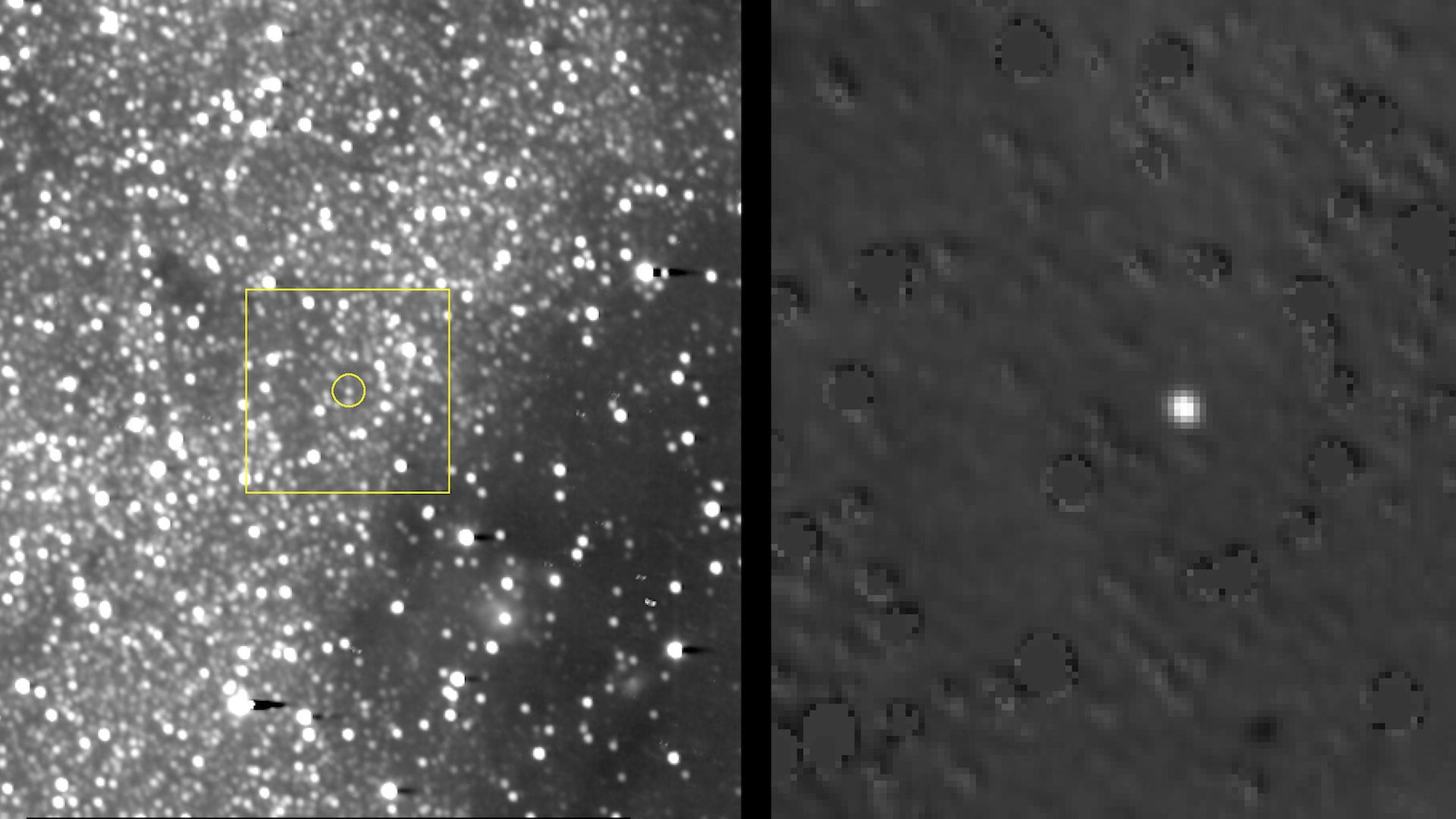
On New Year's Day, NASA's New Horizons spacecraft is expected to make history by conducting the most distant flyby ever, by zooming past an object a billion miles past Pluto. It's called "Ultima Thule," meaning "beyond the known world."
Why it matters: The spacecraft, which is the same one that sent back dazzling images of Pluto in 2015, is slated to be the first to explore an object in the Kuiper Belt — a region of icy bodies beyond the orbit of Neptune that are thought to be leftovers from the solar system's early days.
The goal of the mission is to learn more about the building blocks of planets. "In effect, Ultima should be a valuable window into the early stages of planet formation and what the solar system was like over 4.5 billion years ago," principal investigator Alan Stern wrote in a NASA blog post.
The background: The New Horizons spacecraft is expected to pass three times closer to Ultima Thule than it did to Pluto, offering scientists a closeup view of an object in the middle of the Kuiper Belt.
- Even though it will be zipping past at about 32,000 miles per hour, the spacecraft is expected to yield high resolution images that will be sent back to researchers on Earth.
- This distant region of our solar system has not been explored before, and scientists believe there may be millions of Kuiper Belt objects.
According to Stern, it's known that Ultima Thule was formed about 4 billion miles away from Earth. "Because of where it was formed and the fact that Ultima is not large enough to have a geologic engine like Pluto and larger planets, we expect that Ultima is the most well-preserved sample of a planetary building block ever explored," Stern wrote.
What to watch: Assuming all goes according to plan, images and data from the close approach will start flowing back to Earth on the day of the flyby, though the distance means there will be about a 6-hour delay between data transmission from the spacecraft and reception here on Earth.
"By that first week of January we expect to have even better images and a good idea of whether Ultima has satellites, rings or an atmosphere," Stern wrote.
How to watch during shutdown: A government shutdown will not affect the mission itself, but NASA won't air it live on NASA-TV or blanket its social media channels with coverage, an agency spokesperson told Axios. To follow along, watch a livestream from the Applied Physics Laboratory and monitor its social media accounts.
Editor's note: This piece has been corrected to show that the flyby distance between New Horizons and Ultima Thule will be close to 2,200 miles (not 22,000 miles). Also, the one-way transmission time between the spacecraft and Earth will be about 6 hours (instead of 12 hours).