Sometimes you get a small electric shock from touching your car door handle on a dry summer’s day.
The source of these shocks is a spark discharge, occurring between your body and the body of the car. These sparks happen from accumulation of static electric charge – often arising from two different materials rubbing together. This process – named triboelectric charging – was discovered in ancient Greece, where it was observed that some materials are attracted by amber when rubbed.
Triboelectricity is commonly demonstrated in classroom experiments: by rubbing plastic sticks with cat fur, or by rubbing a balloon on your hair.
Now we know that, if you were returning to a parked car on Mars, you could experience a similar shock. A new study has, for the first time, directly demonstrated electrical discharges on the red planet.
The same triboelectric process operates in volcanic eruptions on Earth, where charge is accumulated by ash particles colliding. In volcanic plumes, the build up of charge can initiate very large lightning discharges – the big cousin of smaller spark discharges. Lightning discharges are even more common in thunderstorms, however, where interactions between soft hail (graupel) and ice crystals cause charge separation.
On Earth, dust storms and dust devils – a relatively short-lived whirlwind formed from rising columns of warm air – are known to substantially electrify, through collisions between dust particles. Typically, sufficient electrification to lead to spark or lightning discharges is not achieved, owing to the ~1 bar pressure at the surface. Conversely, on Mars, the lower pressure (about 1-10% of that on Earth) means that spark discharges are likely at lesser levels of electrification.
For several decades, it has been thought that dust devils on Mars may be able to produce spark discharges. Many lab experiments shaking sand around in a low-pressure carbon dioxide atmosphere, like that of Mars, have recorded highly charged dust and discharges.
However, until now, there have been no direct observations of Martian discharges. There have been several clues to the existence of charging in the Martian atmosphere, such as dust stuck to the wheels of a Nasa rover, for example.
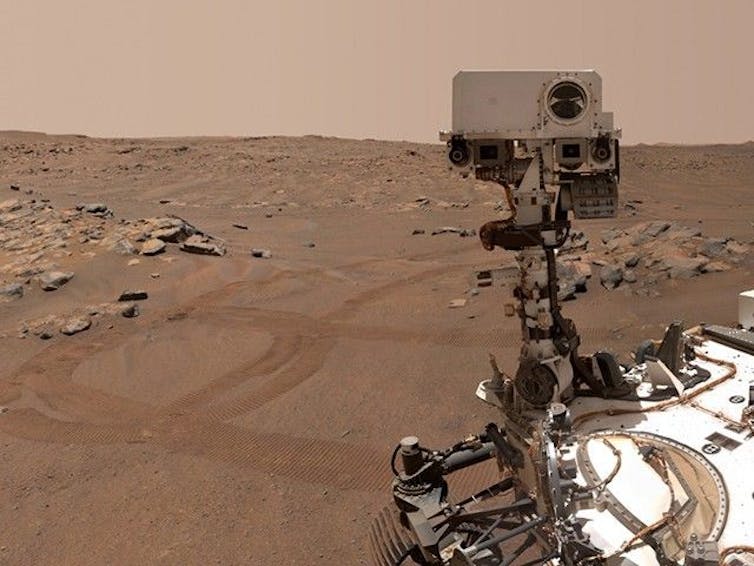
The new – and genuinely serendipitous – observations published in Nature show that electrical discharges are present in the Martian atmosphere.
These results stemmed from a small loop in the wire connecting a microphone on the Perseverance rover to the on-board electronics. This wire, and the microphone system connected to it, proved to be an unexpectedly effective accidental lightning detector. The SuperCam microphone was intended to observe the acoustic environment of Mars, however, small electrical transients were also detected.
In investigating the source of these transient events, it was found that some of them were followed by sounds. The authors convincingly showed that the transients were caused by spark discharges, with electromagnetic signals picked up by the coil being followed by acoustic signals from the microphone. These observations are similar to seeing a flash of light and later hearing the subsequent thunder.
From investigating the time difference between the acoustic and electrical signals, the authors find that the spark discharges occur in the vicinity of the Martian lander – just a few metres away. Further, it was found that these occurrences were more common during dust storms, or when dust devils sweep over the rover.
Generally, two independent sources of corroborating information are considered necessary for unambiguous evidence of a new phenomenon. For example, lightning at Saturn is supported by separate observations from both spacecraft and Earth. When the discharges are weak, however, detection at a distance is much less achievable or even impossible. For these weak events on Mars, in-atmosphere detection is needed. Although the same signal system was used to detect them, the electrical and acoustic signals were conveyed in very different ways.
An analogous situation might be a radio broadcast made from near a thunderstorm. The effect of a lightning strike might cause a crackle of interference to be picked up by an analogue (not internet) radio, shortly before you heard thunder on the broadcast. The same radio provides these two signals, however they would seem to be observed independently.
The finding that electrical discharges occur on Mars has various implications. Atmospheric electricity can cause chemical reactions, such as the formation of complex molecules, perhaps linked to the origins of life. There are also practical applications for future space missions.
Dust was a significant problem during the Apollo missions landing on the lunar surface, as it easily penetrates any mechanical systems. Dust protection is an important part of planning for human travel to Mars. All these problems are exacerbated when the dust creates sparks, as it could result in electronic circuits malfunctioning.
Fortunately, you won’t have to worry much when a dust devil approaches during your next road trip on desert tracks; you can just drive through it, although the experience might remind you that on Mars you might see some sparks in the dust.

Blair McGinness has previously received funding from STFC.
Karen Aplin receives funding from the UK Space Agency,
Martin Fullekrug does not work for, consult, own shares in or receive funding from any company or organisation that would benefit from this article, and has disclosed no relevant affiliations beyond their academic appointment.
This article was originally published on The Conversation. Read the original article.