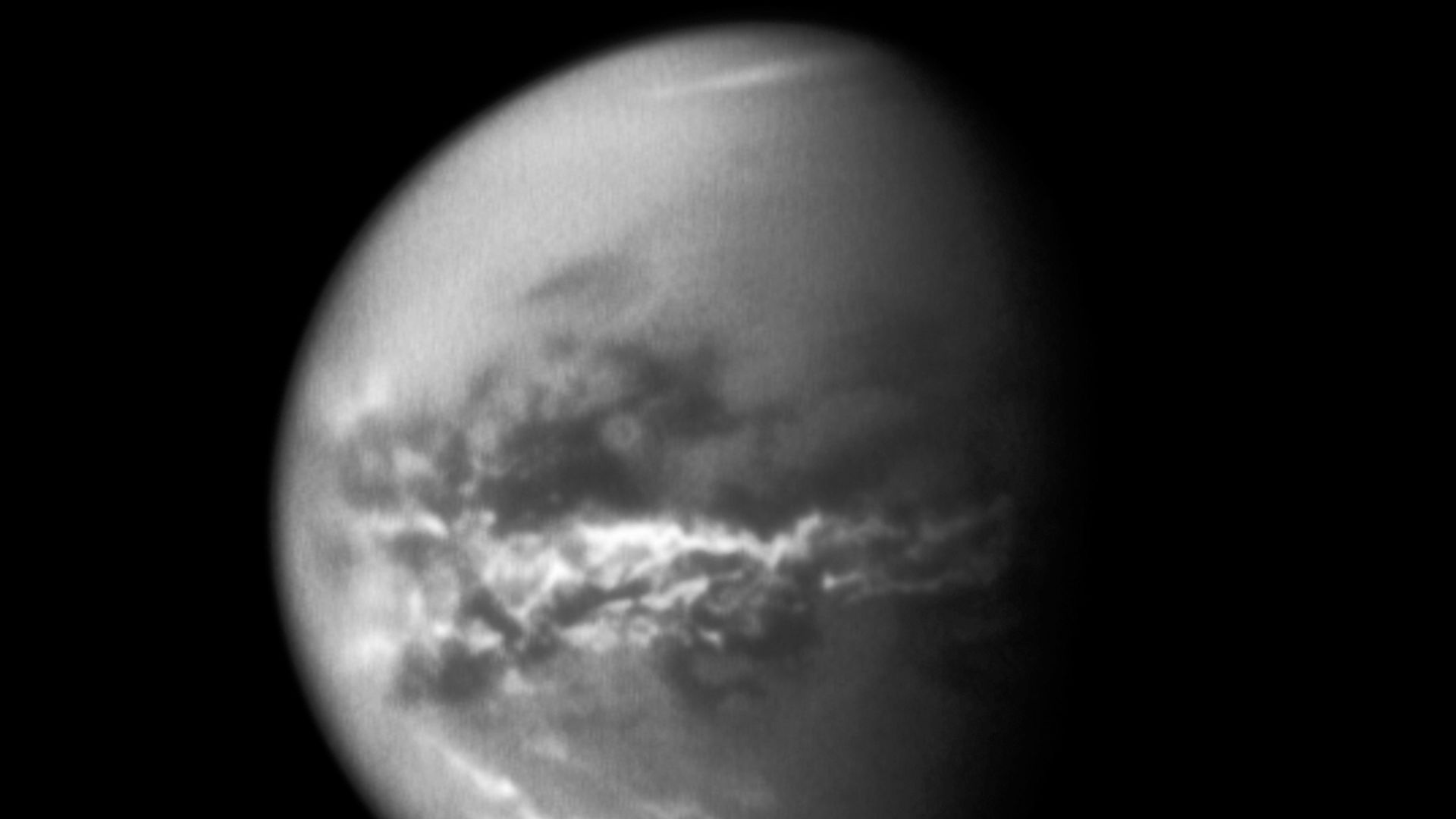
NASA is going to Saturn's largest moon, Titan. The space agency has selected the Dragonfly mission to learn more about the mysterious world from close range.
Why it matters: Studying Titan for an extended period of time from the world's surface will reveal aspects of the moon that we've only gotten a tantalizing glimpse of in the past. Scientists think that Titan could help unlock the mysteries of how life evolved.
Dragonfly is a drone designed to fly above Titan's surface, dropping down to investigate parts of the moon including its dunes and craters.
- NASA is planning to launch the spacecraft in 2026, with an arrival at Titan in 2034.
The big picture: Titan is alien in the most compelling sense. The moon has a thick atmosphere and bodies of liquid ethane and methane on its surface.
The backdrop: This won't be humanity's first visit to Titan. The Huygens lander also touched down on the moon's surface, giving scientists on Earth a brief look.
- Huygens studied Titan's atmosphere during its descent to the surface, but the lander only survived for a little over an hour after touchdown, beaming home photos after landing.
- Dragonfly is part of the agency's New Frontiers program that was also responsible for the New Horizon's mission to Pluto, Juno's mission to Jupiter and the OSIRIS-REx mission to an asteroid.