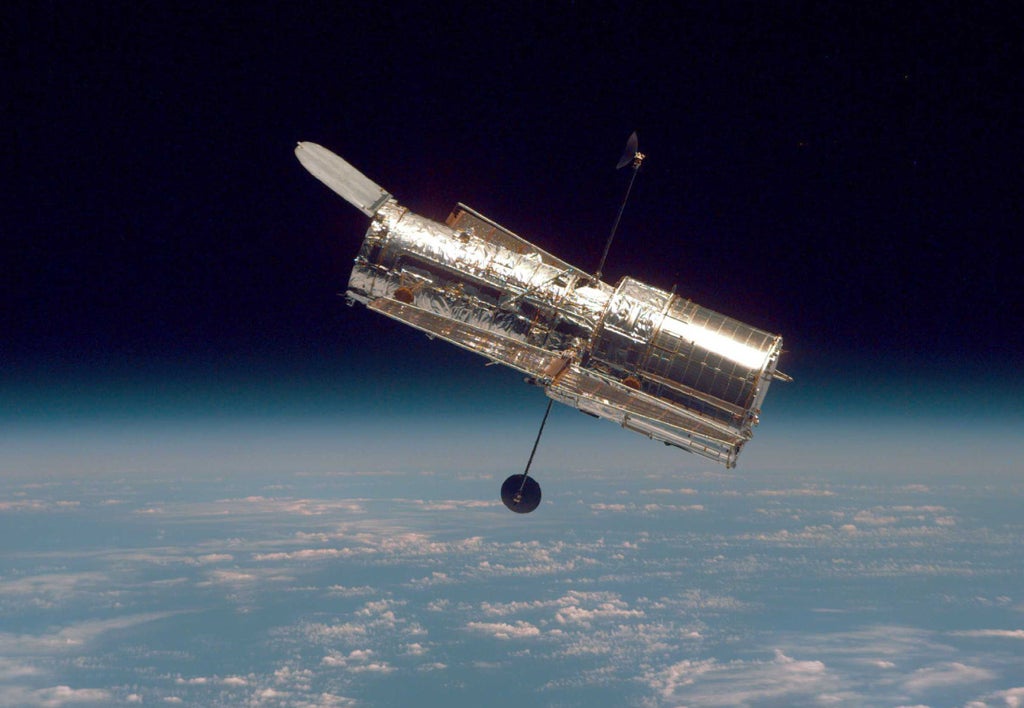
Nasa has identified the possible cause of the issue that stopped the Hubble Space Telescope from working.
The $4.7 billion telescope halted on 13 June, with a degrading memory module appearing to be the fault. The main computer stopped receiving the “keep-alive” signal, which is a standard ‘handshake’ (a way of establishing a connection) between the payload and the spacecraft’s main computers.
The main computer automatically put all instruments on the space telescope in safe mode. Nasa restarted the payload computer the following day in an attempt to resume normal operation, but the problem has persisted.
A series of multi-day tests, including attempts to restart and reconfigure the computer and the backup computer, failed – but Nasa gained vital information from those tests to identify the issue.
The possible cause of the glitch is in the satellite’s Power Control Unit (PCU), which sends a steady five volts of electricity the payload computer’s hardware and its memory.
A secondary protection circuit senses the voltage levels leaving the power regulator, and if this voltage falls below or exceeds allowable levels it will tell the payload computer to stop operations.
What appears to have happened, Nasa says, is that either the voltage level from the regulator is outside of these levels or the secondary protection circuit has degraded over time and is now stuck in this protective state.
Nasa will switch to the backup unit that contains the PCU on 15 July and, if successful, Hubble will return to normal operation a few days later. A similar switch was performed in 2008 after a Command Unit/Science Data Formatter (CU/SDF) module failed. A servicing mission one year later replaced the entire unit with the one currently in use.
Even when the Hubble Space Telescope returns to normal functionality, it may not be in operation for much longer, as it is set to be soon replaced by the James Webb Space Telescope. Nasa will be sending the new craft into orbit on 31 October aboard an Ariane 5 rocket, giving scientists the opportunity to look back 150 million to 1 billion years after time began – something that has been previously inaccessible to them with Hubble.