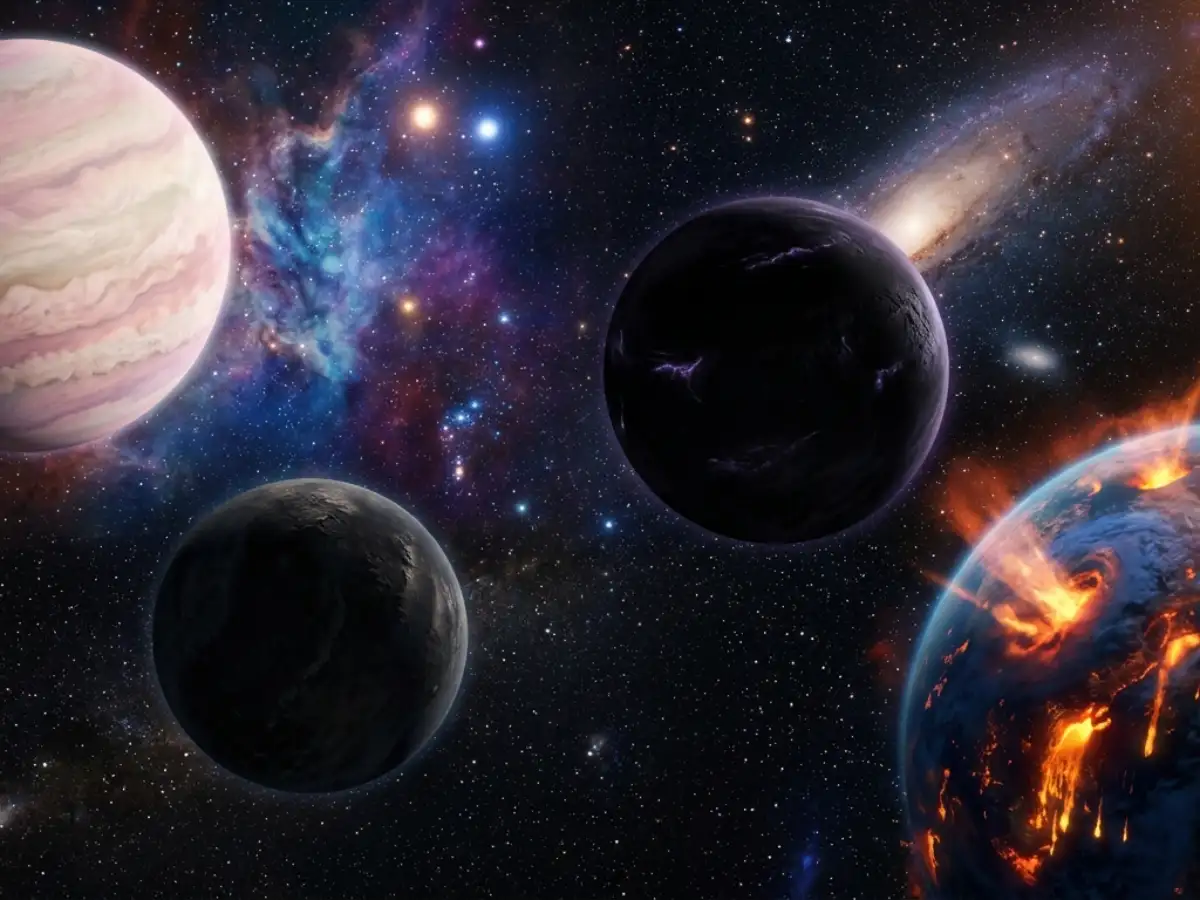
For a very long time, it was thought that the planets in our solar system represented the basic model of the universe. Rocky planets were found near the Sun, followed by gas giants further out from the Sun, frozen planets, and definite orbits. The whole concept has been turned upside down in the past three decades. From the Exoplanet Archive provided by NASA, it is known that there are thousands of planets in the Milky Way galaxy orbiting different stars outside our solar system. Some planets resemble those in our solar system, while others look like something out of fiction.
Recent developments in the design of modern telescopes, such as the Kepler Space Telescope, the James Webb Space Telescope, and the Hubble Space Telescope, indicate the discovery of planets having unique atmospheres, weird weather, weird shapes, and other features of existence contrary to the old concept of planet creation.
Astronomers have been able to discover planets with dark atmospheres where most of the light reaching them is absorbed; planets with rains composed of glass falling from the skies; planets whose appearance can be referred to as marshmallow due to low density compared to cork; and planets existing freely in space and not orbiting around any star.
All these are real planets discovered by astronomers, and have made NASA and the European Space Agency change their view about planet formation, atmosphere meaning under different circumstances, and the physical appearance of planets in the universe.
1. The “Marshmallow” Planet
The most recently identified exotic world is WASP-193b, which scientists affectionately call the "marshmallow planet." Specifically, in 2024, a group of astronomers presented their discovery in the renowned science journal Nature Astronomy, stating that the extraterrestrial object was unusually large in size but unusually light in substance. For example, although the planet was almost 50% larger than Jupiter, its mass was unusually small relative to its volume, making it among the puffiest objects ever detected in the universe.
As per calculations, the celestial body was so light that, theoretically, it could float in water if such a medium existed. According to scientists, the exceptionally hot environment surrounding the planet, resulting from its closeness to the sun, warmed the gaseous shell that expanded to a great extent, comprising hydrogen and helium gases scattered throughout the universe.
In other words, unlike common gas planets such as Jupiter, WASP-193b looked like an oddly bloated star enveloped in clouds that gradually faded into space at its edges. Furthermore, astronomers have yet to comprehend the existence of such planets, given that, under normal circumstances, it would be challenging to retain an atmosphere for extended periods.
2. The Planet That Is Literally Being Stretched Into a Lemon Shape
There are also some planets that are so close to their dense stellar remains that their shapes get warped due to strong gravity. WASP-103b is one of the famous planets that has been identified to suffer from this effect. Observations made by astronomers from data released by ESA showed that this planet, which is about 1,800 light-years away from Earth, orbits the star at such distances that its shape is being stretched into that of a lemon.
While our planet stays spherical in shape because gravity acts equally towards all sides, this particular planet has been suffering from gravitational effects only on its side that is closer to the star, resulting in a visibly elongated shape. It could be compared to a situation when the moon causes high tide on Earth, but in this case, the force is so strong that the entire planet warps due to this action. The heat that is produced on this planet is enormous, with the atmospheric temperatures exceeding 2,500 degrees Celsius and turning many materials into a gaseous state.
3. The “Rogue” Planet
Planets generally revolve around a star, but rogue planets are an exception. Rogue planets roam alone in interstellar space without a star that created them. As per the results of studies published in Nature Astronomy, according to astronomers, many rogue planets might have originated in planetary systems and then have been ejected out of them due to gravitational influences.
The absence of a nearby star means that these planets wander about through interstellar space in near darkness since there is no light from any star available. Some planets may also emit faint red colors due to residual heat generated when they formed billions of years ago. There might also be large rogue planets that could even have oceans below the surface covered in icy layers due to the warming effects of radioactive decay and internal planet heat.
Life on such planets would be unimaginable. You will experience darkness except for the distant twinkling lights from the stars and galaxies on the cosmic horizon. NASA scientists say there might be billions of rogue planets wandering in the Milky Way galaxy.
4. The Darkest Planet Ever Found
WASP-12b is one of the known dark planets. As revealed in a study in The Astrophysical Journal Letters, it is capable of absorbing about 94% of the visible light that hits its surface. This makes it darker than coal or even black acrylic paint. Generally, planets always reflect some light since they have clouds or aerosols in their atmospheres. However, in the case of WASP-12b, astronomers say that its atmosphere is too hot for clouds to form. Temperatures in the atmosphere are above 2,500°C, meaning that light gets absorbed deep into the atmosphere instead of being reflected.
The researchers have compared WASP-12b to a flying shadow in the cosmos. One can expect absolute darkness when they move within the atmosphere of the planet at thousands of miles per hour.
5. The Planet Where Molten Glass Rains Sideways
HD 189733 b could be one of the most deceptive planets that have ever been found. The exoplanet looks like a beautiful and very dark blue planet similar to Earth. As noted by NASA and Hubble, however, that blue color is not due to the presence of water. It is actually due to the presence of silicates contained in its extremely hostile atmosphere.
As scientists state, the temperatures at HD 189733 b can go beyond 1,000 degrees centigrade while the speed of the winds reaches 5,000 miles per hour. At such high temperatures and wind speeds, silicate molecules will condense into glass droplets that fall sideways under the strong winds. Scientists usually call this exoplanet one of the harshest planets ever found. Indeed, no spacecraft would survive for even just a moment when entering the atmosphere.
6. The Lava Planet That is Covered in Oceans of Molten Rock
Another remarkable world is 55 Cancri e, nicknamed the “lava planet.” As reported by NASA, this rocky super-Earth moves so fast around its sun that the temperature at the surface might reach as high as 2,000°C. There might be huge seas of molten lava covering the entire surface of the planet.
This planet makes one revolution around its sun in less than 18 hours; thus, one year here lasts less than a day on our planet. While one side is scorched all the time by the sun, the other remains cold. With the help of infrared observations, scientists discovered signs of volcanic eruptions and changing temperatures on the planet’s surface. Some astronomers suggest that volcanic lava on the planet might create crustal changes never witnessed elsewhere in our Solar System.
These Planets Are Changing Humanity’s View of Reality
This finding has caused astronomy to move away from being a study of familiar planets towards one of extremes. In pre-exoplanet times, it was common for scientists to assume that other solar systems were going to be quite similar to our own. Current discoveries prove that space is actually much weirder, more complicated, and more diverse than humans could ever have guessed.
The scientific community believes that upcoming telescopes may one day find ocean planets, rogue frozen Earth-like planets, or possibly atmospheres that contain biosignatures associated with life. But for now, all we need to know is that the strangest exoplanets discovered to date are enough to change how humans view the potential of our universe forever.