You may have heard the deep, sudden "boom" generated when an aircraft breaks the sound barrier. But most of us have never seen what it looks like from a fluid dynamics perspective — turns out, it's gorgeous.
Why it matters: NASA is in the process of developing and extensively testing a quiet supersonic aircraft that, if successful, could usher in a new era of domestic air travel.
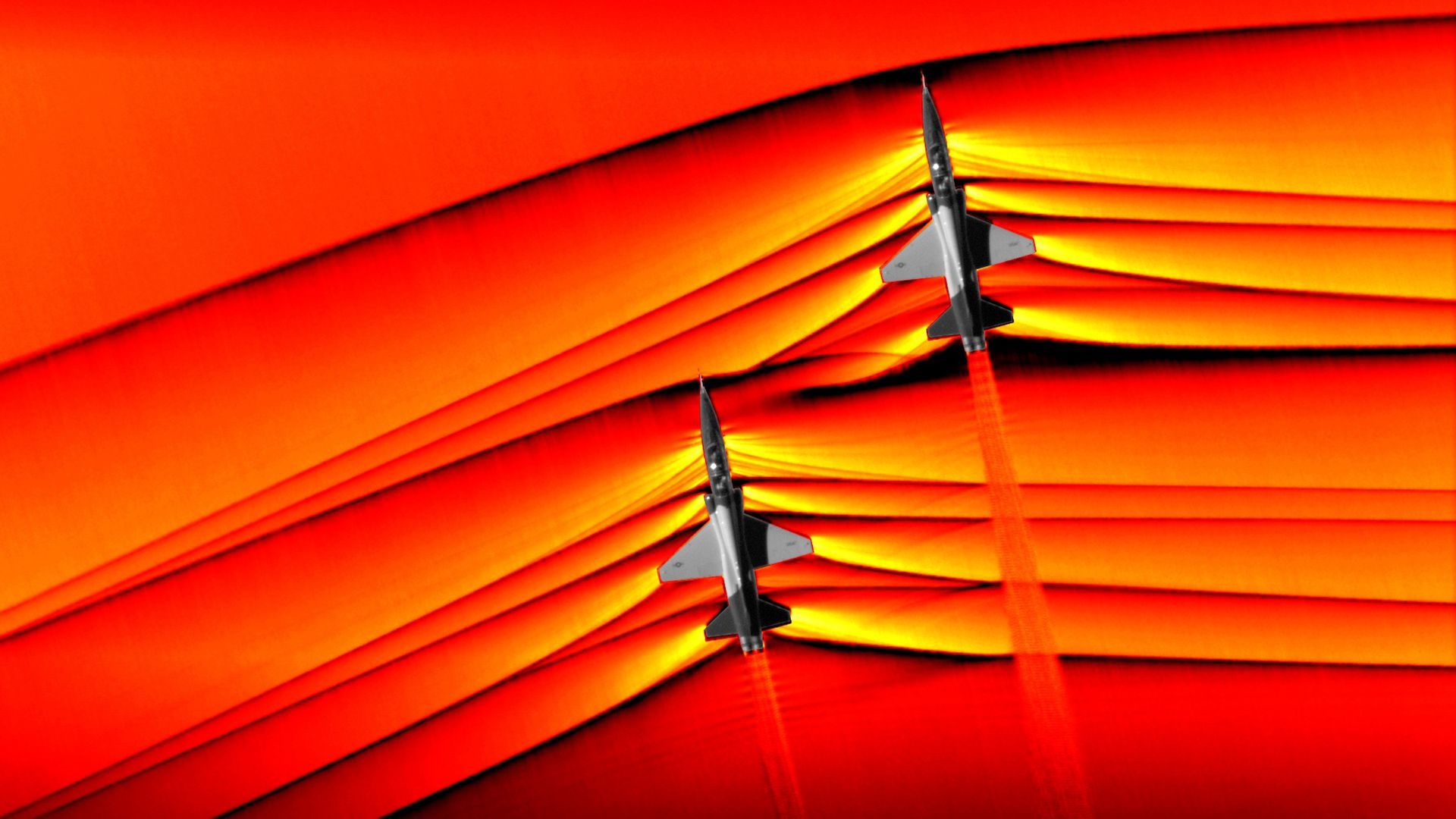
What they did: Recently, NASA tested an air-to-air photographic technology, known as the schlieren photography technique, to capture the first-ever images of how shockwaves from 2 supersonic aircraft interact in flight. This technique relies on how light rays are bent when they encounter changes in the density of a fluid.
- “We never dreamt that it would be this clear, this beautiful,” said physical scientist J.T. Heineck of NASA’s Ames Research Center in California, in a press release.
- Flying above the California desert, the test flights resulted in the successful demonstration of an imaging system that can capture high-quality images of shockwaves, which are rapid pressure changes produced when an aircraft flies supersonic. NASA is interested in sonic booms because it is trying to create designs for quieter supersonic aircraft.
Details: The images show a pair of T-38 training aircraft flying in formation at supersonic speeds. According to NASA, the T-38s in the photo were flying approximately 30 feet away from each other, with the trailing aircraft flying about 10 feet lower than the leading T-38.
What they're saying: “What’s interesting is, if you look at the rear T-38, you see these shocks kind of interact in a curve,” Neal Smith, a research engineer at NASA Ames’ fluid mechanics laboratory, said in the release.
- “This is because the trailing T-38 is flying in the wake of the leading aircraft, so the shocks are going to be shaped differently. This data is really going to help us advance our understanding of how these shocks interact.”