It's been five years since the megahit manga "Naruto" completed its run in the Shukan Shonen Jump weekly magazine. Following the series, which sold over 250 million copies worldwide, the author, Masashi Kishimoto, started a new series, "SAMURAI8 HACHIMARUDEN" (SAMURAI8: The Tale of Hachimaru) in the issue of the magazine that went on sale on May 13.
With "Naruto," Kishimoto enthralled readers all over the world with a fusion of ninja and manga, both part of Japanese pop culture. This time, he is trying to create a samurai boom.
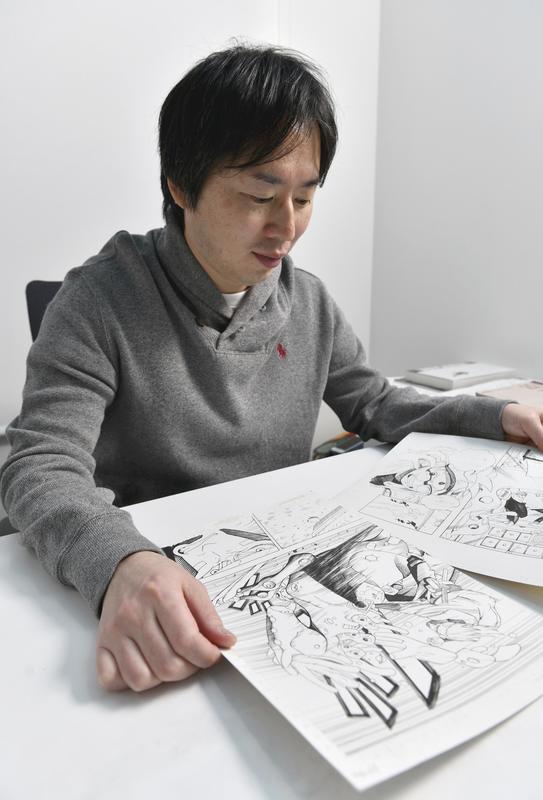
The new manga is drawn by Akira Okubo, a new face whose artistic skills have won Kishimoto's nod of approval.
Kishimoto was born in 1974. The Okayama Prefecture native won a prize in the newcomers' manga awards, run by Shukan Shonen Jump, published by Shueisha Inc., in 1996. He started drawing "Naruto" for the magazine in 1999 and became one of the recipients of the Minister of Education, Culture, Sports, Science and Technology's Art Encouragement Prize for New Artists for the work in 2015.
Wanting to be a samurai
The Yomiuri Shimbun: What went on in your mind when you finished drawing the final episode of "Naruto?"
Masashi Kishimoto: "Now I can finally breathe" is what I thought. I felt as if I was underwater all the time. I felt liberated and could breathe under the sky. For about two years, I would always be going out for a walk.
Q: What is the character Uzumaki Naruto to you?
A: Maybe he's like my child. He's also my partner or like a brother. Sometimes I feel like he is myself. There are also times when I objectively see him as manga merchandise. Recently, I read the first episode again and was impressed that it was surprisingly well constructed.
I have some regrets as well. I'm attached to all the characters, so I want to draw all of them carefully. Maybe at times I concentrated too much on side characters to the detriment of the lead. Jump magazine's then-editor took me to task, saying, "Readers want to see Naruto." I'd like to make the most of that advice in the new series.
Q: How do you feel about the global popularity of "Naruto"?
A: Maybe it's because everyone likes ninja. I hoped that the work, including the anime version, would be widely appreciated overseas. But it was beyond my imagination that it would be recognized this widely.
Q: The lead character of your new work is a boy who aspires to become a samurai.
A: At first, I was thinking of going into a completely different direction from "Naruto," but I then wondered if that is what readers would want. On reflection, I thought that it would be better with a setting that is easy for Japanese people to understand.
I do like samurai myself. When I was a child, I used to watch period shows on TV, such as "Hissatsu Shigotonin" (Deadly contractors) and "O-Edo Sosamo" (The big Edo investigation network), with my grandparents. A samurai expresses everything through his behavior. The image I have of samurai is that of men who stand firm in their loyalty and obligations, to the point of forcing themselves to put up with many things. Maybe I admire those masculine men because I am quick to put up the white feather.
Also, I like "Star Wars" and similar sci-fi films, so I decided to mix them all together. Sci-fi works are difficult because you have to explain many things to readers. But then I realized it's possible to make it more simple by bringing in samurai.
A work to encourage children
Q: Newcomer Akira Okubo is in charge of the drawing for "SAMURAI8." How do you divide your tasks?
A: As the author of the story, I draw up the storyboard, which includes compositions, dialogue and frame layouts.
I picked Okubo for the job because I really want to read this manga with his art. He has worked as my assistant for nine years. His drawings have warmth and a gentle quality. I will go as far as to say that I came up with this series to bring out his talent to the world. Okubo's drawings have already surpassed mine. I think I can also improve after being overtaken by those in the younger generation.
Q: Hachimaru, the lead character of "SAMURAI8," is in frail health, unlike Naruto, who is very fit.
A: When I was a child, I was thin and weak. I hear that there are many children with allergies these days, and I want such children to connect to the story, too. If the protagonist is a perfect person, I can't draw the character because it's difficult for me to feel for such a person. What gives me the greatest pleasure is when I draw a child fighting hard despite their inferiority complex.
Q: In "Naruto," you told stories about various types of family ties. The new work also depicts a strong bond between a father and his child.
A: That's because I want to draw my ideal parents and children. I was 24 when I started "Naruto." Now I'm 44 and a father. I can now understand the feelings of both children and parents. I write about what goes through the mind of Hachimaru by recalling what it was like in my childhood days.
Q: What do you want to get across to today's children?
A: I'm not thinking of pushing any big theme because that would be preachy. I want each reader to freely feel the work. But I have a feeling that it may be more difficult for children today to imagine a bright future than when I was a child. I hope that thanks to the work, I'll be able to give encouragement to children.
About 'Naruto'
The manga ran from September 1999 to November 2014 in the Shukan Shonen Jump weekly manga magazine published by Shueisha. Boy ninja Uzumaki Naruto, who lives in the village of Konohagakure, dreams of obtaining the village's top ninja title of Hokage, overcoming various challenges with Sasuke, Sakura and other friends. Out-of-this-world action scenes and dramatic interactions of characters with colorful personalities are the big attractions of the series. The manga passionately portrayed the power of friendship that prevails over fate in the end, thereby becoming one of the most notable manga works of the Heisei era (1989-2019).
Publication of the entire 72 volumes of "Naruto" surpassed 153 million copies in Japan alone. More than 97 million copies have been printed in over 46 countries and regions overseas. The manga has been adapted into a TV anime series, as well as kabuki and other theatrical productions. Its popularity continues to spread.
About 'SAMURAI8: The Tale of Hachimaru'
The story is set in an alternative world with an idiosyncratic machine civilization. The protagonist is a boy called Hachimaru, who is hooked up to a huge life-support system. He lives with his father and spends his days playing games. In the world he lives in, there are also human warriors and their superior beings, cyborg samurai. When Daruma, a cat-shaped samurai, appears in front of Hachimaru, the boy's fate starts undergoing a radical change.
Read more from The Japan News at https://japannews.yomiuri.co.jp/