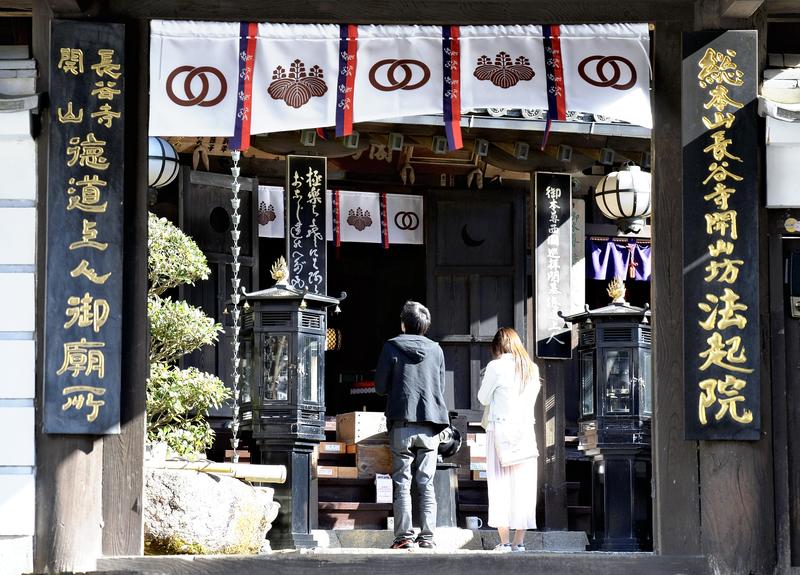
SAKURAI, Nara -- This year marks the 1,300th anniversary of the founding of Saikoku Sanjusansho, the oldest pilgrimage route in the nation.
The 33-temple route was established by the legendary Buddhist priest Tokudo (656-735), who founded 49 temples, including Hasedera temple in Sakurai, Nara Prefecture.
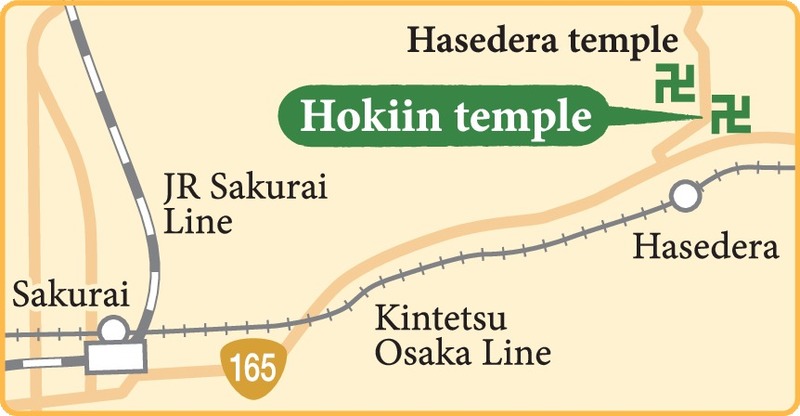
Hokiin temple, located in Sakurai near Hasedera, is an extra stop of sorts on the 33-temple route. Tokudo spent the later years of his life in seclusion and died at Hokiin.
Mountains surround the temple town build around Hasedera, with a river flowing through the town. Hokiin sits amid the tranquil atmosphere.
Tokudo is said to have founded the temple just before his death in 735 and enshrined his own seated statue there. He is thought to have created the statue, whose face captures his mild character.
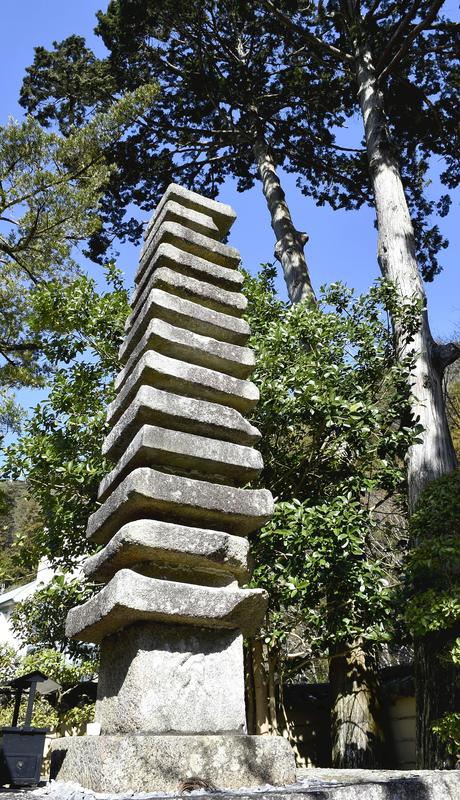
The priest's mausoleum, a 13-story stone pagoda, can also be found on the temple grounds. Legend has it that the location of the pagoda was the place where he passed away after climbing a pine tree to become a bodhisattva.
Born in present-day Taishi, Hyogo Prefecture, Tokudo is believed to have been from a clan of immigrants from the Asian mainland. He entered the Buddhist priesthood after losing his parents in his teens.
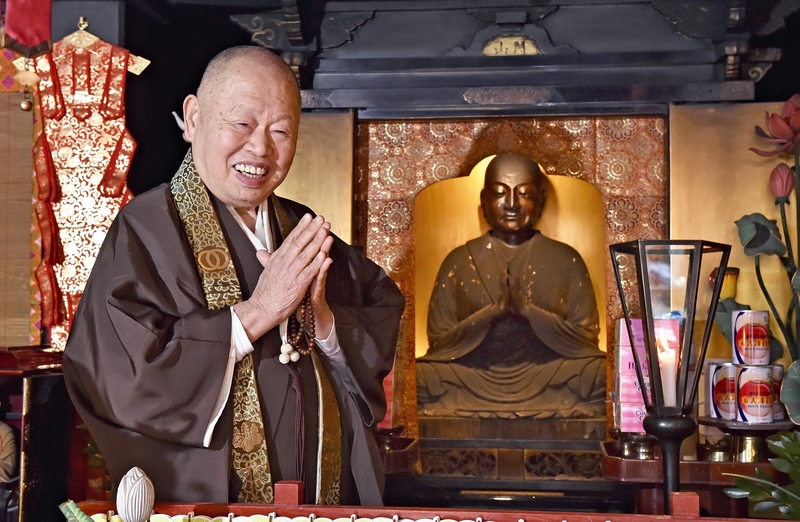
Shoken Kita, chief priest of Hokiin, said, "I think he was able to create a new faith based on pilgrimage, as he had contact with the continent's advanced culture, thereby developing the ability to see ahead."
In 718, Tokudo fell ill and hovered between life and death. At that time, it is said that Tokudo met Enma, judge of the afterlife, in a dream. In the dream, he received an oracle instructing him to preach the 33-temple pilgrimage. He is then said to have recovered from a state of apparent death.
The new faith, however, was not well received and gradually died out. About 270 years later, the retired Emperor Kazan (968-1008), who entered the Buddhist priesthood, revived the faith, which consequently became popular among commoners during the Edo period (1603-1867).
Hokiin's main building was rebuilt in 1695. "As this temple is small, we feel very close to visitors. Whenever I have even just a moment, I tell them about the meaning of the pilgrimage and how to enjoy it," Kita said.
To commemorate the 1,300th anniversary of the Saikoku pilgrimage, priests from the 33 temples will gather for a grand Buddhist memorial service at Hasedera temple on April 15.
"The memorial service will be held to remember Tokudo's great virtues. I hope it will be a great opportunity for visitors to connect with the Kannon bodhisattva," said Hasedera temple priest Shoryu Ito.
--Access
Hokiin temple is about 10 minutes on foot from Kintetsu Hasedera Station. The temple is open to visitors free of charge from 8:30 a.m. to 5 p.m. Hasedera temple is about a three-minute walk from Hokiin. For Hokiin: (0744) 47 8032. For Hasedera: (0744) 47-7001.
To find out more about Japan's attractions, visit http://the-japan-news.com/news/d&d
Read more from The Japan News at https://japannews.yomiuri.co.jp/