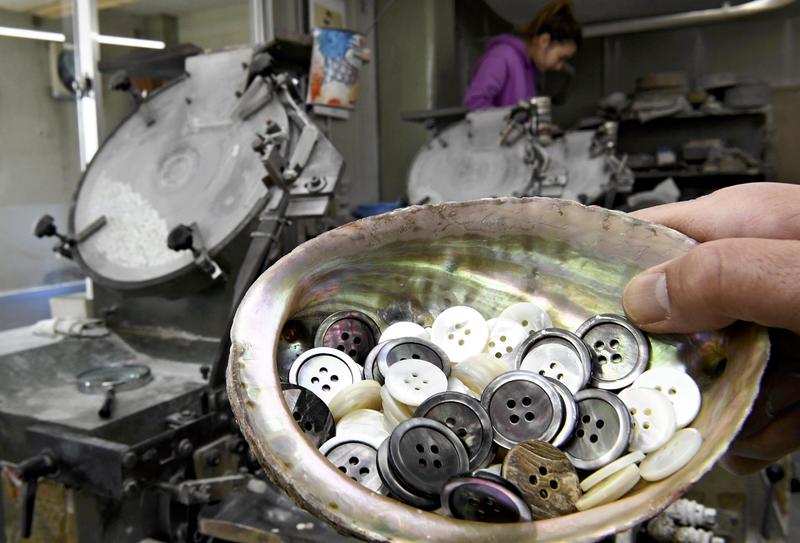
KAWANISHI, Nara -- Gold-lip oyster shells shine in rainbow colors, black-lip oyster shells have a noble air, and Takase shells exude a pure whiteness.
The town of Kawanishi, Nara Prefecture, is Japan's largest production area of shell buttons, which are made by processing these shells. Shell buttons are beautiful and shimmer as if they are reflecting the waves of the sea. Why are such beautiful shell buttons produced in landlocked Nara Prefecture? I visited the town to find out.
Factory near rice paddies
Kawanishi is located in the middle of the Yamato Plain and agriculture is the town's main industry. A plant of the shell button manufacturer Tomoi is located near rice paddy fields. Inside the plant, various machines are lined up and shell buttons are produced one after another. "We make 1.2 million shell buttons here a month," said Tomoi President Hiroshi Tomoi, 58. Founded in 1914, the company is the largest maker of shell buttons in Japan.
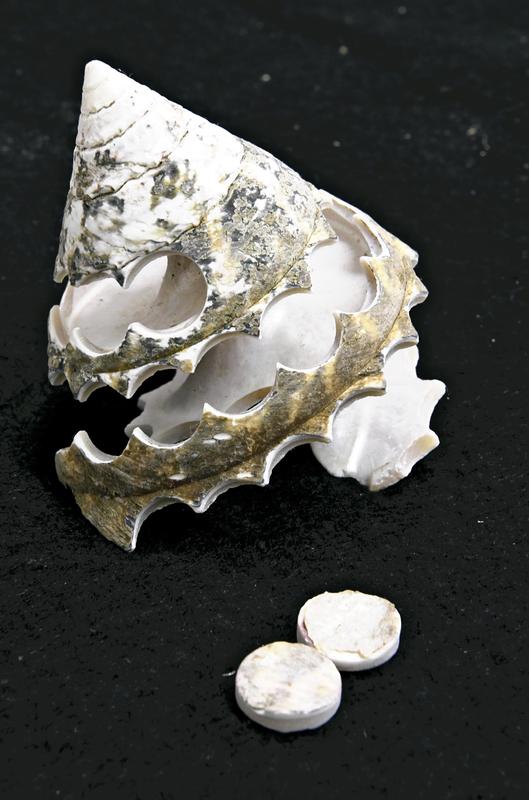
Each button is 8 to 40 millimeters in diameter and 1.5 to 5 millimeters in thickness. The company uses about 10 kinds of shells as raw materials and imports shells cut into the shape of a button from countries near the equator such as Papua New Guinea. At the plant, the button-shaped shells are sharpened on a whetstone into a uniform thickness and holes are punched. A lazer is used to carve letters into them.
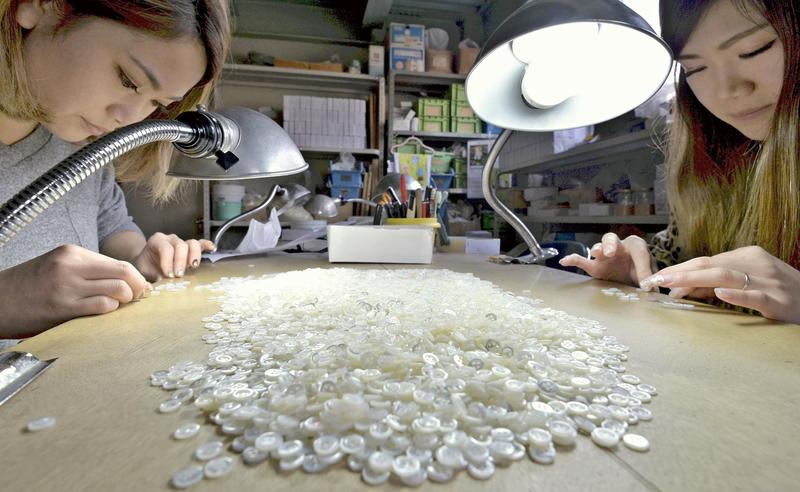
Most of the operations are mechanized. Even so, young craftspeople carefully inspect each button under fluorescent lighting to do delicate work, such as quality-checking the front and back sides and selecting first-class and second-class products.
Buttons as off-season work
Tomoi is the third president of the company. He learned advanced manufacturing techniques in Italy, which is famous for shell buttons, and introduced these techniques into his company's plant. "We are equal to Italy in terms of careful work," Tomoi proudly said.
According to Kiyonori Yoshioka, 52, the secretary general of the town's chamber of commerce and industry, shell buttons produced in Kawanishi dominate the domestic market and are the town's established specialty. Shell buttons started to be produced in the town in the late Meiji era (1868-1912). It is said that techniques introduced by a German engineer in Kobe were brought into the town and became widespread as work to do during the agricultural off-season.
But still, why did the industry take root in this town? The Yamato River and other rivers run through the town, and Kawanishi once thrived on maritime shipping. So, it is said that the town was suitable for transporting shells used as raw materials for shell buttons from Osaka. In addition, Yoshioka said, "The earnest nature of the town residents might have been a good fit for the production of small shell buttons, which requires diligent and patient work."
From the mid-1950s to the mid-1960s, when production was at its peak, about 300 households were involved in shell button production. However, shell buttons lost ground to cheaper polyester buttons and the number of companies producing shell buttons decreased to about 20, including microbusinesses.
In 2014, seven businesses including Tomoi established the Kawanishi Button Club within the town's chamber of commerce and industry. It sells the town's shell buttons on the internet to consumers, who place small orders.
Small size, big presence
Shell buttons produced in Kawanishi are of high quality and have been sold in Italy in recent years. In Japan, they are popular among those who treasure authenticity-oriented shell buttons.
Clothing manufacturer Maker's Shirt Kamakura based in Kamakura, Kanagawa Prefecture, uses the town's shell buttons for about 60% of its products. They are relatively expensive compared to those produced in China, but the sizes and hole placements are uniform, so they make for more beautiful finished products.
Takahiro Sano, 41, the director of a company affiliated with Maker's Shirt Kamakura that manufactures the brand's products, said: "Shell buttons are similar to accessories. The more basic the product is, the more important the raw material's quality becomes."
During my visit to the town, I remembered my mother's words, "Changing buttons will change the impression of the clothing." They are small in size but have a big presence. I now understand that this is because craftspeople put their techniques and skills into the buttons.
-- How to get there
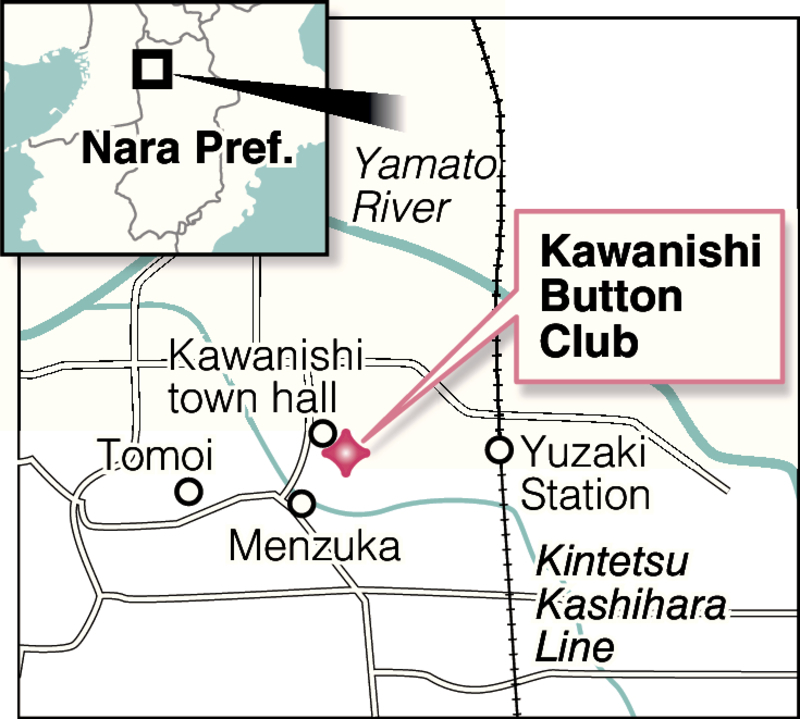
It is about a 15-minute walk from Kintetsu Yuzaki Station. The Kawanishi Button Club also sells irregular shaped buttons and parts without holes online. For more information, call the Kawanishi chamber of commerce and industry at (0745) 44-0480.
-- Extend your trip!
Stone monuments
Noh's kanze-ryu school has its roots in a traditional Japanese performing art Sarugaku. A Sarugaku troupe, Yuzaki-za, was based in the Yuzaki district of Kawanishi in the Muromachi period (1336-1573) and Kanami, a star actor of the troupe, is said to have lived in Yuzaki. Subsequently, the troupe changed its name to Kanze-za, and Kanami and his son Zeami are said to have established the foundation of noh.
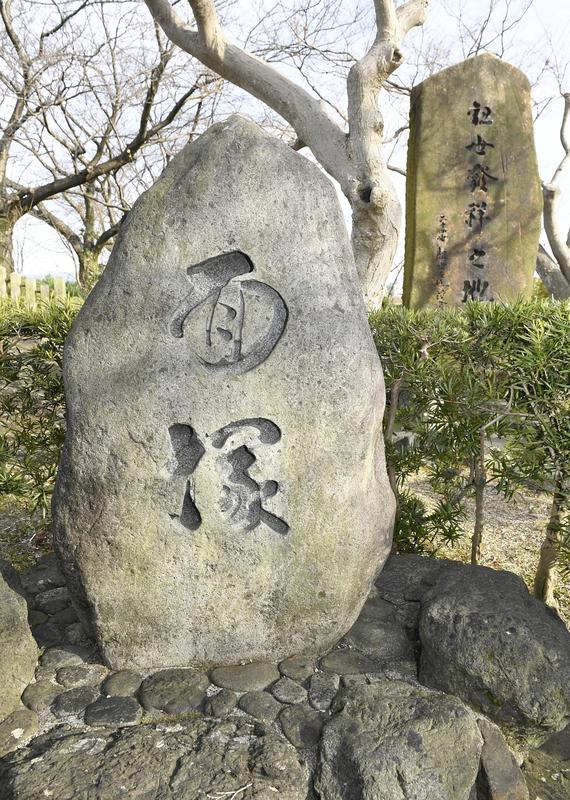
In the town, folklore exists about an Okina (elderly man) noh mask that fell from the sky. In 1936, stone monuments engraved with "Menzuka (the mound of mask)" and "Kanze Hassho no Chi (the birthplace of Kanze)" were built. They were relocated to their current site in 1967.
Read more from The Japan News at https://japannews.yomiuri.co.jp/