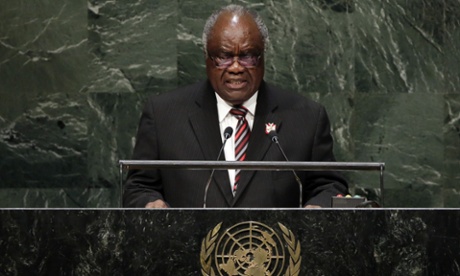
Namibia’s president, Hifikepunye Pohamba, has won the $5m (£3.2m) African leadership prize awarded by the Mo Ibrahim Foundation for boosting governance, media freedom and human rights in the southern African country.
Pohamba, 79, was a founding member of Namibia’s ruling party, South West Africa People’s Organisation (Swapo), and was held as a political prisoner during South Africa’s colonial rule over the country. He was whipped in public for advocating for an independent Namibia.
Pohamba’s win is the first time the prize has been awarded since 2011, when it was given to Cape Verde’s former president Pedro Verona Pires. The honour is the world’s most valuable individual prize, gifting the winner $5m over 10 years and $200,000 a year for life.
“President Pohamba’s focus in forging national cohesion and reconciliation at a key stage of Namibia’s consolidation of democracy and social and economic development impressed the prize committee,” said Salim Ahmed Salim, Tanzania’s former prime minister and chairman of the prize committee, which announced the winner at a ceremony in Nairobi, Kenya.
Pohamba was elected in 2004 and reelected in 2009. He is the first acting president to win the prize, but he has said he will hand power to prime minister Hage Geingob, who won November’s presidential election, later this month.
Salim said: “During the decade of Hifikepunye Pohamba’s presidency, Namibia’s reputation has been cemented as a well-governed, stable and inclusive democracy with strong media freedom and respect for human rights.”
Pohamba was praised for overseeing strong economic growth with gross domestic product per capita rising from $3,297 in 2004 to $5,693 in 2013, according to the World Bank.
Under Pohamba’s leadership, Swapo has been applauded for making strides in gender equality, with 25 of 72 parliamentary seats filled by women. The party has also been commended for improving national health services and increasing Namibia’s life expectancy from 55 in 2004 to 64 in 2012.
The Mo Ibrahim Foundation, which publishes an annual assessment of governance in every African country known as the Ibrahim Index of African Governance (IIAG), credited Pohamba with Namibia’s standing at sixth-best in the continent.
The index ranks African countries according to their progress in promoting legal systems, protecting human rights and engendering economic and human development.
Since the prize was founded in 2007, just four winners have been named. These include Botswana’s former president, Festus Gontebanye Mogae, who won in 2008, and Mozambique’s former president Joaquim Alberto Chissano, who was awarded the prize in 2007. Nelson Mandela was given an honorary prize in 2007.
Mo Ibrahim, who made his $1.1bn fortune in the telecoms sector, spoke highly of Pires’ modesty and commitment to Cape Verde’s development. “When he lost the election, he called a taxi because he has no car. And he went to live with his mother because he has no apartment. Look at him and you see a very modest man. I’ve been to his house and I know how they live.”
Ibrahim said Pohamba “introduced democracy” to Namibia, and he praised him for his strong economic leadership. “He [Pohamba] took this country, which has no resources, out of the low-income country list.”
“He has served his country since its independence and his leadership has renewed his people’s trust in democracy. His legacy is that of strengthened institutions through the various initiatives introduced during his tenure in office. He is a role model for the continent.”
• This article was amended on 2 March 2015 to clarify that in the quote below, Ibrahim was referring to the former Cape Verde president Pedro Verona Pires, not Pohamba: “When he lost the election, he called a taxi because he has no car. And he went to live with his mother because he has no apartment. Look at him and you see a very modest man. I’ve been to his house and I know how they live.”