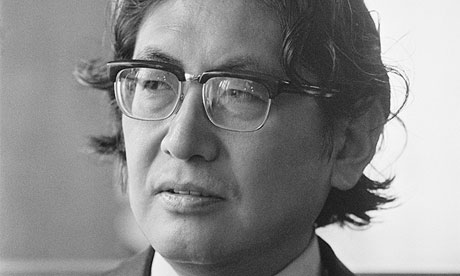
The last time the director Nagisa Oshima came into my head was while watching Bobcat Goldthwait's World's Greatest Dad. A teenage boy kills himself in a failed auto-erotic strangling experiment and his father (Robin Williams), a failed writer, disguises it as a heart-wrenching suicide and writes a sucrose bestselling "memoir" of his tragic son.
Without Oshima's sensational 1976 masterpiece Ai No Corrida – known to English-speaking audiences as In the Realm of the Senses – none of that could exist. Western audiences were stunned at the film's dark and fanatical intensity, its violence, its fusion of eros and thanatos, and of course its erotic choking scenes, that black mass of ritualised sexuality with which a woman kills her lover. Many of the most worldly critics had no idea about this sexual practice, and though there are recorded fatalities in Britain before the release of Ai No Corrida, Oshima may well have the distinction of popularised auto-erotic strangling in the west.
Oshima deserves to be known for more than In the Realm of the Senses, but this magnificently uncompromising film itself deserves to be known for more than sexual controversy. Based on a real-life scandal from 1930s Japan, it is about passion, submission: a renunciation of the self that co-exists with a vocation for sensuality and self-immolating pleasure. Eiko Matsuda plays Sada, a serving girl who comes to work for an innkeeper, Kichi (Tatsuya Fuji); he seduces her; she becomes infatuated with him and they are soon insatiably obsessed with each other's bodies. There is no backstory; they do not get to "know each other" in any conventional sense; they don't break up and make up. Their sexual passion simply escalates into a bloody destruction that defies mortality, ageing and the slow, dull retreat of sex. To 21st-century audiences who are used to everything being notionally "sexy" — from cars to smartphones – while movies are evasive about the actual business of sex, this is still a powerfully subversive drama about pleasure and the present moment.
Perhaps it is appropriate that another of his mostly highly regarded films was Death By Hanging (1968), a sharply satirical and political movie – again, based on a real-life case – about a young Korean who is executed for rape and murder. The legal establishment is horrified when the hanging is bungled and the man is still alive, and flashbacks sketch in the involvement of various participants and the investment they have made in this execution.
The sensational return of David Bowie to the world's stage is another reminder of a film that became one of Oshima's most successful, commercially: Merry Christmas Mr Lawrence, from 1983, a drama replete with pain, guilt and eroticism, starring Bowie as a British wartime prisoner. Audiences and critics were and are divided about Bowie's acting talents, but his presence and charisma are unarguable.
Another startling and Buñuelesque satire was Max Mon Amour (1986) in which Charlotte Rampling's cool female character, a diplomat's wife, has an "affair" with a chimpanzee she has installed in a flat, and her husband insists on coming to terms with her love and absorbing the animal into an open marriage à trois.
Oshima was a brilliant satirist, provocateur and poet of the senses whose movies were elegant, angular weapons against stifling hypocrisy and confirmity.