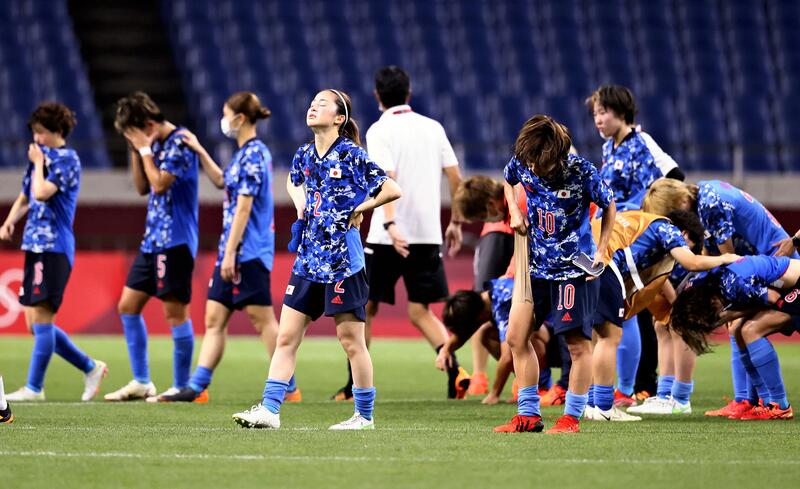
Japan's once-world beating national women's soccer team, popularly known as Nadeshiko Japan, will not be taking a medal from the Tokyo Olympics back to their homes.
Magdalena Eriksson, Stina Blackstenius and Kosovare Asllani scored and Sweden knocked the host country out of the tournament with a 3-1 victory in the quarterfinals on Friday night at Saitama Stadium.
Japan, which won a silver medal at the 2012 London Olympics but did not even qualify for Rio in 2016, got a first-half goal from forward Mina Tanaka.
"Right now, we're just a top-eight team," said Mana Iwabuchi, who covered her face with her hands after the final whistle.
Sweden will face Australia, a 4-3 winner in extra time over Britain, on Monday in Yokohama for a place in the final. The other semifinal will pit the United States against Canada after both teams advanced on penalty shootouts.
For the current version of Nadeshiko Japan, ranked 10th in the world, the quest for Olympic glory on home soil came to an abrupt end with the loss to the No. 5 Swedes.
As had been their habit in the tournament, the Japanese conceded an early goal as Moeka Minami was beaten on a 7th-minute cross and Eriksson scored. Still, the Japanese held their own against the tough Swedes, and got the equalizer in the 23rd minute when Tanaka netted Yui Hasegawa's well-placed cross for her second goal of the tournament.
After that, Iwabuchi and Hasegawa helped create chances by finding spaces and launching passes, but in the second half, it was Japan that conceded a pair of goals. Blackstenius got behind defender Risa Shimizu and scored the go-ahead goal in the 53rd minute, then Asllani converted a penalty 15 minutes later after a handball by Narumi Miura.
Japan was overwhelmed by its opponent's power and speed at key points. "We're just not good enough," Hasegawa said.
When coach Asako Takakura took over the team in 2016, she declared, "We want to play soccer that leads the world."
Takakura had been coach of the national U-17 team, and watched the growth of Hasegawa and Shimizu into key players on the senior team as it went through a generational change.
Takakura instituted training camps aimed at making the team more physical, but at the 2019 Women's World Cup, Nadeshiko was eliminated in the round of 16.
Facing the opponent's athleticism and pressure, Japan failed to make use of its main strength of passwork.
Japan won the World Cup for the first and only time in July 2011. "We should think again about what we need to do to beat the world," said Saki Kumagai, who netted the decisive penalty in the shootout of the 2011 final.
Read more from The Japan News at https://japannews.yomiuri.co.jp/