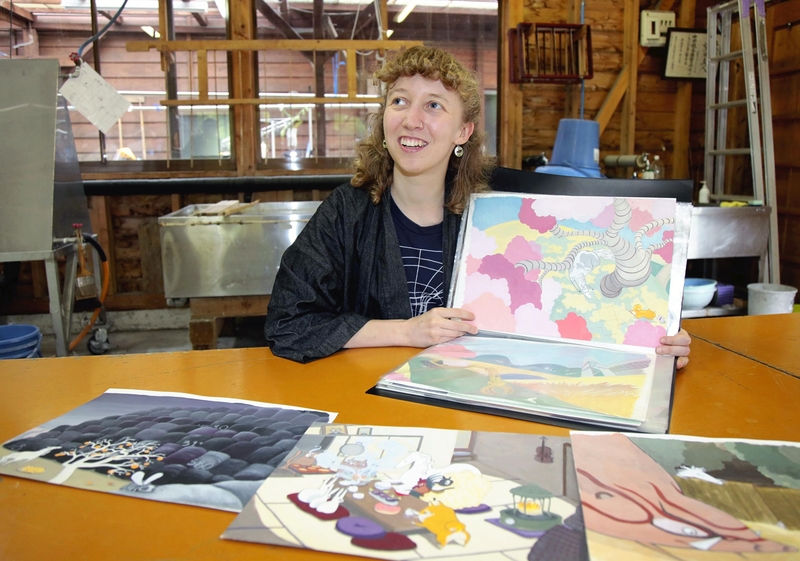
A woman from New Zealand working to help revitalize Fukushima, which was devastated by the Great East Japan Earthquake, is producing a picture book depicting the prefecture's recovery from the earthquake and the nuclear power plant accident. The book was made using Tono Washi, a traditional Japanese paper whose handicraft technique has been handed down in the Tono region in Iwaki, Fukushima Prefecture.
Sylvia Gallagher, 26, has liked Japanese animation since childhood and started studying Japanese on her own when she was a high school student. She came to Japan in 2017 and worked as an Assistant Language Teacher (ALT) in Iwaki before becoming a Local Vitalizing Cooperator -- a position commissioned by local governments for persons to settle in rural areas for one to three years to support regional revitalization -- of Iwaki last autumn. "I want to show the world how people here are regaining their daily lives," she said.
As a Local Vitalizing Cooperator, Gallagher was assigned the task of assisting with passing down the tradition of Tono Washi, which has a history of more than 400 years, to future generations.
The last craftsman to make the paper died six years ago. And in order to protect the papermaking skill, which is on the verge of disappearing, she works on organizing events to let participants experience papermaking, in addition to making school diplomas and business cards using the traditional paper.
Her attraction to washi came from a facination with its beauty. "It has a handmade warmth, and above all, it looks beautiful," she thought.
Gallagher was in New Zealand when the accident at Tokyo Electric Power Company Holdings, Inc.'s Fukushima No.1 nuclear power plant occurred. After that, she felt that the name "Fukushima" was the only thing people knew and that the reality of reconstruction was hard to come across. When she was an ALT, she used her days off to volunteer to mow grass in the gardens at private houses along the coast where evacuation orders had been issued. Seeing these places already returning to normal, she came up with the idea of disseminating the current situation of Fukushima to foreign countries by drawing pictures, which is her special skill. Two of her British friends who were also ALTs helped her.
The title of the 26-page picture book is "F Is for Fukushima," which tells the story of a horse and a dog who had been forced to evacuate from their hometown and returned there to lead a normal life with their friends. Gallagher drew all the pictures based on the sceneries she saw in the disaster-hit area. The picture book includes not only the bright side of reconstruction but also scenes of the difficilt-to-return zones where houses are surrounded by barricades and there are no signs of people.
The picture book was completed last December. Gallagher is now looking for a publisher to publish her work. The text of the picture book is written in both English and Japanese so that it can be used for language study.
"I want to convey the tradition and the atmosphere of Iwaki and let people know that there are many residents who are recovering their lives in Fukushima Prefecture," Gallagher said.
Read more from The Japan News at https://japannews.yomiuri.co.jp/