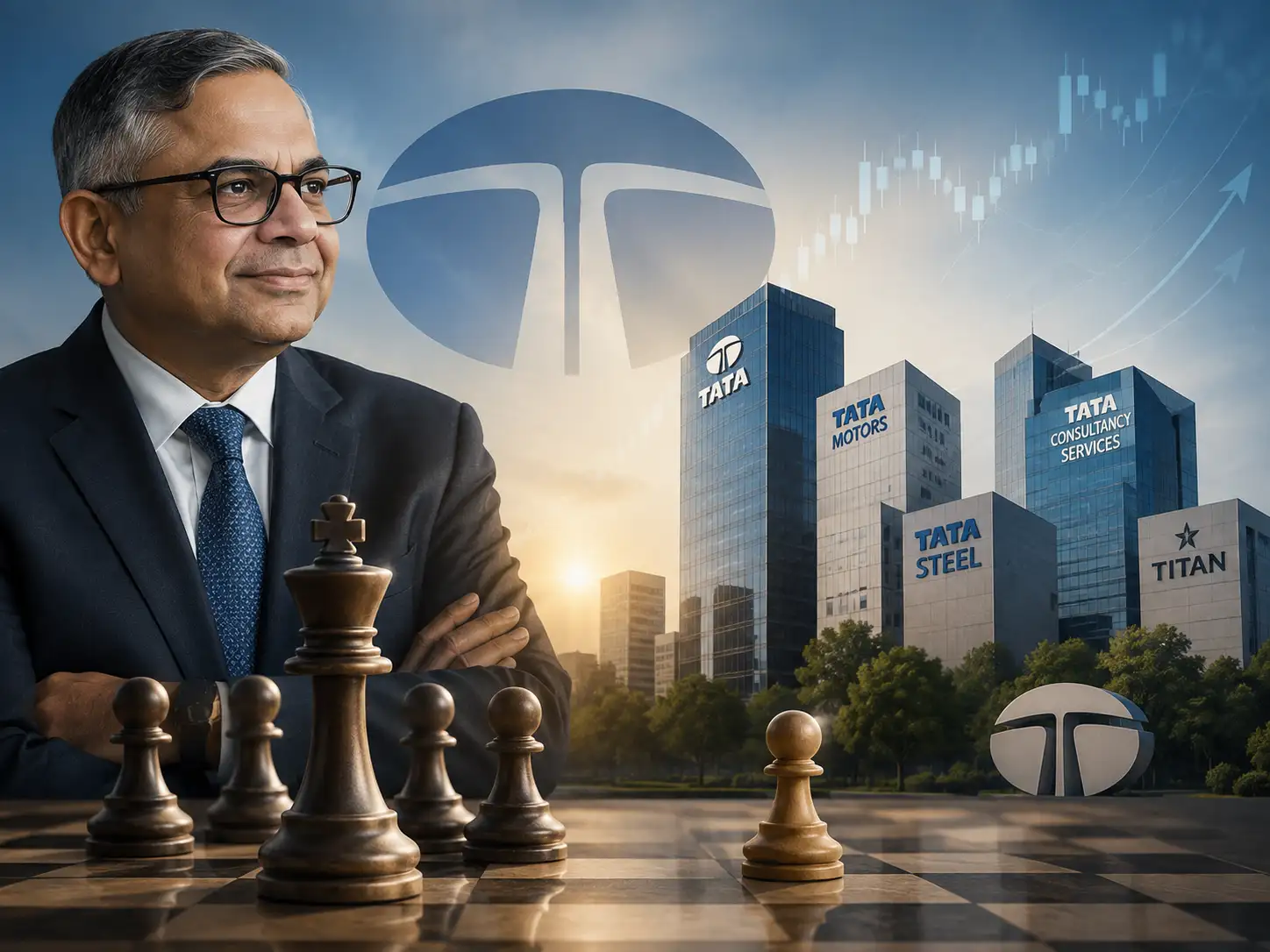
N. Chandrasekaran’s coming exit has put a 3.3-fold stock market wealth creation run at Tata Group into a sudden succession test, forcing investors to assess whether the conglomerate’s listed companies can sustain their gains amid mounting pressure at some of its largest businesses.
The combined market value of Tata Group companies has climbed 3.3-fold since Chandrasekaran took charge of Tata Sons on Feb. 21, 2017, and now stands at about Rs 22.5 lakh crore. Some of the biggest advances over that period include gains of about 1,700% in Trent, 1,140% in NELCO, 1,060% in Tata Investment Corp., 1,020% in Titan Co. and 670% in Tata Consumer Products.
The market’s initial verdict on the leadership uncertainty was swift. Tata Consultancy Services slid 5.3% on Wednesday, making India’s largest IT services exporter the biggest loser on the Nifty 50. Tata Motors Passenger Vehicles Ltd. fell 3.3%, while Titan and Tata Steel dropped more than 2% each, adding pressure on Indian equity benchmarks.
“For a systemically important group it is very important to provide clear guidance on the succession planning,” said Abhay Agarwal, founder at Piper Serica Advisors Pvt., adding that stocks will remain weak till the uncertainty is removed. “Not only that, lenders and senior management at the Group companies will also be anxious to know,” he was quoted as saying by Bloomberg.
Also Read | TCS, other Tata stocks fall as N Chandrasekaran resigns
Chandrasekaran, 63, said he won’t seek reappointment when his term ends in February because he lacks the backing of the Tata Sons board. The decision followed months of tension with Tata Trusts, the charity arm that owns 66% of the holding company.
“Tata Sons is a very large institution and there are many strategic projects that are under critical stages of execution ... clarity on leadership is important for employees, investors, partners and other stakeholders,” Chandrasekaran said.
A High Bar for the Successor
The scale of the value creation during Chandrasekaran’s tenure sets a demanding benchmark. Tata Group revenue rose from Rs 6 lakh crore in FY17 to Rs 16.24 lakh crore in FY26, while profit increased from \Rs 34,909 crore to Rs 1.7 lakh crore.
The conglomerate’s companies generated combined revenue of $185 billion in the past financial year. Its 26 publicly traded businesses had a total market capitalisation of $277 billion as of March 31.
“He steered the group to strong profits, particularly at its listed companies, though challenges remained in some of the unlisted businesses,” said Deven Choksey, managing director at DRChoksey FinServ. “His successor may face a tougher environment, with an increasingly assertive trustee board.”
Also Read | N Chandrasekaran: From TCS trainee to Tata titan, the Ratan Tata pick signs off
The record across Tata stocks, however, has already become more uneven. TCS has dropped 26.55% in 2026, and Tata Motors is down 8.5%. Tata Steel has gained 2.6%, while Titan is up 23.7%. That divergence leaves investors facing a collection of company-specific risks rather than a single Tata Group trade.
Over the past year, the conglomerate has grappled with regulatory scrutiny of Air India after a fatal crash, pricing pressure at TCS and a cyberattack at JLR that disrupted production and weighed on Britain’s economic output.
Those operational challenges now overlap with a dispute at the top of the group. Chandrasekaran and Tata Trusts have disagreed over a potential listing of Tata Sons, losses at Air India, the planned exit of a minority shareholder and board representation.
Tata Sons postponed a decision on Chandrasekaran’s reappointment in February after Noel Tata, chairman of Tata Trusts, opposed the move. “It has been 6 months since that board meeting, and no resolution has been reached till date,” Chandrasekaran said in his statement. He plans to remain chairman until his term expires in February.
The standoff echoes an earlier upheaval at the 158-year-old conglomerate. In 2016, the Tata Sons board ousted then chairman Cyrus Mistry after he fell out with group patriarch and Tata Trusts head Ratan Tata over corporate-governance issues. Chandrasekaran took charge the following year.
Market veteran Ambareesh Baliga expects the current selloff to prove temporary. “It’s a knee-jerk reaction as Chandra has been at the helm for a long time, however, once the new chairperson is announced, it would be back to business as usual,” he said.
“We have witnessed such uncertain periods for Tata Group, when Ratan Tata had taken over in early 1990s and more recently during the Cyrus Mistry imbroglio, but it has always managed to steer through. So this time it shouldn’t be any different.”
Stock-Specific Tests
The charts indicate that investors may have to navigate the leadership transition one stock at a time, according to Mayank Jain, market analyst at Share.Market by PhonePe.
TCS remains in a prolonged secondary downtrend after falling from levels above Rs 4,400. The stock is attempting to build a short-term base around the Rs 2,000-to- Rs 2,300 support zone. The Rs 2,670-to- Rs 2,700 range, near its 200-day simple moving average, is the first major resistance, while a sustained close above Rs 3,000-to- Rs 3,180 would be needed to indicate a structural trend reversal.
Tata Motors has formed a higher-low structure after rebounding from a Rs 360 base, with immediate support around Rs 400-to-Rs 410 and resistance at Rs 500-to-Rs 520. Tata Motors Passenger Vehicles remains in an extended downtrend and is testing support at Rs 320-to-Rs 335. A break below Rs 320 would extend its pattern of lower lows, while resistance sits near Rs 357 and then Rs 390-to-Rs 400.
Tata Elxsi has staged a modest recovery after finding demand around Rs 3,400-to-Rs 3,500, but faces immediate resistance near Rs 3,820 and a more significant long-term hurdle around its 200-day moving average at Rs 4,600.
The near-term test for Tata stocks is therefore twofold: whether the group can quickly remove the leadership overhang and whether its individual companies can navigate their distinct operating and market pressures. Until there is clarity on the successor, the 3.3-fold expansion in market value under Chandrasekaran will remain both the measure of his tenure and the hurdle confronting whoever follows him.
(Disclaimer: Recommendations, suggestions, views and opinions given by the experts are their own. These do not represent the views of Economic Times)