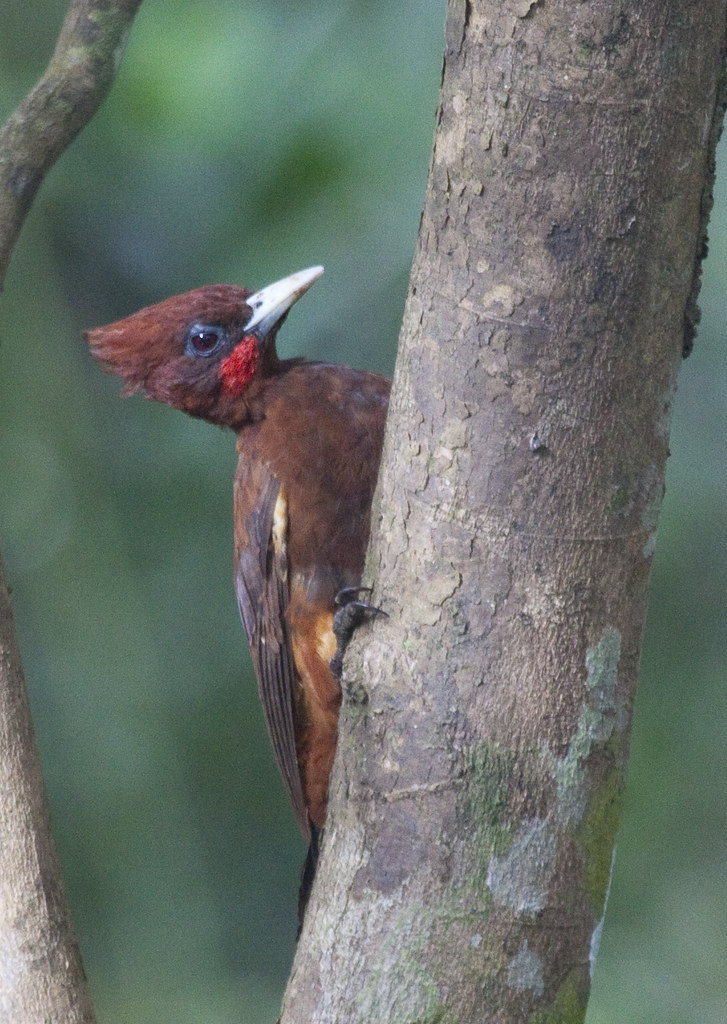
Chestnut woodpecker, Celeus elegans jumana (protonym, Picus elegans), also known as the elegant woodpecker, as the rufous-crested woodpecker or, in Brasilian Portuguese, as the Pica-pau-chocolate. Other subspecies are known alternately as the russet-crested woodpecker, the pale-crowned crested woodpecker or as the yellow-crested woodpecker, photographed on the south bank of the Rio Negro, about 35km upstream from Manaus, Amazonas, in the República Federativa do Brasil.
Image: Dave Rintoul, 21 May 2011 [velociraptorize].
Canon EOS 5D Mark II, ISO: 1600, 400mm, 5.6, 1/250 sec
Question: This beautiful Brasilian mystery bird species has several characters that adapt it well to its special arboreal life style. What are those characters? Can you name this species?
Response: This is a subspecies of chestnut woodpecker, Celeus elegans jumana, which is the only subspecies of this chocolate-brown woodpecker that lacks a cream-coloured crest and forehead and lacks black barring on its back and chest feathers.
I was a little disappointed that no one mentioned any of the special features that woodpeckers possess that adapt them extremely well to their special niche: living and feeding on the trunks of trees. So here's a list of some of these characters:
Woodpeckers have stiffened tails that they use as a prop whilst drilling holes into tree bark. They have very long and sticky tongues that they use as probes to get at the hidden larvae and eggs of insects.
Woodpeckers also have strong bills for drilling and drumming on trees and long sticky tongues for extracting insects and their larvae. They have evolved a number of adaptations to prevent brain damage from the rapid and repeated decelerations experienced whilst beating their bills on trees, including a special structure at the base of the bill that acts as a shock absorber. The eyes are protected from flying debris by a nictitating membrane and the nostrils are protected by special feathers that cover them.
Of course, woodpeckers have strong zygodactyl feet that allow them to hang onto tree bark. zygodactyly refers to the arrangement of the four toes: in the case of woodpeckers, the first (hallux) and the fourth toes face backward and the second and third toes face forward.
.
You are invited to review all of the daily mystery birds by going to their dedicated graphic index page.
If you have bird images, video or mp3 files that you'd like to share with a large and (mostly) appreciative international audience here at The Guardian, feel free to contact me to learn more.
.
email: grrlscientist@gmail.com
twitter: @GrrlScientist