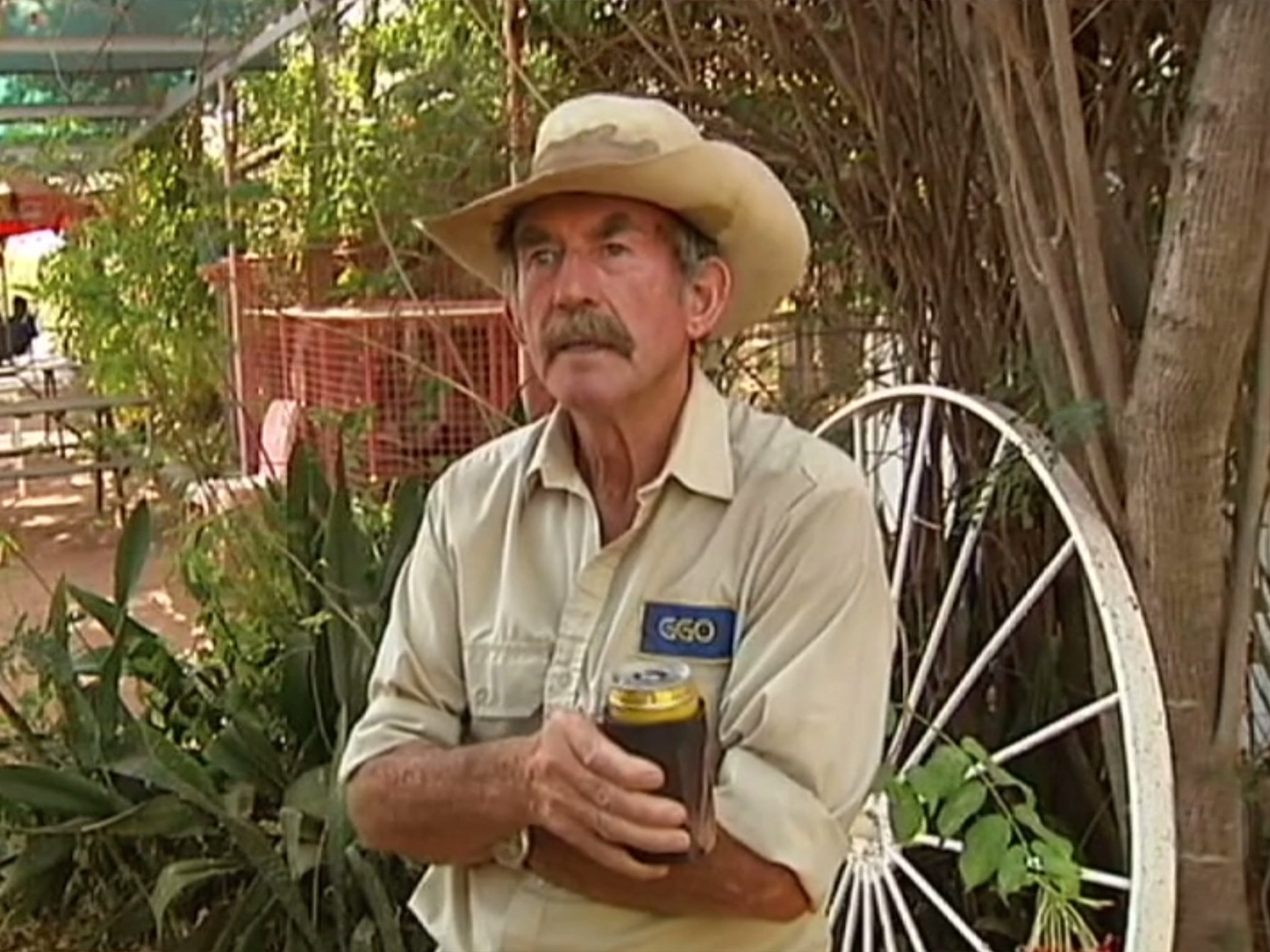
Dusk was falling on the sweltering hot day of 16 December 2017, when Paddy Moriarty went to the Pink Panther, the only hotel and bar in Larrimah, to end the day with his usual round of drinks.
He downed eight beers, typical for Mr Moriarty, a labourer who spent most of his life in Australia’s rugged outback. Then he left for home with his dog by his side.
He was never seen again. Neither was his dog, a kelpie named Kellie.
Four days later, when the police arrived the Northern Territory town of just 11 people, they entered Mr Moriarty’s unlocked house to find a cowboy hat on a cooler box and a barbecue chicken still in the microwave.
The authorities suspect foul play and have been treating the case as a murder, with every single person in Larrimah – all 11 of them – being probed for clues.
Topping the list of potential suspects now – at least going by the questioning in a recent inquest involving the town’s residents – are a former Pink Panther bartender, who was one of the last people to see the missing man, and a gardener, with whom Mr Moriarty had fought just days before his disappearance.
Detectives have also questioned the owner of a roadside tea house.

But with no clear evidence or even a motive for Mr Moriarty’s disappearance, every one of Larrimah’s 11 residents is in one way or another part of the investigation – with each pointing a finger at a neighbour or two, while denying their own involvement in what has become the latest mystery to capture Australia’s imagination.
There are only two gathering places for residents and visitors, the Pink Panther and Fran’s Devonshire Tea House.
“Paddy used to be here nearly every day, I miss him so much,” said one of Mr Moriarty’s closest friends, Barry Sharpe, the publican of the Pink Panther.
Mr Sharpe's self-proclaimed passion is nurturing the exotic animals he keeps behind the bright pink hotel, which he has owned for almost 15 years.
The mix includes rare and exotic birds, snakes and a hulking saltwater crocodile named Sam, to whom some suspect Mr Moriarty was fed after being murdered.
All Mr Sharpe said he knew about the disappearance was that his friend did not show up for “church” – a Sunday morning ritual in which residents gather in the Pink Panther’s front room to watch “Landline,” the nation’s premier rural affairs program. It was then that locals sounded the alarm.
A three-day search by foot, on four-wheel-drives and from the air ruled out death by misadventure. To date, the police have found no trace of Mr Moriarty or his dog.
One of the last people to see Mr Moriarty was Richard Simpson, the one-time bartender at the Pink Panther, who has a reputation for volatility.
“He was every day drunk before lunch,” Mr Sharpe said of Mr Simpson, his former employee. “Not only smashed, but not very pleasant.”
Mr Simpson scoffed at similar accusations when asked about them during the coroner’s inquest, a public hearing in which witnesses are questioned in open court. Upon being told that some people in Larrimah thought he had something to do with the disappearance, Mr Simpson declared them all “goddamn fools.”

Mr Simpson instead suggested that the police should be looking elsewhere – down the main road at the Tea House.
“I’ve got no pies left,” a short woman with spiked blonde hair shrieked from the kitchen. A row of RVs lined up outside as patrons spilled out to buy tea and pies, despite online reviews warning of “rubbish food” and questionable prices.
The cook, Fran Hodgetts, has long prided herself on her scones and meat pies. She often tells visitors they are famous around the world.
Now, though, they are renowned for all the wrong reasons.
“I reckon he’s in the pie,” joked Robyn Duignan, a visitor from Victoria who had been following Mr Moriarty’s case in the news media and stopped by to see if there had been any developments.
“He went through the mincer,” Ms Duignan added from the Tea House’s garden, a yard scattered with old toys and signs trumpeting Ms Hodgetts’s culinary expertise.
Mr Moriarty and Ms Hodgetts were neighbours who often clashed, the police said.
He lived directly across the main road from the Tea House, and several people in town said it had annoyed him when her customers parked on his property.
As payback, residents said, Mr Moriarty routinely told them not to eat her food because nothing was homemade or fresh, adding that even his dog would not eat her pies.
If Mr Moriarty had enemies, he also had allies. Years ago, when Mr Sharpe, the publican from the Pink Panther, decided his crocodile Sam was not enough of an attraction, he started selling his own meat pies. Mr Moriarty advertised those pies in front of his house with a massive sign that read: “Larrimah Hotel Best Pies in Town.”
Ms Hodgetts told investigators that Mr Moriarty regularly taunted her. He often called her “the bush pig” – a name that caught on with some of her neighbours. Last year, it got serious enough for her to seek an order of protection, but a local court rejected her request.
She said she last saw Mr Moriarty four days before he went missing, when she accused him of putting a dead kangaroo near her house.
That history of acrimony led some locals to tell the police she wanted him dead – an allegation she denies.
“Imagine me carrying a dog and a body, I mean come on,” Ms Hodgetts said at the inquest in June. “I’ve had me septic done, me incinerators searched, me house done four times,” she added, referring to a police search of her property. “Nobody found anything.”
The testimony from Ms Hodgetts, sitting on the stand in a tiny courtroom in the nearby town of Katherine, was part of an investigation by the Northern Territory coroner, a special magistrate assigned to determine the cause and manner of Mr Moriarty’s death.
Local authorities said they are so reliant on the residents to solve the case that they held the inquest much earlier than they normally do in part because most of the residents are in their 70s and might not have years to wait.
The hearing included testimony from most of Larrimah’s residents. They all provided nervous answers to probing questions in a stuffy room filled with several dozen observers, including a few nosy tourists.
Early on, the focus fell on Ms Hodgetts. Bobby Roth, a Larrimah local of 19 years, who used to wash dishes at the Tea House, said the cafe owner didn’t like Mr Moriarty.
“She used to say, ‘I’ll kill Paddy,’” Ms Roth said at one point, breaking into tears.
But during her own testimony, Ms Hodgetts ended up shifting attention to her gardener, Owen Laurie, a tall, burly man who was known for keeping to himself, and for taking good care of the Tea House plants.
The questioning centred on an argument that he and Mr Moriarty had about Kellie, Mr Moriarty’s dog, three days before they disappeared.
That day, Kellie had been barking at the Tea House from a spot in the middle of the road. An argument between Mr Moriarty and Mr Laurie ensued, according to testimony, with Mr Laurie shouting at Mr Moriarty to shut the dog up “or I’ll shut it up for you.”
Ms Hodgetts went a step further, telling the court that Mr Laurie attempted to “jump the fence.”
“I told him ‘don’t do anything stupid,’” Ms Hodgetts said.
Mr Laurie admitted to having a bad temper, but he denied any involvement, turning the court’s attention back to where Mr Moriarty was last seen: The Pink Panther.
Mr Simpson no longer works at the pub. Mr Sharpe said he was fired a week before the coroner’s inquest.
He has since moved on, keeping Larrimah’s population steady at 11. Until December last year, it used to be 12.
Around the bar, patrons still talk about Mr Moriarty’s disappearance.
“Church” on Sundays has resumed, but without the charm Mr Moriarty used to bring to it. Because he had no family in Australia, the public trustee now controls his property. To keep an eye on anything that might look suspicious, his home has been fitted with security cameras, and it’s flanked by a large missing person sign.
It includes a picture of Mr Moriarty, smiling, with a question many in town are still asking: “What happened to Paddy?”
The New York Times