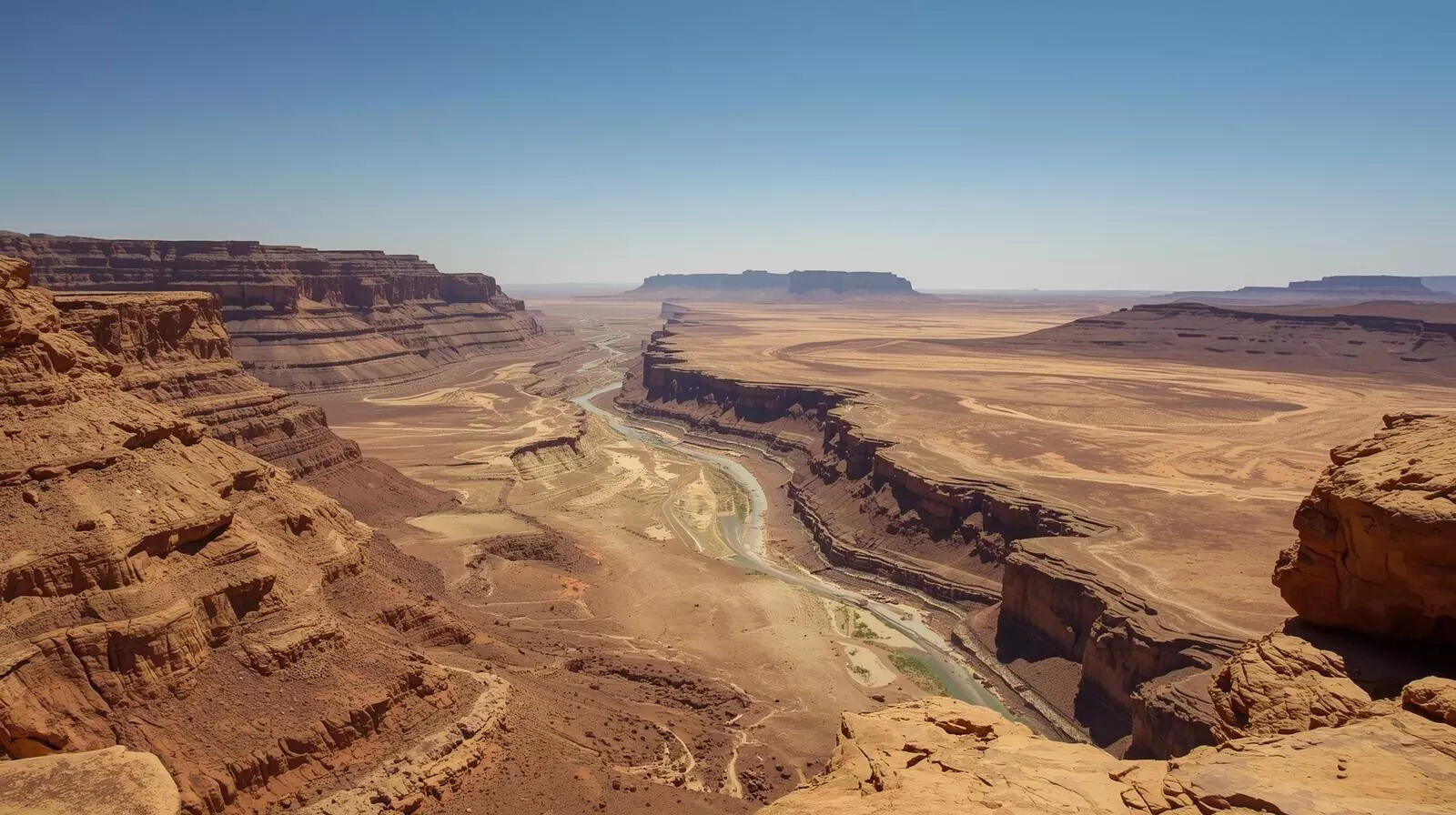
Quiet remains of far earlier worlds can be found on cliffs in some of southern Africa's harshest regions. Signs of changing climates and gradual geological stress are frequently preserved in marble and limestone formations, which were developed long before the deserts of today. The majority of markings align with established patterns of mineral alteration or erosion. But something that contradicts those ideas has been observed by researchers in sporadic outcrops throughout Namibia and portions of the Arabian Peninsula. Tight, parallel lines of fine, repeating tunnels pass through the stone. They carve into solid rock by extending past fractures while yet following them. They are uniformly spaced and have a regulated shape. These characteristics seem antiquated, dormant, and hard to describe. They highlight procedures that no longer function in these settings.
Evidence of ancient microbial activity found in Namibian Desert rock formations
The structures have been identified in desert regions of Namibia, Oman and Saudi Arabia. In Namibia, they are found in Neoproterozoic marble exposed along river valleys and plateaus far from the coast. Similar features occur in limestone formations across the Arabian Peninsula. The common factor is geological stability. These rocks have not been heavily deformed for hundreds of millions of years.
The tunnels appear as bands rather than isolated holes. Each band can extend for metres, sometimes following a fracture before fading back into intact stone. Individual tunnels are small, less than a millimetre wide and only a few centimetres long. They are always aligned. They do not cross or branch randomly. This regularity is one of the details that drew attention in the field.
Erosion alone does not fit
At first glance, weathering seems an obvious explanation. Desert rocks often show pitting, flaking and chemical alteration. But these tunnels behave differently. They cut across mineral layers without disturbing them. In many cases, the original colour banding of the marble remains visible along the tunnel walls, suggesting material was removed rather than replaced.
Typical karst processes produce irregular cavities and widened fractures. Crystallisation leaves angular patterns. Tectonic stress creates breaks, not fine parallel tubes. None of these processes produce tightly packed, evenly spaced borings that stop at similar depths. The geometry looks controlled, not accidental.
Signs pointing toward biological activity
Researchers of the article
“Subfossil Fracture-Related Euendolithic Micro-burrows in Marble and Limestone”did a closer analysis that adds weight to a biological explanation. The tunnels are often filled with fine white calcite that contrasts with the host rock. Chemical testing shows that this infill is depleted in several elements compared to the surrounding stone. Along the tunnel edges, researchers have detected thin rims enriched in phosphorus and sulphur.
Microscopy and spectroscopy reveal traces of degraded biological material. Carbon isotope values also fall within ranges associated with life. DNA and proteins are no longer present, which is not surprising given the age. But the chemical fingerprints remain. Together, they suggest that microorganisms once bored into the rock while alive, then left behind altered mineral chemistry when conditions changed.
What kind of organisms could do this
Endolithic microbes are known to live inside rocks in extreme environments. Some occupy cracks. Others actively dissolve minerals to create space. These organisms are found in places such as Antarctica and the Atacama Desert, where surface conditions are harsh but rock interiors offer protection.
The newly described tunnels resemble endolithic activity, where microbes bore directly into carbonate rock. What's unusual is the scale and organisation. The tunnels form long bands with consistent orientation, suggesting a shared growth direction or environmental trigger. No known modern organism produces exactly this pattern. It remains unclear whether the responsible microbes still exist or are extinct.
Deserts hide unexpected histories
Today, the regions where these tunnels occur are hyperarid. Rain is rare. Biological activity is limited. Yet the tunnels imply conditions that once allowed sustained microbial life within the rock. That does not require lush landscapes, but it does suggest a different balance of moisture and chemistry.
Because deserts preserve surfaces with little disturbance, they can lock in evidence that would be erased elsewhere. Features formed deep inside rock masses can later be exposed by erosion, appearing almost out of place in the modern climate.
This matters for Earth and beyond
Carbonate rocks hold most of Earth’s carbon. Understanding how life interacts with them matters for models of the global carbon cycle. Even small biological effects, repeated over large areas and long times, can shift carbon between solid rock and the environment.
These findings also matter beyond Earth. Similar carbonate rocks exist on Mars. If microbes once lived inside them, their traces might look subtle and unfamiliar. The tunnels in Namibia and Arabia show that life can leave marks that do not resemble fossils in the usual sense.
The bands end quietly in fractures. There is no clear start or finish. Just traces, cut into stone, waiting to be noticed.