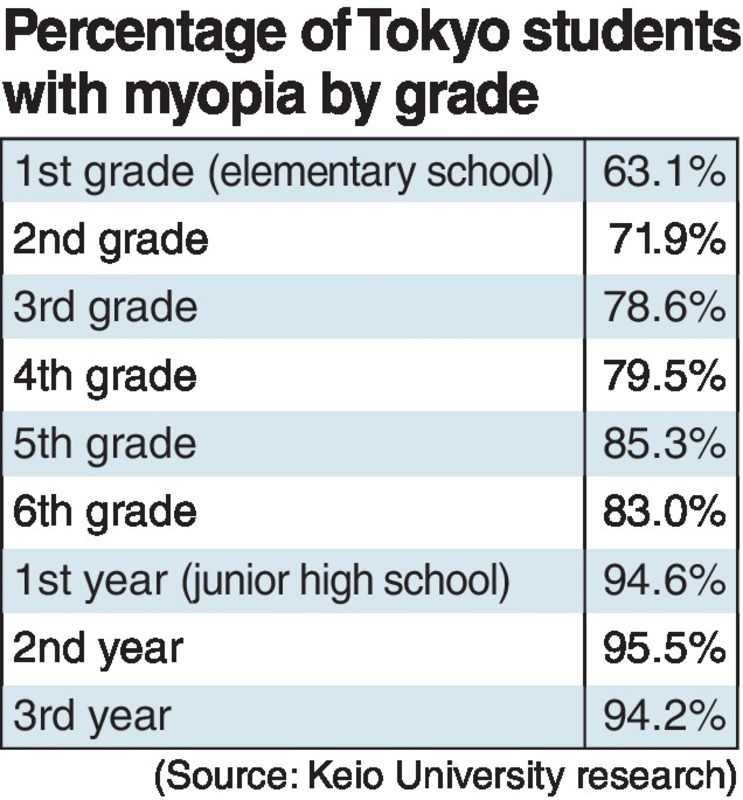
Ninety-five percent of junior high school students and 77 percent of elementary school students in Tokyo are near-sighted, according to a study published in an online ophthalmology journal by a university research team.
Since severe myopia can lead to blindness, experts said measures need to be taken to prevent children from becoming near-sighted.
A Keio University research team, led by ophthalmology professor Kazuo Tsubota, conducted a survey of 689 ward-run elementary school students and 727 private junior high schools students in Tokyo in April and May 2017. By applying light to their eyes using a special device, the researchers were able to closely study the focal length of each eye and any deformation of the students' eyeballs.
In keeping with international research trends, the team determined that children with a focal distance of two meters or less were near-sighted.
The survey found 63 percent of first-grade elementary school students were near-sighted, while roughly 80 percent of third- to sixth-grade students had myopic vision. The survey also found that more than 95 percent of second-year junior high school students were near-sighted. Four percent of elementary school students and 11 percent of junior high school students had severe myopia with a focal length of less than 17 centimeters.
Recent studies have shown that spending time outdoors is effective in slowing the progression of myopia. The rise in near-sightedness is believed to be due mainly to the fact that people are spending more time indoors and more often looking at things that are close to them, such as when using a smartphone or studying.
Since people with near-sightedness have deformed eyeballs, those with severe near-sightedness are prone to having their optic nerve or retina damaged. They are also at risk of blindness.
Read more from The Japan News at https://japannews.yomiuri.co.jp/