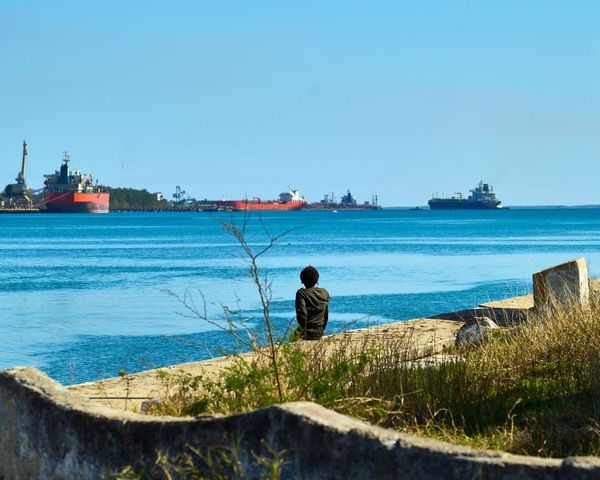
With its sandy white beaches and crystal clear waters, the Solomon Islands looks like paradise.
But many of us here have lost our homes and, in my case, even family members because of the climate crisis.
My family and I believe sea level rise contributed to the deaths of my two disabled brothers, who were pulled into the water and drowned.
The sea used to be 50 metres away from our house but as time went on, I could see the water coming closer and closer, until it was eventually right on our doorstep.
My worried parents told us not to go down to where we used to play but in the summer of 2014, my 10-year-old brother Michael, who could not walk properly, was sitting on the sea wall where our grandparents used to read stories to us.
During an exceptionally high-tide, Michael was pulled into the sea and drowned.
Tragically, my six-year-old brother Dona also drowned when he was crawling along the path by the house and was swept into the water by the tide in 2017.
The sea never used to come up so close and now my home is a constant reminder of the loss of my brothers, whose graves are in our garden.

Sometimes during high tides my village in Langa Langa Lagoon, Malaita province, gets covered with sea water.
The root crops and vegetables for our meals get destroyed by the salt water so all we can eat is rice, tinned food, and noodles.
This affects our diet and our overall health.
Our village sits on a man-made island, many of which have been around for centuries, built by our ancestors from rocks on top of shallow reefs.
Some of these islands, like my parents’ and grandparents’ former homes, are now submerged.
In 1986, they had to leave their old home after one of the most deadly cyclones in Solomon Islands history struck.
Now all that remains are a few rocks poking above the water.
After the cyclone, my family set up home on a new island where my brothers, sisters and I used to play safely among the mangrove trees and the coconuts.
Now everywhere I loved as a child is underwater.
I do not feel safe here but there is nowhere else for us to go.
Many families relocate to higher ground, but this causes conflict over land ownership.
Sea level rise in the Solomon Islands is happening at a rate of almost three times the global average, at around 7-10mm per year since 1993.
And while the rising seas cannot be blamed on climate change alone, it provides a window to the rest of the world of what is to come in the next 100 years if we do not take urgent action.
Activities like logging, cutting mangrove trees for firewood and household cooking contribute because they threaten our food security and ecosystems.
But when it comes to global emissions, our country contributes very little compared to the western world and yet we are the ones living with its effects.
Climate change is a global issue which cannot be addressed by an individual nation.
For us it is a daily concern for our lives.
Our people are strong, but the land we live on is vulnerable.
I can only hope my home in paradise will still be here in 50 years time.
Save the Children's climate action in the Solomon Islands
The Solomon Islands is at the forefront of climate change despite the country contributing very little to global carbon emissions.
Children there are being taught to prevent and respond to the impact of climate change by charity Save the Children.
They’re taught how to protect their local environment and adapt to extreme weather and sea level rise that impacts their everyday lives.
Save the Children’s projects also aim to build the resilience of communities and the government as climate change increasingly damages the nation.

This includes setting up early warning systems for cyclones and planning disaster responses that protect schools, so students can continue their education even in emergencies.
Through special projects, the charity helps equip children to take the lead for developing solutions that address the impact of climate change, both now and in the future.
The NGO is also working with the United Nations’ Green Climate Fund to improve access to climate change impact data, which will help inform local and national governments.
Across the world, Save the Children is teaching children in schools and the broader community, on how they can develop preventative measures and take action to respond to the impacts of immediate and expected climate changes.