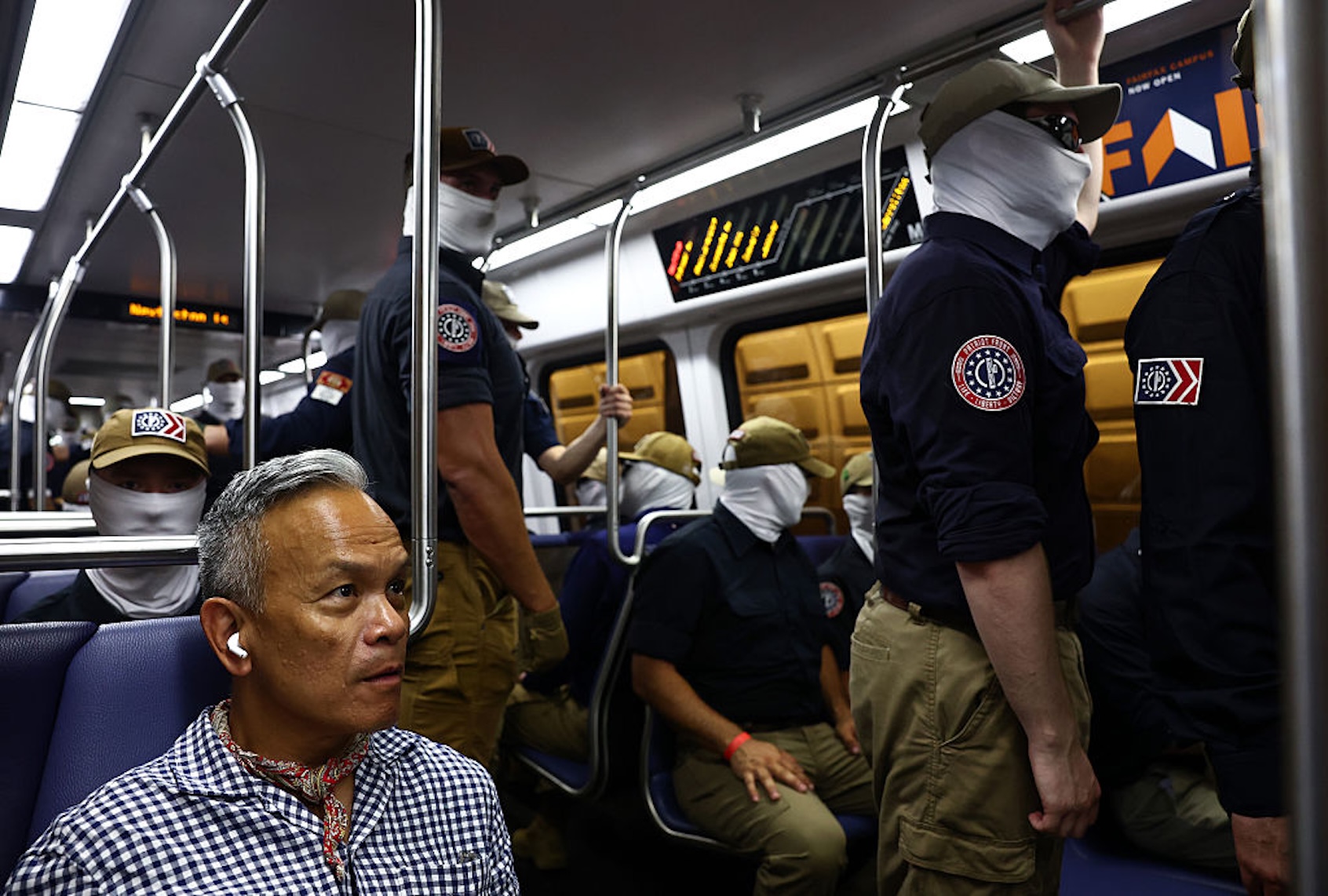
On the Fourth of July, while I was on my way to a party, I found myself riding a Washington Metro train surrounded by hundreds of masked white supremacists. A subway car is supposed to be one of society’s great equalizers. But it was the last place I expected to reflect on what it means to be an American.
A Getty Images photographer captured the moment. As far as I could see, I was the only unmasked person in the sea of Patriot Front members. I had my AirPods in, and my gingham shirt and bandana signaled I was ready to celebrate Independence Day. But my face and body language told a different story.
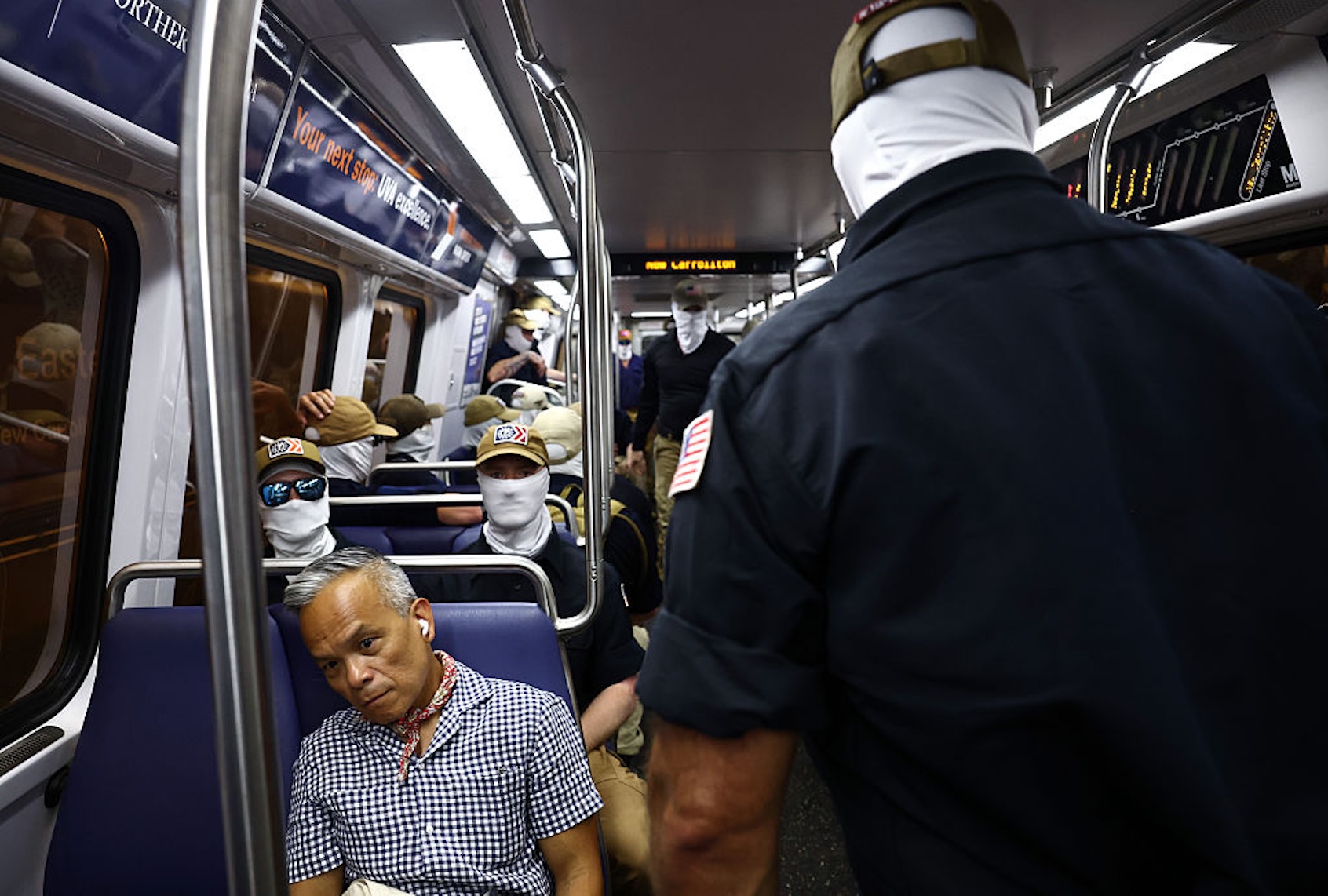
(Finn Gomez/Getty Images) Roswell Encina is surrounded by masked members of the Patriot Front, a white supremacist group
Within hours, the photographs had spread across social media and news outlets. Friends began texting. Reporters called. Many asked whether I had been frightened.
The honest answer is yes.
But after the initial shock faded, I realized the moment offered something else: an opportunity to talk about the country I love, the work still left to do, and why history and civics education matter now more than ever.
I came to this country as an infant because my father served in the U.S. Navy. During my childhood, our family moved back and forth between the United States and the Philippines before eventually settling here. America became home not simply because we lived here, but because my parents believed deeply in the responsibilities that came with citizenship.
One memory has stayed with me ever since: In 1988, I had just turned 18, my father took me to the U.S. Embassy in Manila so I could vote in my very first presidential election. I still remember walking into the embassy, receiving my ballot and feeling an overwhelming sense of pride and responsibility. I was not simply casting a vote. I was participating in an idea that generations of Americans had fought to preserve.
That feeling has never left me. My parents believed citizenship required more than voting every few years. They served in homeowners associations, national civic groups and local community organizations. Civic engagement was not something they preached, it was how they lived. Watching them taught me that democracy depends less on grand speeches than on ordinary people showing up for their neighbors.
Today, I have the privilege of serving as president and CEO of the U.S. Capitol Historical Society, where our mission is to preserve history, elevate civics and help Americans better understand Congress and the Capitol. Every day we welcome students into the Capitol, train teachers from across the country, host conversations with historians and public servants, and encourage visitors to see themselves as part of the American story.
That work matters because the Capitol is not only a building. It is where our national ideals are debated, tested, challenged and renewed. It has witnessed some of our greatest triumphs and deepest failures. It is also where Abraham Lincoln, as the nation stood on the brink of Civil War, appealed to “the better angels of our nature.” More than 160 years later, those words still feel remarkably relevant.
History is often treated as something preserved behind museum glass. I see it differently. History is alive. It is conversation, disagreement, aspiration, compromise and the ongoing effort to build a more perfect Union. It is something every generation inherits and has a responsibility to shape.
That is why civics education matters. George Washington understood this from the very beginning. Shortly after the Constitution took effect, he urged Congress to establish a national university where future generations could learn not only how government works, but also the civic values needed to sustain the Republic. John Adams, Thomas Jefferson, James Madison, Benjamin Franklin and Alexander Hamilton all embraced similar ideas. That university was never built, but the need for its proposed objectives never ceased. Every generation has faced the same challenge: preparing citizens not only to understand our system of government, but to sustain it.
That is especially true as we continue to celebrate America’s semiquincentennial. The 250th anniversary of the Declaration of Independence should be more than fireworks, parades and patriotic songs. It should also be an invitation to reflect honestly on who we have been and who we aspire to become.
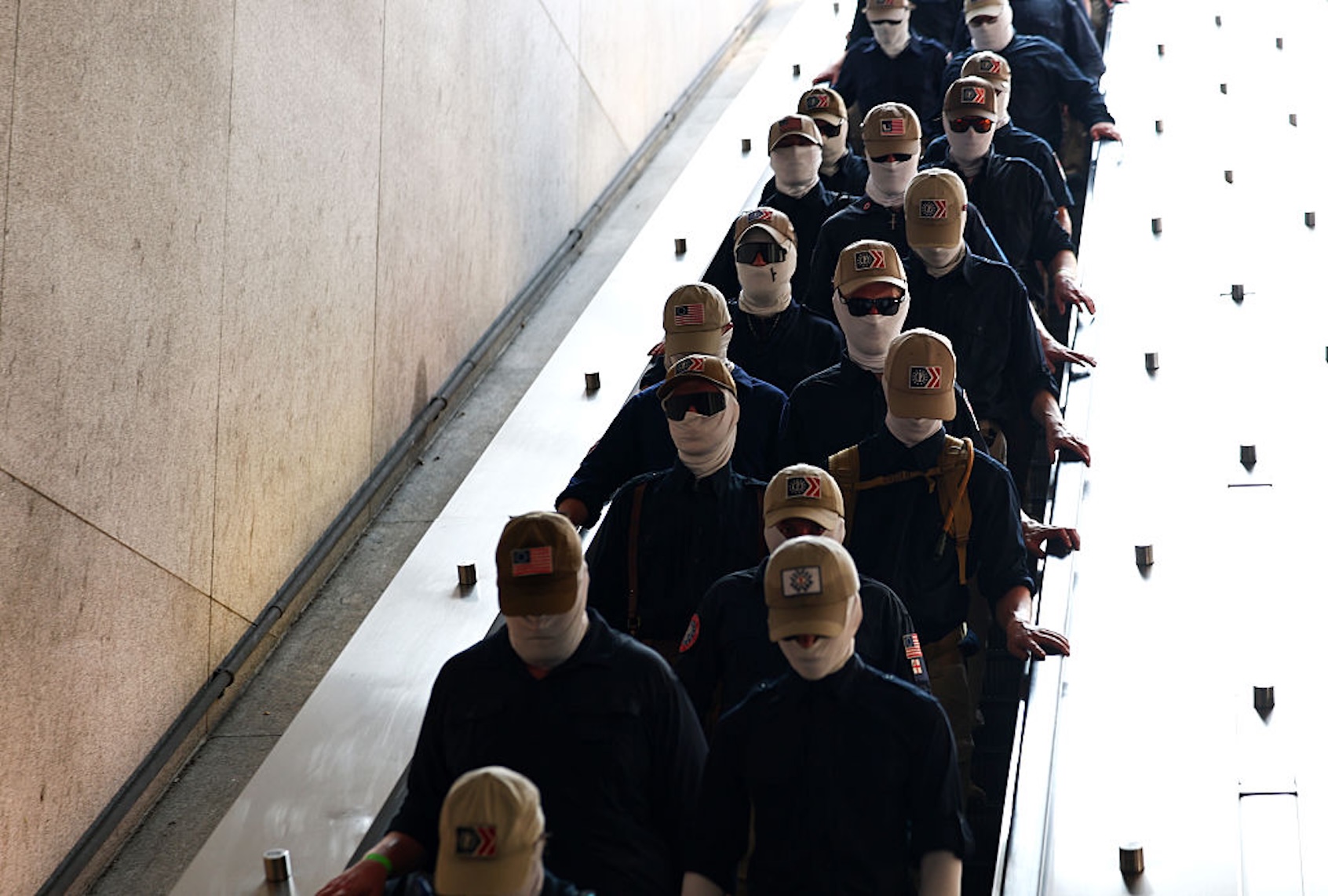
(Finn Gomez/Getty Images) Masked members of the Patriot Front descend into the Washington Metro
Our history has never been simple, and it should never be presented as such. It is a story of extraordinary achievement and expanding freedom. It is also a story of slavery, exclusion, prejudice, violence and people determined to decide who belongs. Those truths are not contradictions. They are part of the American story, and understanding that narrative is what allows us to appreciate how far we have come while recognizing how much work remains.
At the heart of the Declaration are words that have challenged Americans for 250 years: “We hold these truths to be self evident, that all men are created equal.” Those words were both a promise and a challenge, calling on each generation to bring the nation closer to its founding ideals. The abolitionists accepted that challenge. The suffragists accepted that challenge. The Civil Rights Movement accepted that challenge. Today, that responsibility belongs to us.
Our country has never required us to agree with one another. In fact, disagreement has always been part of the American experiment. After one of the most bitter elections in our history, Thomas Jefferson reminded a divided nation that “every difference of opinion is not a difference of principle,” before adding, “We are all Republicans, we are all Federalists.” Those words remain relevant today.
Patriotism is not about deciding who belongs. It is not about intimidation or fear. Patriotism is about widening the circle of liberty, dignity and opportunity so that more people can fully participate in the promise of this country. That is what I found myself thinking about while sitting quietly on that Metro train: not anger, not revenge, but responsibility.
There are days when democracy feels fragile. Days when division feels overwhelming and the work of bringing people together seems frustrating, even fruitless. Last week, at an event in Washington, House Speaker Mike Johnson reminded the audience of one of John Quincy Adams’ favorite lines: “Duty is ours; results are God’s.” I have thought about those words ever since.
We cannot control every outcome, but we can choose how we respond. We can keep showing up. We can teach history honestly, elevate civics, vote, serve, listen and continue believing, as Lincoln urged us, in the better angels of our nature.
Eventually, the Metro ride I endured will fade from memory, and the photograph will too. I hope what remains is the conversation it sparked about who we are as Americans.
Our story is still being written. And despite what those masked men might believe, every one of us has a role in shaping its next chapter.