When one of my best and most trusted mates asked if I wanted my nine-year-old son to start cricket a few summers ago, I almost said no. As a kid, my first response to cricket was an amalgamation of boredom and terror. My father, on hearing that we’d be playing cricket at secondary school, had bought me a Sondico Clive Lloyd bat and set up a wicket at the end of the garden. The bat was rock hard and each nick of the ball sent knuckle-shattering vibrations up through my protective gardening gloves. These were the days before protective helmets and it only took a few of my six-foot father’s fizzing deliveries whumping the garden fence for my, and my twin brother’s, enthusiasm to drain away entirely.
That September, I went to the local comp but we didn’t play one game of cricket in six years. The Sondico bat, which was far too nice for the beach, remained in a cupboard and cricket was done. My dad was too busy with work to persist at all this in the way we dads do now (looking on YouTube for the right way to do something) and I reverted to the core 1980s suburban pursuits of lollygagging and jumping my bike from unstable ramps made from scrap plywood. As a dad, I look back on these summers with mixed feelings. I loved killing time outside the Spar or riding up and down alleyways but I also remember feeling incredibly bored.
I accepted my friend’s offer of joining the local cricket club and at Oscar’s first game I dozed off on a large white park bench while fluffy clouds tracked through a blue sky over the pavilion. This was my kind of parenting. As I watched him cut a ball to the boundary, I hoped that he’d at least give it a few more months before jacking it in.
At this point, I was a bit clueless about fatherhood and didn’t yet realise how important cricket would become to us as a way of spending more time together. In some ways, I was just like my father. For him, getting my brother and me into sport was probably as much about us acquiring social skills as it was about fitness or confidence. I suspect with my father there was also a class element. I asked for a BMX and I got a racer. I asked to do karate and I was signed up to a tennis academy. The final straw was the day he presented me with a set of secondhand Sam Snead golf clubs (my brother received a half set of Slazengers). Golf, we were informed, was a useful skill we could use in business. I think there was probably a big difference between knocking balls around PGA golf courses on the corporate days my dad attended and playing whack and walk around a thinly grassed gravel pit in outer London.
We played golf with Dad a few times, but mostly he would just drop us off at the municipal course and we would get on with it. It was the same when we were enlisted in the local tennis academy. In the 1970s and 1980s there was a “them and us” thing with adults and kids: why would adults want to hang out with kids or vice versa? Didn’t we want to be independent, off on our own? This doesn’t feel right to me. Historically, boys would have been deeply connected to their fathers as mentors and guides – either as apprentices or, going much further back to the days of hunter-gatherers. Through urbanisation and industrialisation, this element to our relationships appears to have been lost.
I feel now that all my best (and worst) days as a child were spent with my father – and it really didn’t matter what we were doing. Even though he was a director of an engineering firm, he was always heading off to someone’s house to fix their boiler for free. I loved going with him, holding a torch over his shoulder and passing him mugs of tea. On days like this, or on rarer trips to museums, I saw another, calmer, happier Dad, different to the exhausted guy I saw for a quick half an hour at night when he finally got home from work.
As I got older, the times I liked him best were when we forgot our roles as father and son: like at college when he’d drop us off and stay for a few drinks in the pub with all the lads. Or even family barbecues where he’d also have a couple and the authoritarian mask would slip and I’d get to see how funny he was and how much people enjoyed his company. He loved to laugh – this is not something I’d see much when he had the proverbial foot on my neck to revise.
As I had my own children, it seemed natural that I would spend more time with them than my father had spent with me. I tried to make up for the time that my father and I didn’t have by getting him along to see his grandsons play cricket, but even so it always seemed like he was always too busy: first with wrapping things up at work, then adjusting to retirement and then, finally, his illness. He died at just 62, from mesothelioma, related to asbestos he’d cleared from a building after his father sent him out to work at 16.
A few months after he died, I realised that he hadn’t seen Oscar play cricket once. I was on the receiving end of the oldest lesson known to man: there is always something important to do, there is always later, until there is no later and it is too late. It’s not like I didn’t understand this or know it to be true, but some lessons have to be worn like a bruise to be understood. I felt deep down that there was no point me being a father if all my sons ever saw of me was this same old facade of stressed disciplinarian. It’s not that I wanted to be best mates with them – I just wanted our life on this planet to be about more than getting the right grades or getting into the right college.
That summer, I signed up to manage the teams of my two younger sons – both of whom had picked up on their older brother’s enthusiasm and all wanted to play cricket. I probably help to run or attend about three or four games a week during the season. Oddly, one of the best parts is driving to the far-flung games. If we’re on our own I get a lot of hard-hitting questions, mostly about my life and stuff I’ve done in the past (Q: “Why was the old magazine you worked for called Loaded?” A: “Er …”)
Running teams, you get a sense of the kids whose dads never come to games because they are working late during the week or going cycling at the weekend. I can’t understand this. These are the good times. Sometimes the kids wander up and tell you where their dads are, apropos of nothing. These are the times when they need a parent’s understanding, an arm round their shoulder to say, “I used to get out like that all the time! It’s a family tradition!”
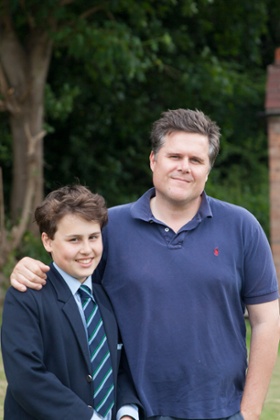
Sometimes I think it’s great for them to look up and see Dad as part of their life, their group. Life can’t all be about turning up at the big moments – the 16th, 18th, 21st birthdays, university graduation and his wedding. I’d bet most kids would trade all that to have just had you there when they got a golden duck and some idiot laughed.
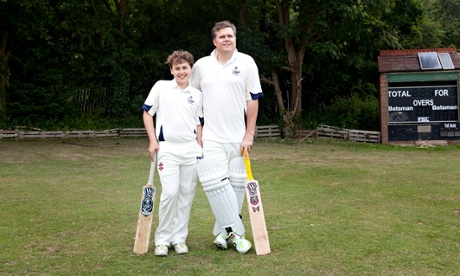
After a couple of years of shuttling the kids around, one of my best friends pointed out that our sons were old enough to play in the same teams as we were. Being slightly too hopeless to play for a club, I decided to start my own village cricket team: the Muswell Maidens. The idea is that my friends and I will all be able to play games with our sons (most of whom are better than us anyway). We have had so much fun so far that we hope the team will be here after we’re gone, hopefully run by our lads to play with their own sons and daughters.
I now play on and off with Oscar in a couple of teams and feel that this shared pursuit provides us with common ground outside of the competent authoritarian/clumsy kid role that I got stuck in with my own father. It’s not about me being Oscar’s mate, but about him seeing who I am beyond my dad role and me seeing who he is beyond his son role.
The other day, a dad was telling me that he felt his son really didn’t like him. He’s a lovely, caring man, but the son simply got on better with his mother.
This is what sport can do for men. Sport helps men, in particular, build bonds and relationships. This is stuff as a dad you can talk about. It gives me the opportunity to say to my son, yes I was terrible today and the world didn’t end. I know most of the fathers of my generation are looking for shared experiences with their children, beyond the litany of “do your homework” or “tidy your room” that we were raised on.
The first time I batted with Oscar was at an indoor match at Lord’s. After my father died, I’d had this bug in my head about batting with Oscar – I didn’t want to repeat the same pattern. About two balls in to my fantasy moment, running a quick single, I fell flat on my face, a clattering heap of bat, helmet and pads. As I lie there catching my breath, feeling my knee swell, a 12-year-old hand hove into view. I look up at this face through the grill of this helmet thinking, didn’t I just bring you back from the hospital?
“Get up, Dad,” he says, in a patient but impossibly deep voice. I took his hand and we continued on. At some point in our short innings, the best thing happened – the thing that has happened each time I have batted with him since: for a short time I forgot that he is my son and simply saw him as an equal – just another team mate batting down the other end and it’s what I always wanted.

.jpg?w=600)