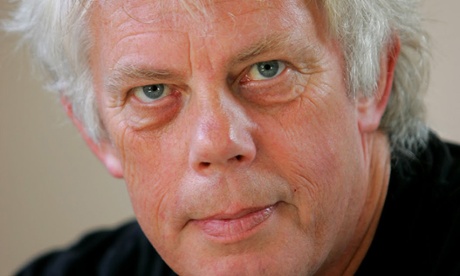
For many years I admired Mal Peet from afar. Not with a telescopic lens or binoculars I’ll have you know (but only because back then I didn’t know where he lived).
The closest I’d ever got to him was at a Guardian children’s fiction awards ceremony in 2009 (Mal won his book Keeper) when I positioned myself close by in the hope of working up the courage to speak to him.
I didn’t of course. He was Mal Peet, what the hell would I say to him? And besides, he kept nipping outside for a cig, and as much as I admired him, I’d make a terrible smoking companion. It’s hard to gush when you’re coughing your lungs up.
Instead I awaited a new Peet novel with longing, while trying to ape his writing style as my own writing efforts stuttered and stalled.
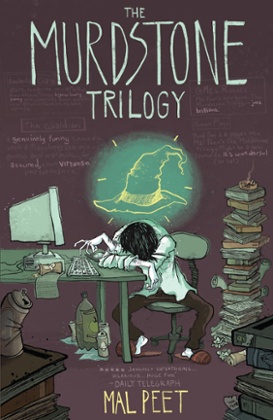
So when I became sales director at David Fickling Books, which I am as well as being an author, and spotted Mal’s new book on our list, there was only one manuscript I was ever going to read first; The Murdstone Trilogy.
I read it overnight. A massive statement for a reader too easily distracted by Twitter and Netflix.
And it was… different.
In fact, take Mal’s name off it and I would never have associated it with him. Not a chance.
You see, I’d been introduced to Mal via his Paul Faustino books, a trilogy of football novels, set in South America, and to say I’d fallen in love would be an understatement.
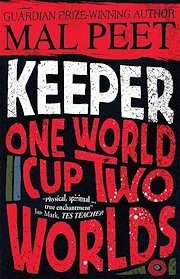
I’ve never read a better football novel than Keeper. Not even David Peace’s The Damned United can match up the wonder that I felt when I read about “El Gato”, Peet’s hero.
Keeper is incredible. Profound, lyrical, yet compulsively addictive. No wonder it won The Branford Boase Award, no wonder it was the title Mal continued to receive the most fan-mail about, from ALL OVER the world, right up to his death in March this year.
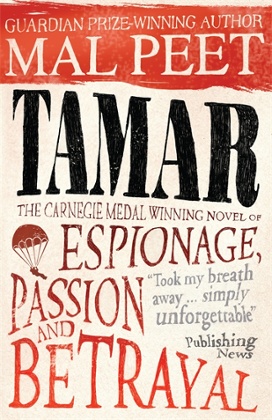
But it’s almost impossible to link Keeper, or the Carnegie-winning Tamar, or Life, An unexploded Diagram, to the same author that dared to write The Murdstone Trilogy, although I have to say, when I read any of them again now, it’s always in the latter where I can hear Mal’s voice the clearest.
You see The Murdstone Trilogy is a naughty book… just like Mal.
It’s a savagely funny book… just like Mal.
It’s a wicked book… just like M- OK, you get the message.
Meg Rosoff summed it up best in her tweet:
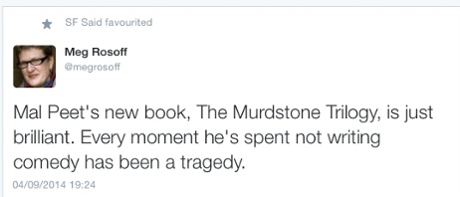
YES. That’s it exactly. How could a man capable of writing such layered, intense novels also be capable to writing something so scurrilous and funny that I physically ached whilst reading it?
The Murdstone Trilogy meant a lot to Mal. He was very open about the fact that he started it initially from a place of resentment. Spleens were being vented about an injustice he felt acutely,
“Why, when the genre was so derivative, did fantasy novels still sell so many copies?”
It wasn’t a question I could ever answer, regardless of how many glasses of Sauvignon Blanc he poured me (I know, get me. Drinking wine with one of my heroes. It took me half a dozen meetings by the way, to stop fanboy-ing in embarrassing fashion).
So why were sword and sandals fantasy bigger than anything he wrote?
I’ve thought about this injustice a lot more since Mal died, and the only half-decent answer I can come up with, no matter how unjust it sounds, is this: Mal Peet’s books are impossible to sum up in two lines.
You see publishers, sales idiots like me, love a one line pitch. That film industry standard to distill an entire story into one measly line. A line that asks the immortal, and hideously lazy question, What’s it like?
“It’s Twilight, with Angels.”
“It’s Wimpy Kid meets Walliams… but with Zombies.”
“It’s Artemis Fowl meets Fifty Shades of Grey (I kid you not, I’ve heard that one).”
How on earth could you ever do that with a novel written by Mal?
You couldn’t. Nor should you try. And I wonder if that might’ve been part of the problem. You couldn’t compare Mal to anyone. And as a result no-one knew where to place his books.
He was often called a YA writer. It’s fair to say Mal disagreed.
“Phil dear heart,” he’d laugh. “How can I write for an audience that doesn’t even exist? I’ve NEVER met a teenager who’d call themselves a young adult.”
My boss, Mr Fickling agrees. His bow tie turns an even deeper shade of frustrated red when I tell him we have to “code” our books, for bookscan purposes at least.
His reply is always the same.
“Great stories reach any age. That’s what defines them as great.”
And that sums up Mal’s books for me. He was a great. Forgive me the cliché, but that was his blessing and his curse. He was, for me, just too good.
So as The Murdstone Trilogy is released in paperback, here I am, banging the Mal Peet drum, running a twitter campaign asking friends, peers or fans to share their memories or thoughts on the great man, via the hashtag #rememberingmal.
It doesn’t matter whether you read Murdstone, or Exposure, or The Penalty, or any number of the beautiful books he wrote with his wonderful wife Elspeth, as long as you read one of Mal’s books, and once you’ve finished, you tell a friend, you pass it on. Then you read the next.
That’s how we remember Mal. That’s how we keep his legacy alive.
Please join in on Twitter #rememberingmal if you’re on it. You can also email childrens.books@theguardian.com and we’ll add comments to the end of this blog.