In the early 1960s my parents looked around a little bedsit in Kentish Town. Both students, they had an eight-week-old baby and wanted somewhere to settle. But the windows were rotting and the wallpaper was slipping towards damp skirting boards. In the end the young couple rejected the property in favour of a place 10 doors down. They have stayed there ever since.
I moved back to London from Brighton in the early Noughties. Single and with a good job, I was looking at places in Hackney, where my sisters lived. But then my parents mentioned that a flat was for sale in the same building they had considered 40 years earlier. They wanted to have another peek inside, out of curiosity. I was charmed, and despite the misgivings of my siblings that I wouldn’t get a moment’s peace, I moved in. People are surprised when they hear that I live so close to where I grew up. The demise of the nuclear family has made it a quirk among my friends.
In many ways our road is a typical London street: a mixture of Victorian terraces, some grand double-fronted villas and a postwar apartment block. More recently, however, it has had national media attention, prompted by the arrival a few years ago of Ed Miliband and his family. When they decamped from Primrose Hill, the move produced a swathe of articles describing my neighbourhood as a place of leafy-lefty-intellectual-middle-class types. The road I grew up on, and moved back to, has become shorthand for the gentrification of north London. The gap between the property haves and have-nots has never been starker, and housing is set to be a defining issue of the next general election. Ours is just one street, but it could be anywhere in the capital.

My family are not the only surviving inhabitants from those days. Roshan Merchant, a retired teacher, moved here in the late 1950s and raised her family. She came from Hampstead, where she had been renting a flat overlooking the heath. “My husband Rex and I had been offered to buy the house we were living in for £5,000,” she says, “but there was a sitting tenant who was always causing trouble. She had a reputation. I remember our milkman said that she was ‘too evil to die’, so that rather put us off.”
They looked elsewhere. As young teachers, their budget was not huge. “We thought about living in East Finchley, but flats there were expensive. We had friends living in Dartmouth Park, and we thought: ‘If they can afford it, so can we.’” Prices were in the low thousands, which even then seemed like plenty. Roshan remembers a neighbour who asked £4,000 for their house. It took nearly two years to shift.
The street had an unsavoury reputation. You were warned not to walk down it after dark. It was mainly home to a transient population of bedsitters or large families crowded on to one floor. The buildings were toothless old crones: cracked stucco, peeling paint and rotten windows. Front doors were covered with hardboard and the gardens a mess. The Miliband home was owned by a Swiss-born violin teacher called Elspeth Iliff. She lived alone, occasionally taking in lodgers she met through her music. When she died she left the house to the National Trust, who sold the property before it passed on to the Leader of the Opposition. When Ed moved in, so did the cameras and radio cars, but it wasn’t the first time the media had sniffed around the area.
Three doors down from the house is a 1960s block of flats, the kind of concrete disaster, built on a Second World War bomb site, that would never be permitted today. It was owned by the USSR as a London base for the Tass news agency. During the Cold War reporters were regularly scurried out of the country in tit-for-tat expulsions. My father once chased a BBC crew off our front steps.
The Soviet presence was responsible for another household, too. Three doors down from us was a basement flat occupied by a series of childless couples. They were all in their 50s, all of a polite Home Counties disposition. But they never spoke much about their backgrounds or their work. Our suspicions were later confirmed – the flat was owned by MI5, and housed intelligence officers who kept an eye on the Reds over the road.
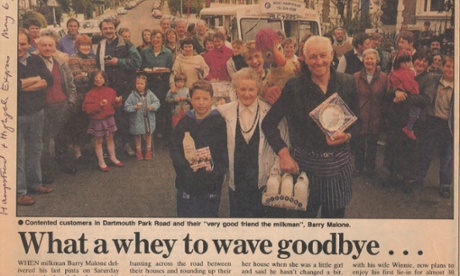
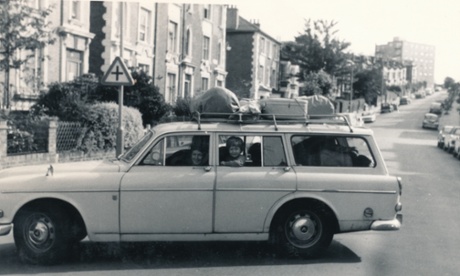
The Russians themselves, with their red diplomatic Volvos supplied by local Greek Cypriot garage owner Andy, were courteous and curious. When our long-serving Express Dairy milkman Barry retired, we threw a surprise street party for him. Neighbours chipped in to buy a silver platter inscribed with his name and dates of work. Tass reporters took pictures and wrote about the event for their Russian readership, flagging up the honour and decency of the British working class.
The street was always mixed class and multicultural: in the 1930s it offered cheap havens to an influx of Czechoslovakian refugees. A family who fled the Sudetenland moved into our house before the war: Czech diplomat Jan Masaryk, who represented the government in London during the Nazi occupation of his homeland, was a frequent visitor. My mother discovered this after a knock on the door in the 1990s. On the doorstep were two young Czechs, who said one of them had been born in our house. She had been delivered by old Mrs Fryatt, who lived in the basement when I was a child. Other Czechoslovakian families stayed briefly – an informal network sent homeless, stateless refugees to NW5 while war raged in Europe.
In the 1960s a group of hippies ran a commune here. Alongside the Cypriot families who fled the civil war, there were people from the Caribbean of the Windrush generation and various families from Uganda who stayed temporarily in housing-association flats after Idi Amin threw them out.
One Ugandan family had a teenager called Altafa: he ran barefoot for miles through the streets and over Hampstead Heath, and had a trick of leaping athletically out of the first-floor window on to the steps below. As a child I found it thrilling. Looking back I realise he was suffering from post-traumatic stress, caused by the flight from Africa, his family losing everything under the threat of violence. He went to a local school but couldn’t hack it. His parents, suddenly finding themselves in Dartmouth Park with no work or family and in mourning for a life lost, were welcomed by neighbours with small acts of kindness. One day they disappeared, perhaps rehoused, and we never got to say goodbye to Altafa.
Not every story was so heartwarming. A grand corner house was owned by a lady called Mrs Peters, who let rooms out to lodgers. Superbly scruffy, it had a touch of the Radley Place about it: curtains shut all day, windows hidden behind a wild front garden. There were late-night comings and goings, with rumours that the rooms were used for disreputable practices. One lodger assaulted a female neighbour, but was chased off by the historian AJP Taylor, whose son lived (and still does) in the road.
Other houses were bought by the progressive Camden Council in the 1970s and turned into social housing; a few remain, having survived the right-to-buy onslaught of the 1980s. Dotted among the builders, road workers and council employees who lived there, were steadfast members of the north London intelligentsia – forerunners of the Milibands.
Poet Margot Heinemann, former partner of the physicist and crystallographer JD Bernal, and the one-time girlfriend of Spanish Civil War poet John Cornford, spent her later years in a ground-floor flat. My mum put up her bookshelves, chuffed to offer aid to such a major figure in 20th century British Communism. Paco Peña bought one of the double-fronted houses. There’s an Observer connection, too: the great Philip French, film critic of the newspaper for 50 years, brought his family up here and is still in situ. Children’s publisher Eddie Lincoln had a garden with a mulberry tree and a pond full of newts – great attractions for my younger self. His garden, and many others, contained self-seeded apple trees. Before becoming a property developer in the 1870s, the Earl of Dartmouth, who gave his name to the area, used the land for orchards and the remnants still survive.
It’s hard to imagine how such a mix could exist today. When my parents moved in, they borrowed a few hundred pounds from my grandfather, a GP. For the rest they got a mortgage from the council on the condition that they would do it up. My mother, a keen DIYer, took charge. “The basement hadn’t been touched for 30 years,” she recalls. “The floors were rotten. We took the boards up but ran out of money before we could put in a kitchen.” But somehow they made do, recycling sinks and buying second-hand cookers. My parents acquired the house bit by bit, moving as our family expanded and the other occupants moved out.
In recent years, the old guard have begun to slip gently into the night. Figures of my childhood have gone: violin-teaching Elspeth, church organist Valerie Durham, kite-flying Roger and Dorothy Levy. Another stalwart, Judy Walker, died in the spring. She was a solicitor who hosted firework parties for the whole neighbourhood. Labour councillor Ivor Walker, and Bill Moggridge, a designer who built the first laptop, would vie to let off the biggest rocket. Bill and Ivor have died, too, and so has Eddie Lincoln.
While people have always come and gone to an extent, there has been a fundamental shift in the past few years, as house prices have gone from “extreme” to “insane”. “Families used to stay put,” says Hanne Landin, who moved here in 1973 with her husband, Ken Adams. “But slowly the older residents have seen their children grow up and move out. Either they have wanted something smaller, or they have passed away. It means people who could afford to live here in the 1950s and 1960s have begun to sell. Houses have gone on the market for the first time in 40 years.”
These days, terraced houses go for £2m or more, out of reach of all but the wealthiest. When Ed Miliband announced plans for a mansion tax at the Labour Party conference last month, some senior Labour colleagues – and one or two Dartmouth Park residents – reacted angrily. Under the proposed system, many of Ed’s neighbours could face large bills. But if you told the ramshackle inhabitants of the 1960s that they were living in “mansions” they’d have howled with laughter, and the older residents on my street are overwhelmingly in favour of a new levy.
“We know it won’t solve all the problems with the housing market,” says Hanne, “but it could be a start. We can’t wait to start paying it, frankly. It’s not wishful thinking or a yearning for the past that means we want our neighbourhoods to be affordable.”
Money has an insulating quality: it can protect, but it also reduces the random interactions that are such a potent part of living in a neighbourhood. The gardens on my street are a good example. These days the fences are immaculate, the lawns kept manicured by gardeners . When I was growing up you could clamber from one end of the street to the other through gaps in the decrepit Victorian walls, taking secret paths known only to foxes. The children on the street had a codeword, “the Chippy”, for a ramshackle camp we’d made out of discarded bricks, to throw the adults off the scent when we wanted to meet up.
All that has gone. The houses are no longer falling down or squashed with families. Children aren’t washed in sinks any more. Instead, we get distasteful weekly missives from estate agents. They boast of sales that show how a varied, archetypal neighbourhood is in danger of being eroded. One recently arrived couple, both on six-figure salaries, asked not to be named. Being able to buy a property in this neighbourhood these days, it seems, is enough to single you out for unwanted attention.
They say they moved here because of “the large houses, and the fact it’s not chi-chi like Hampstead or Primrose Hill. You see neighbours at the weekends, they’re not all out at their country homes. You don’t see Fortnum’s vans pull up.” Dartmouth Park is not yet Mayfair, in other words – not a comparison my parents’ generation would have felt compelled to make. “It feels like a real street, with real people.”
Note: This article was amended on October 29. An earlier version erred in stating that Margot Heinemann was married to JD Bernal, the Nobel-prize winning chemist. JD Bernal was a physicist and crystallographer, and never won the Nobel. While he lived with Margot Heinemann, the two were never married.