I don’t need an app to tell me how old I am – I already know. But, these days, we no longer have to define ourselves by mere chronological age. Instead, we can determine the “true” age of our various constituent components – brain, heart (thanks to a new test from the NHS), general outlook, overall appearance – by taking a battery of online tests that aim to prove age isn’t just a number; it’s a whole bunch of numbers. So how old am I, really?
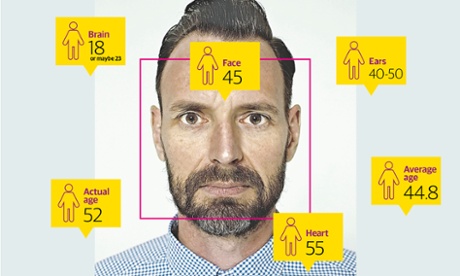
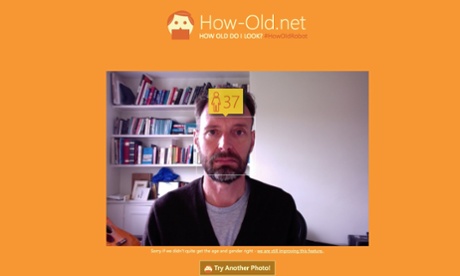
How-old.net uses cloud-based algorithms to determine the age of the person in any photo. I took a picture of myself sitting at my desk, and uploaded it. The app guessed I was 37. Overcoming a strong desire to stop there, I took another photo in which I was deliberately making a pained, world-weary face: 53. Let’s split the difference, and call it 45.
The Death Clock claims it can predict the date of my death from just a few vital statistics: age, gender, BMI, etc. The good news is that I still have almost 687m seconds of life left. The bad news is that will only take me as far as 17 March, 2037. When I went back and adjusted my outlook from “normal” to “optimistic”, the Death Clock gave me another 25 years to live.
The NHS website now offers a test to calculate my “heart age”. It turns out my heart, at 55, is older than the rest of my body. But the questionnaire has penalised me – unfairly, I think – for not knowing my blood pressure or my cholesterol. I might well be young at heart.
A website called mymentalage.com decided that my mental age was 18, whereas another told me my brain was five years older than I was. That’s what I get for answering “no” to questions such as: “I take fish oil supplements high in omega-3 fatty acids or flaxseed supplements at least five times per week.” I don’t even do things I enjoy five times a week.
A multiple-choice quiz designed to calculate my “Disney age” started with the statement, “The first thing I do when I get to a Disney park is …” A word of warning: “Look for the nearest exit” is not among the listed options. I may not have entered into the spirit of this one, because it gave my Disney age as 450. I won’t be including that result in my findings.
A YouTube hearing test put my ear age somewhere between 40 and 50. The Australian beauty website I visited never did email me my true skin age, perhaps because they realised I wasn’t going to turn up to that consultation I booked at a clinic in New South Wales.
There are several online questionnaires aimed at guessing your age from your attitude to certain cultural phenomena, but the choices are absurdly reductive. The correct answer to the question “Credit card or cash?” is clearly “It depends”. A Buzzfeed checklist called “How Old Are You Actually?” decided I was 52 after I did nothing but a tick bunch of boxes – which is ridiculous and, even more irritatingly, spot on. It was my birthday last week.
Using the results of seven separate tests, my overall internet age averaged out at 44.83 years. Obviously, the true figure depends on what sort of face I’m making at the time.