In a new series, our writers explore their best worst film. They’ll tell you what the critics got wrong – and why it’s time to give these movies another chance.
As an academic, I am always amused to see my peers and students recoil in horror when I tell them I am a fan of Adam Sandler films.
“Really?” they usually say knowingly.
While his dramatic work in Punch Drunk Love (2002), The Meyerowitz Stories (2017) and Uncut Gems (2019) has been critically lauded, Sandler and his brand of slapstick comedy, though popular with audiences, are equally unpopular with critics.
But if you look beyond the surface-level silliness, many of his mass-market films contain a clever blend of social commentary, philosophy and moral education — all of which can be seen in the critically maligned Click (2006).
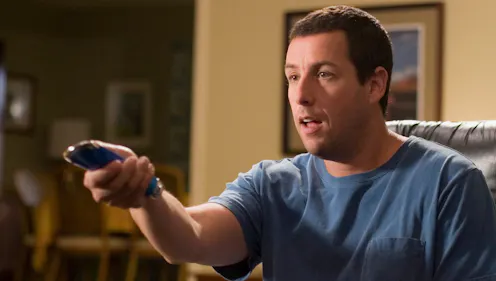
Directed by Frank Coraci, Click centres around Michael Newman (Sandler), a time-poor architect working long hours to try to get the promotion constantly dangled before him by his manipulative boss, all so he can provide an upper-middle class lifestyle to his wife and young children. Given a magical remote control, Michael finds he can speed up time.
Despite grossing over US$240 million (A$335 million) at the worldwide box office, Click has a Rotten Tomatoes score of just 34%.
Writing for The Guardian, Phillip French said, “There are more farts and embarrassing sex jokes than laughs — far more”.
John P. McCarthy from ReelTalk declared, “Sandler doesn’t have the class to pull it off”.
This response isn’t surprising. Click is guilty of using the same brand of immature humour hated by Sandler’s critics. But beyond the crass jokes (such as the repeated motif of the family dog mounting a plush toy duck), Click delivers profound lessons on work, life and relationships.
Sandler’s genius lies in his ability to deliver these messages with impact to a mass audience.
Searching for short-cuts
Michael’s predicament is all too familiar. Do we work to live, or live to work? Should life be a race we rush through at breakneck speed, keeping up with the Joneses, living our “best lives” and succeeding at all costs?
According to the Austrian-British philosopher Ludwig Wittgenstein, “In philosophy the winner of the race is the one who can run most slowly. Or: the one who gets there last.”
Click provides a perfect illustration of how tempting it can be to take short-cuts through life - contrary to the wisdom of Wittgenstein.
We see this play out early in the film, when Michael goes to buy a universal TV remote. At the shop, he meets Morty (Christopher Walken), a quirky salesman who gifts him one that performs like a TiVo. Popular in the early 2000s, this kind of video recorder could pause and rewind live television. Only in this instance, the remote works for real life.
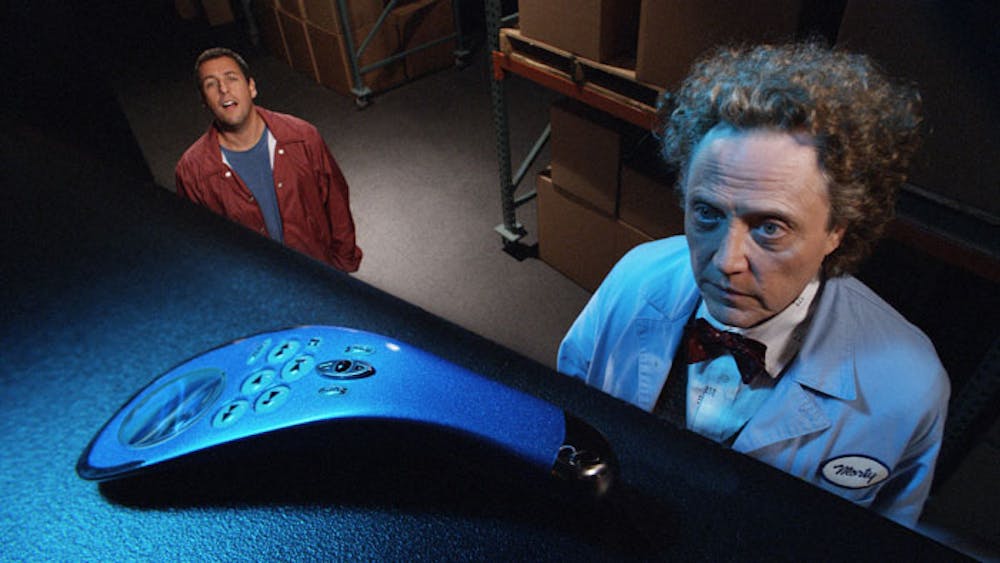
Michael is thrilled with the remote’s powers, eagerly using it to fast-forward through boring and difficult situations. But, much to his horror, he soon realises repeating this action over time programs the remote to do so on autopilot.
To make matters worse, he discovers skipping through all the bad parts of life means he loses his connection with his family.
This is the philosophy at the heart of Click: in relationships, there are no shortcuts.
Strong, lasting relationships are not built on scattered celebrations of feelgood special events. Rather, it is the cumulative effect of doing mundane and insignificant things together over and over that bring us closer, and keep us close.
Having realised his relationships to his wife and children are more important than money and career, Michael desperately tries to spend time with them to make up for all that he missed. But it is too late – his wife has remarried and his children are now too busy living their own lives.
Read more: My best worst film: She's The Man – Amanda Bynes shines in a hilarious commentary on gender
It gets better
Thankfully, Click does not merely place the problem under a microscope without offering closure. Upon discovering he has a chance at a do-over, Michael throws the remote away without hesitation.
In so doing, he demonstrates we can all choose to change for the better.
Although TiVo has long since been superseded, I still love this film. Click never fails to remind me the time I spend with my loved ones matters.
As we all grapple today with the promise of perfect lives serviced by apps designed to help us rush through life at breakneck speed, this message is more pertinent than ever.

Jo Li Tay does not work for, consult, own shares in or receive funding from any company or organisation that would benefit from this article, and has disclosed no relevant affiliations beyond their academic appointment.
This article was originally published on The Conversation. Read the original article.