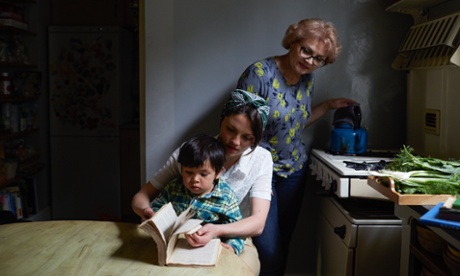
My father’s mother, Vera Paskova, was born in 1928 in a small village in the Tyumen region of Siberia. Her father, a cobbler, was considered a “businessman” by the Soviet regime, which was fairly new at the time, and was promptly and unceremoniously executed by the Red Army. The family’s modest house and only cow was confiscated “for the people”.
My grandmother was an infinitely curious and knowledge-thirsty little girl and was so determined to educate herself that she would plough her way to school in heavy snow every day. The journey took two hours each way, and on one occasion the weather was so severe that she nearly froze to death. She was rescued by a passing man riding his horse-drawn brichka.
Some years later, to escape from an unfortunate marriage to a broken alcoholic, she picked up her little daughter Valyushka, jumped on a train and headed to Tashkent, in Uzbekistan. I think I have definitely inherited her adventurous gene.
Vera, a dark-haired, almond-eyed Siberian beauty – met my Ukrainian grandfather Aleksey – a broad-shouldered, charismatic soldier from Vinnitsa, in central Ukraine, on the train to Tashkent. They fell in love there and then and settled in Uzbekistan’s capital, where my father was born a year later.
Tashkent, 2,000km away from where Vera had grown up, was a desirable destination for Russians from the north. Even during times of bitter hunger and destitution, people tried their luck and shifted to Tashkent to bring some wheat back for their families. It was famous for its abundance and became known as The City of Bread – there was even a book written by Alexander Neverov, and later a film, of the same name.
In 1958, when my dad was born, Tashkent’s markets were brimming with rice, wheat, mountains of fruit, nuts, chickpeas and lentils. But despite the city’s riches, things didn’t go well for my grandparents in Tashkent and eventually they decided to leave. They moved to Voznesensk in Ukraine, but my babushka brought with her all the incredible recipes she had learned from her Tajik and Uzbek neighbours while she had lived there.
My grandmother never stopped cooking Siberian pelmeni and delicious Ukrainian vareniki (both dumplings) and curd cheese pancakes. It was she who taught my mother to make beshparmak and the Uzbek plov (pilaf) recipe below.
When she moved from Tashkent she found she had to adapt her recipes to suit Ukrainian ingredients. Beshparmak is a traditional central Asian lamb dish vaguely comparable to lasagna – silky sheets of pasta, poached, pulled meat and onions cooked in kurdiuk (fat-rumped sheep) lamb fat. However, lamb wasn’t available in the south of Ukraine, so the fattest chicken she could find the market went into the pot, and the onions were cooked in chicken fat instead.
The plov recipe below has gone through several transformations of its own. My grandmother would cook it with Ukraine’s staple meat, pork – which her Uzbek friends would have been horrified by, as most Uzbeks are Muslim. Then my mother started rearing ducks 10 years ago and grew a barberry bush. She started making the plov with duck. Now I am in London, and duck is expensive, so I collect giblets in my freezer when I buy duck, using them only when I have collected enough.
A traditional plov uses an equal amount of meat, carrots and onions, and I am sticking to this magical formula. Kurdiuk – fat-rumped lamb fat –is traditionally used, but I love duck fat and use that! Feel free to use lamb if you want a more authentic dish, otherwise try my version – I think the sweet, richness of the duck fat and giblets really works well.
The daikon and pomegranate salad recipe has also been adapted to suit my tastes. The original is a lot simpler, without pomegranate molasses or honey, and normally served to complement Uzbeki kebabs. But I love sweet and sour flavours, and the duck plov is so rich that my version of this salad is not at all out of place when they are put together.
Duck plov
Feel free to use chunks of lamb – just make sure to slow-cook them over a low heat in water or stock before adding the rice. Use plenty of fat, onions and carrots.
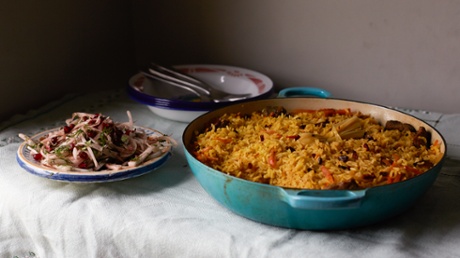
Serves 6-8
500g duck hearts and giblets (don’t use livers here)
100g duck fat
500g onions, thinly sliced
500g carrots, julienned
2 tsp cumin, toasted and crushed
½ tsp turmeric
1 bay leaf
A pinch of saffron
Salt and black pepper
Water or chicken stock
300g long-grain rice, thoroughly rinsed
1 garlic head, top layers peeled, but head left whole
A handful of barberries (optional)
1 Fry the giblets in duck fat over a medium-high heat until well browned. Add the onions, lower the heat and fry until transparent. Add the carrots and cook for 5 minutes.
2 Add the spices and a pinch of salt, and cook for 1 minute. Then add the water or stock, so it rises about 6cm above the meat. Taste for salt: it should be just a tad oversalted, as the rice will absorb most of it.
3 Add the rice, but don’t stir it in. Put the whole garlic in the centre and cover with a lid.
4 Cook over a medium heat for 5 minutes, then lower the heat and cook for another 10. Have a look halfway through: if the rice is still uncooked but it looks like there isn’t enough water, make a hole in the rice with the back of a wooden spoon and add a little more water. Cover with the lid again.
5 Serve with some pickles or a sharp, crunchy fresh salad.
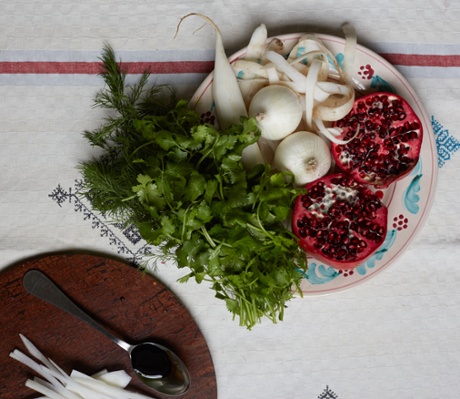
Daikon, pomegranate and herb salad
The traditional version of this dish is much simpler, more sour, and is traditionally served with kebabs. You can swap daikon for white cabbage or raw turnips. What you need is a sharp and fresh accompaniment to the luscious plov – so use your creativity with whatever crunchiness you have in the fridge.
Serves 8
1 pomegranate, seeds only
2 tbsp pomegranate molasses
1 tbsp white wine vinegar/lemon juice
½ tbsp honey (optional)
A pinch of salt
1 daikon, peeled and julienned
1 small mild white onion, peeled and thinly sliced
15g dill, chopped
15g coriander, chopped
1 Squeeze half the pomegranate seeds over a large bowl and discard the pips. Add the pomegranate molasses, vinegar and honey and season generously with salt.
2 Put the julienned daikon and onion in the bowl and massage them with the dressing. Leave to macerate for 15 minutes. Add the herbs, decorate with the remaining pomegranate seeds and serve immediately.