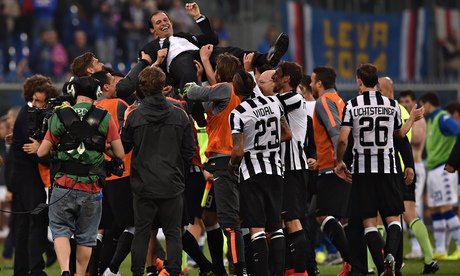
Champagne corks flew in the Juventus changing room, but few players actually partook. Most preferred to swig from bottles of Gatorade. Together they danced and hugged and sang songs about becoming champions of Italy for the fourth consecutive year. But there would be no confetti, no commemorative T-shirts, not even any immediate plans for a night of drunken excess.
It was a strikingly low-key conclusion to another remarkable league campaign. Juventus’s season had begun, in the words of the defender Leonardo Bonucci, “amid chaos”, after Antonio Conte resigned on day one of pre-season training. Punches, kicks, eggs and gobs of spit rained down on the car of Max Allegri when he arrived as his replacement.
A great many Juve supporters were furious at the appointment. Allegri was not only a former rival but one who had knowingly baited them during his tenure with Milan – riffing on the two titles that the Bianconeri had stripped from them as a result of the Calciopoli scandal. He had joked that they should count one extra for winning Serie B.
More than that, Allegri was perceived as not good being enough for the role. Sceptical supporters noted how he had been fired by Milan at the start of 2014 with the Rossoneri sat 11th in the table. Few acknowledged his previous successes at the club – from winning the scudetto in 2011, to securing a third-place finish the following season despite seeing Zlatan Ibrahimovic, Thiago Silva and Alessandro Nesta depart.
How far the narrative has shifted. At the end of the 1-0 victory over Sampdoria which sealed Juve’s scudetto on Saturday, players gathered around Allegri to throw him up into the air. The club’s president, Andrea Agnelli, felt moved to post on Twitter for only the 17th time in three years. “To take this team in hand on 15 July and lead them to victory again takes balls!” he wrote. “Thanks Max.”
This will be remembered as Allegri’s scudetto. It was fitting that his team should line up on Saturday in the same 4-3-1-2 formation which he used so often at Milan, but the truth is that the manager has never been dogmatic when it comes to tactics. Allegri’s greatest strength is his pragmatism, a willingness to bend according to circumstances without ever losing sight of his fundamental goal of winning matches.
We saw this in Milan, where he handled himself masterfully in dealings with Silvio Berlusconi. Plucked from the relative obscurity of Cagliari, he was portrayed at first as a puppet who had been brought in to cater to the owner’s whims. Instead, he showed from the outset that he knew how to pick his battles.
Criticised by Berlusconi for appearing on TV looking unkempt, Allegri made sure to comb his hair and straighten his tie before subsequent post-match interviews. But when Berlusconi agitated for Ronaldinho to play more often, the manager resisted – unwilling to risk the balance of his team. The Brazilian was sold in the next transfer window.
In Turin, Allegri’s pragmatism has manifested itself in the way he has adapted his formations. To begin with, he stuck to the 3-5-2 used by Conte, reasoning that this would be easiest for his players after such a disrupted preseason. He was duly accused of bringing nothing new to the table but, as long as the results kept coming, Allegri did not especially care.
It was only the Champions League group stage defeats away to Atlético Madrid and Olympiakos that led him to contemplate a change of course. Needing a win in the return game against the Greek side, Allegri gambled on a switch to a four-man defence. Juve trailed just after the hour mark but eventually won 3-2. Allegri signed off his post-match tweet with a “#fiuuu” (Italian for “phew”) that quickly went viral. It was both a defining moment of his team’s season, and also the one in which his relationship with the Juventus fans finally started to thaw.
Since then, Allegri has chopped and changed formations, adjusting according to opponent but also according to the players available. It is worth remembering that this season’s successes have been achieved despite lengthy absences (some of them continuing) to players as important as Paul Pogba, Andrea Barzagli, Kwadwo Asamoah and Andrea Pirlo.
Where Conte’s teams played at a constant high tempo, Allegri has taught Juventus how to ease off and conserve energy at the right times. As Maurizio Crosetti put it in La Repubblica on Sunday, “if the most important organ of Conte’s Juve was its [hungry] stomach, then for Allegri’s Juve it is the brain.”
Neither approach is inherently superior to the other. In football, as in many other things, there is more than one way to succeed. Conte’s three consecutive league titles will not quickly be forgotten, and Allegri will neither finish this league season undefeated, as his predecessor did in 2011-12, nor having broken the 100-point barrier, as Juve did last year.
Allegri has, however, proven that he belongs at a club of the highest level. He is only the sixth manager ever to win Serie A with two different teams and the first ever to do so in his first season at each one. His is also the first Juventus side since the advent of three points for a win to claim the title with four games left to spare.
Such serene progress has allowed the Old Lady to fix her attention on goals further ahead. Juventus have a Coppa Italia final against Lazio to look forward to next month. Beat the Biancocelesti, and they will become the first team ever to win the competition 10 times – a feat that would entitle them to add a silver star alongside the three gold ones that appear above the club badge on next season’s shirt.
But for now, of course, all attention is on the team’s Champions League semi-final against Real Madrid. It was precisely this prospect that kept the celebrations so muted at the weekend. Juve’s players returned from Genoa on Saturday and withdrew immediately to the hotel where they will remain until Tuesday’s first leg. “Of course, we would have liked to celebrate all night,” said Gigi Buffon. “But that would be to give a little advantage to Real Madrid. These are people who do not need any advantages.”
The goalkeeper made it plain, though, that he was not taking this latest domestic triumph for granted. He lingered for several minutes thanking and signing autographs for the 200 or so fans who showed up to greet the team bus when it returned at 11.30pm to Turin. “I always have tears in my eyes when I win,” added Buffon. “If that was not the case, then it would be better to stop playing.”
There is little prospect of that happening any time soon. Buffon has already hinted at a desire to play on until the 2018 World Cup. Even as speculation continues to mount regarding the futures of Pogba, Carlos Tevez and Arturo Vidal, few would bet against his Juventus team returning to win a record-equalling fifth consecutive scudetto next year.
Talking points
• Buffon may be planning long term, but Andrea Pirlo dropped a hint that this could be his final season with Juventus. In a conversation with reporters from Gazzetta dello Sport and Tuttosport, the midfielder said that winning the Champions League “could be the perfect way to close [my time at the club]”. He subsequently added that if he did leave, it would be to move abroad, saying: “Juve will be my last Serie A team regardless.”
• Contrary to expectations, Filippo Inzaghi remains the manager of Milan. A note was circulated to reporters on Sunday night stating that the manager would remain in place until the end of the season, even if it is hard to conceive of any scenario in which he would stay around longer than that. Milan showed spirit to hold Napoli without a goal until the 70th minute after Mattia De Sciglio had been sent off within moments of kick-off at the Stadio San Paolo, but ultimately still slumped to a 3-0 defeat.
• If the Rossoneri were looking for something to hold on to, then perhaps it might be the debut of the 17-year-old youth-team graduate Gian Filippo Felicioli. Inzaghi promised at full-time to give others a chance over the remaining four games. Offering a first opportunity to a future star might be one way for him to soften an otherwise miserable legacy to his time as manager.
• As for Napoli, they edged a point closer to the Champions League places, thanks to Lazio’s draw with Atalanta. Roma leapfrogged their neighbours into second place with a 2-0 win over Genoa. Seydou Doumbia got things started for the second game in succession, but Alessandro Florenzi’s coast-to-coast run and finish was probably the goal of the round.
• That said, I did also very much enjoy Antonio Di Natale’s inside-of-the-heel finish against Verona. That was the 206th goal of his Serie A career, moving him clear of Roberto Baggio into sole possession of sixth place on the all-time scoring charts.
• Fiorentina are back up to fifth but the more important aspect of their 3-1 victory over Cesena was simply that it ended a run of four consecutive defeats – providing a timely confidence lift before Thursday’s Europa League semi-final first leg at Sevilla. “We will be ready, and we will give everything to reach the final,” assured Vincenzo Montella. “We will play to win the game in Spain, too.”
• Drawing at home to Chievo was not a good look for Inter. Still, better than getting caught on camera with a finger up your nose.
Results: Atalanta 1-1 Lazio, Fiorentina 3-1 Cesena, Inter 0-0 Chievo, Napoli 3-0 Milan, Roma 2-0 Genoa, Sampdoria 0-1 Juventus, Sassuolo 0-0 Palermo, Verona 0-1 Udinese.