Charles Ewart was “a man of herculean strength” who chopped off the head of a French soldier with one slash of his sword at the Battle of Waterloo – and was worth just 15 shillings and sixpence a month to the British army.
Muster rolls and pay lists, records of troops signed up and wages paid which were kept monthly or quarterly, have been drawn from the tattered originals in the collections of the National Archives and go online on Friday through the genealogy website Ancestry covering the period 1812-1817.
The numbers peak in 1815 – the year of the Battle of Waterloo – with more than 250,000 names recorded. The records are searchable by name, regiment, date and station, for the cavalry, foot guards and regular infantry regiments.
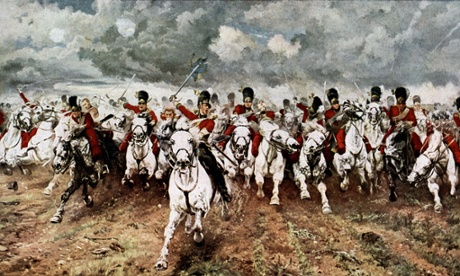
Ewart, born in Kilmarnock in 1769, was 1.9 metres (6ft 4in) tall, while the average height of soldiers at Waterloo was about 1.7 metres (5ft 8in). He was highly experienced by the time of the battle on 18 Junethat finally defeated Napoleon, with decades of service in the Scots Greys, who would play a leading role.
His life story is told by a descendant, Owen Davis, in the archive of Waterloo soldiers being compiled by the National Army Museum to mark the bicentenary.
Ewart is said to have decapitated a French soldier who shot a young English officer who was accepting his surrender, with Ewart crying: “Ask mercy of God, for the de’il a bit will ye get it at my hands.”
He went on to capture a French eagle standard, one of two taken during the battle, and for a period watched the fighting when he was ordered to take the trophy to the back of the lines, recalling later: “I cannot express the horrors I beheld. The bodies of my brave comrades were lying so thick upon the field that it was scarcely possible to pass, and horses innumerable. I took the eagle into Brussels amid the acclamations of thousands of spectators who saw it.”
Ewart’s bleak view of the victory – described by the Duke of Wellington as “a damned nice thing – the nearest run thing you ever saw in your life” – was borne out by the experience of another soldier whose name is preserved in the muster rolls. Harrold Chisholm signed up aged 15 and saw half of his 92nd Regiment of Foot killed in two days, at the battles of Quatre Bras and Waterloo. He survived with a minor leg wound.
Ewart retired with a pension after the battle and was guest of honour at a Waterloo dinner in Edinburgh the following year when Sir Walter Scott proposed a toast to him. He later travelled the country with the author as an after-dinner speaker. He died aged 77 in 1846 in Salford, where his remains were rediscovered under a builder’s yard in 1936 and reburied on the Castle Esplanade in Edinburgh.
Ancestry is offering free access this weekend to its UK collection of 1bn records, including the United Kingdom Muster Books 1812-1817.