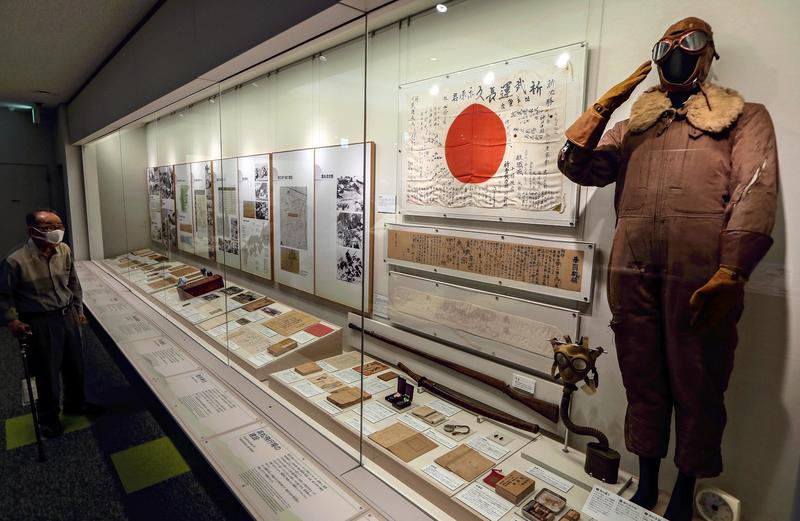
TAKAMATSU -- Donations of belongings and other mementos from World War II have been pouring in from war survivors or their family members to peace memorial museums and other such institutions nationwide.
As the generation who lived through the war and their children are aging, a growing number of people have decided to bring in such items, in the hope to preserve the memory for future generations while they still can.
However, in the past few years, there have been cases in which museums have received nearly double the number of items they used to, and have been unable to accept them due to lack of storage space, highlighting the need to improve the facilities of such museums.
The Peace Memorial Museum in Takamatsu, which has a collection of more than 10,000 items, has seen an increase in the number of donations since its opening in 2016. The number in the last fiscal year totaled to 308, nearly double the 167 items given in the first year.
Hiromu Shinomiya, 93, of Takamatsu compiled his experiences during the war into a booklet and donated it to the museum. It gives an account of the day when the city was attacked by an air raid. He wrote about how stunned he felt as he watched the city burn to the ground while he was on patrol in the Seto Inland Sea.
"It's just so unbearable to think that the memories of the war might be forgotten after I die," said Shinomiya.
In many cases, the items are donated by the family members as they find it hard to keep their loved one's belongings that have been left behind, according to the museum. Many war survivors also donate items themselves as they want to do so while they are alive and well.
However, some facilities that accept these types of donations often struggle to secure storage space.
Kanagawa Heiwa Kinenkan in Yokohama opened in 1995 with a collection of about 800 items. With so many items being donated, it eventually had to stop accepting them around 2013 because the facility ran out of storage space. Instead, another facility in Kanagawa Prefecture is now accepting donations for the museum.
Sasebo Kushu Shiryoshitsu in Sasebo, Nagasaki Prefecture, also ran out of space to store donated items. The facility, operated by the association of air raid victims' families and other groups, has items on display in a room of an old unused school building. But as the number of donations near about 1,800, all the items will be relocated to a city-run facility twice the size of the current location later this month.
"We'll have more room than before, but as we continue to receive donations, this difficult situation will continue," said the man who runs the museum.
At Heiwa Kinenkan in Higashi-Omi, Shiga Prefecture, nearly 90% of the space was filled about three years ago. The museum managed to open up 20% to 30% more space by such methods as bundling letters and postcards and folding clothes.
"After 75 years since the end of the war, the number of survivors is decreasing, so it is becoming even more important for us to consider the history of war-related artifacts and other items to learn more about what happened," Ikuro Anzai, director emeritus of the Kyoto Museum for World Peace, Ritsumeikan University, said.
"The government has a responsibility to convey the facts to the next generation, thus it should create more opportunities for people to learn about what occurred during the war by developing facilities to store and exhibit donated items as well as support for local governments," he said.
Read more from The Japan News at https://japannews.yomiuri.co.jp/