Tuesday in Roppongi and my colleague and I are looking at a line forming in front of our eyes. This district in Tokyo once known for its disco halls is still popular for its clubs and bars, but it isn't even 5 p.m.
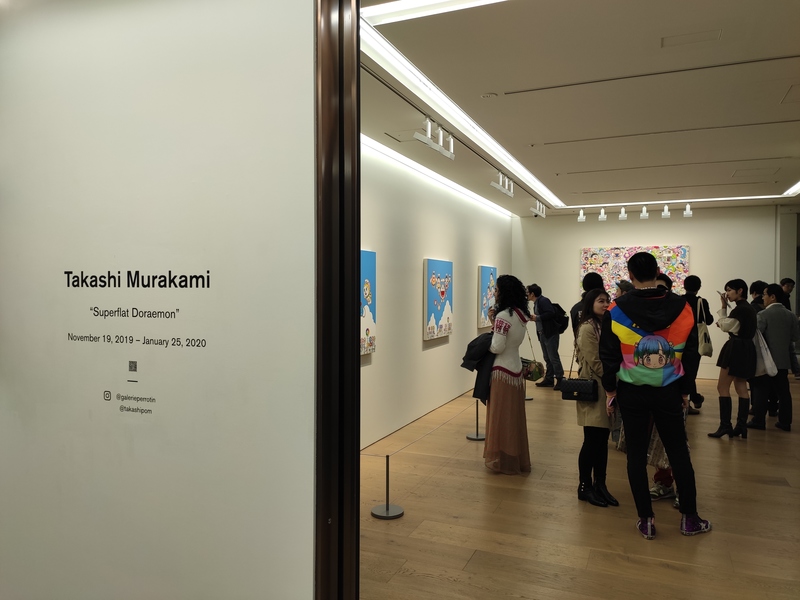
The men and women span all ages, in all kinds of attire. They are quietly waiting to enter the opening of an art exhibition at gallery Perrotin Tokyo called "Takashi Murakami: Superflat Doraemon."
Two of those terms speak for themselves. Murakami is one of the most well-known artists working today, having garnered a following with his early colorful pop art creations and later working with brands such as Louis Vuitton. It is also his first solo show in Tokyo since 2015 and first at Perrotin Tokyo, a Tokyo branch of one of his representatives. That explains the line.
Born in Tokyo in 1962, Murakami is based in the capital and runs Kaikai Kiki Co., which operates galleries and promotes new artists.
As for Doraemon, show anyone in Japan an image of the robot cat and they can name him and tell you some story about the character or hum the TV show's theme song. In most parts of Asia, he is also immediately recognizable.
Since debuting as a manga in 1969, Doraemon has appeared in cartoons on TV and in movies that seem to hit cinemas in Japan every year. The story is about Doraemon coming back from the future to help a human schoolboy called Nobita-kun.
What about Superflat? To find out more, my colleague and I decide to explore the exhibit.
The gallery is on the first floor of the Piramide Building, just a street away from the main strips of Roppongi. Upon entering, we see colorful artworks on square canvases and one canvas in the shape of Doraemon hanging on white walls.
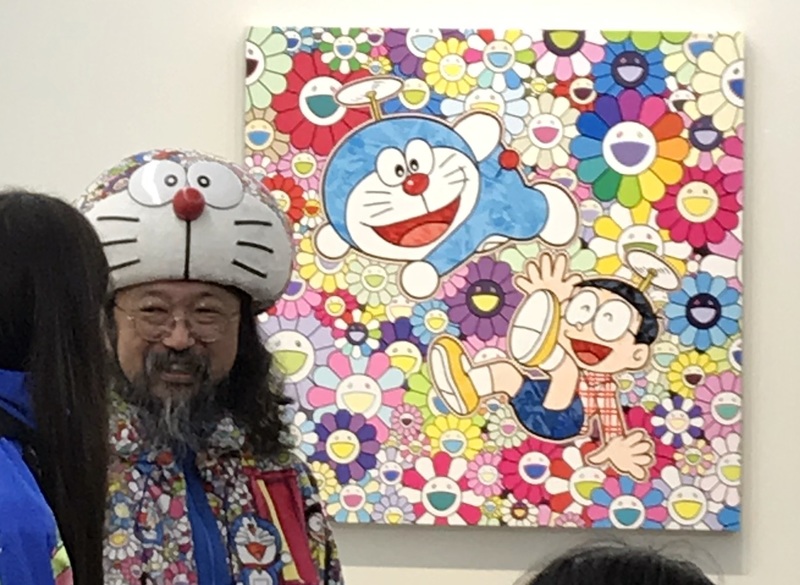
Besides the artworks, nothing else appears. No explanations or labels. A pamphlet we received at the entrance tells us the Doraemon-shaped one is called "Doraemon Sitting Up: 'Yoo-hoo, Nobita!'" It shows Doraemon's body filled with Murakami's signature smiling flowers and several iterations of Doraemon and Nobita-kun. Like most of the works on view, it is made from acrylic and platinum leaf on canvas.
We turn our attention to three works colored in the same blue as Doraemon. All are 100-centimeter-square canvases with clouds and a bottom row of Murakami's flowers. These background elements all seem the same, but after a longer look we see the clouds are slightly different. In the blue field are Doraemon and other characters with "take-copter" or "hopter" rotors on their heads to help them fly.
As we look closer it seems the backgrounds are screen printed and the characters look as if they are pasted on top. You almost want to touch the works to check. Physically, the works are extremely flat, but Murakami uses perspective to give depth so these cartoon characters appear to fly through the sky.
Murakami coined the term "Superflat" with "flat" coming from "the two-dimensionality of Edo period paintings as well as manga/anime," according to art journalist Yoshio Suzuki. It could also be extended to the flattening of culture "in the sense that there should be an equality in expression" and that it is "meaningless" to categorize culture, Suzuki adds.
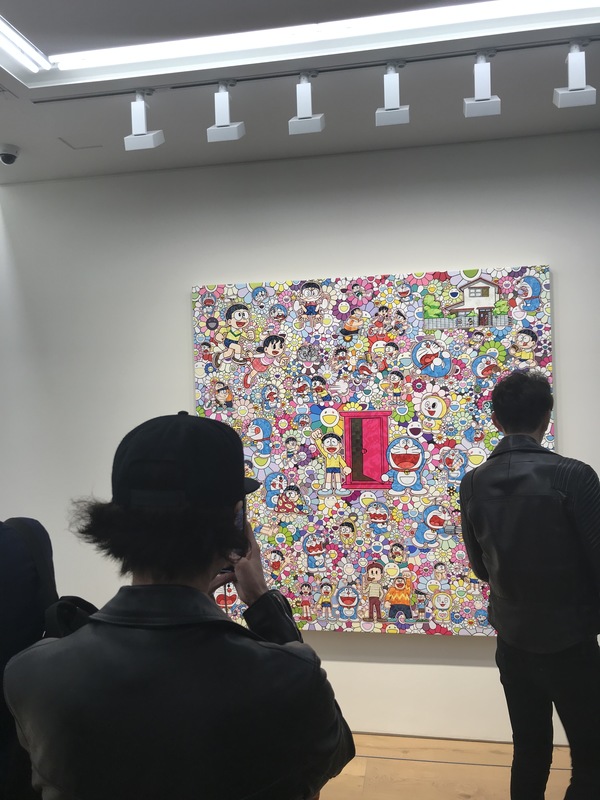
We can feel this coming from Murakami's works, especially in the largest work on view, "A Sketch of Anywhere Door (Dokodemo Door) and an Excellent Day."
The 180-centimeter-square canvas catches the eye with its colorful busyness. Atop the background of hundreds if not thousands of Murakami flowers are several dozen scenes of Doraemon interacting with other characters. Across the bottom is a lineup of the main characters alongside a cartoon version of their creator, Fujiko F. Fujio.
The most intriguing part of this work is the slightly open red door in the middle with Doraemon and Nobita-kun standing on each side raising a fist in joy. What the door leads to is a checkered pattern made of gold and platinum leaf that is reminiscent of art from the Edo period (1603-1867). Perhaps the door connects this contemporary artwork with that of the past.
There are two other rooms in the gallery and in the last one we see Murakami in person, wearing a Doraemon-like turban and talking with American DJ Steve Aoki, whose art collection includes Murakami. Their entourage ushers them through the crowd.
In the courtyard outside the gallery people hang around to catch a glimpse of Murakami. I hear them speaking Japanese, Mandarin, Cantonese, Shanghainese, Korean and French. Speaking English nearby are two men in their 20s who have just finished viewing the exhibition.
Mikuto Murayama, originally from Los Angeles but living in Tokyo, says of Murakami: "In terms of commercial art, in terms of the Japanese art world, he's at the top of it. It's cool to see such a traditional and legendary character like Doraemon come together with Murakami."
He has seen Murakami's works in L.A. and Chicago and finds this exhibition interesting.
"In the past, I know he does screen printing and he also does sculptures, but I hadn't seen anything like the aluminum," Murayama says, referring to the platinum leaf, "with the stickers."
Eric Chen, who is from Toronto and is visiting Tokyo, also mentions the word "stickers" to describe the Doraemon characters seemingly pasted on the flat backgrounds.
"It's just very nostalgic -- reminds me of my childhood," Chen says, referring to Doraemon. "Also, I look at the painting and it's smiling at me. I can't not be happy."
Chen says he had gone to another gallery on the building's fourth floor early in the day and happened to see the Murakami opening advertised. He sums up what perhaps everyone lining up for the exhibit was thinking.
"If it was Doraemon, I would have been interested," he says, "but I don't think I would have come back if it wasn't Murakami."
"Takashi Murakami: Superflat Doraemon" runs through Jan. 25, 2020, at Perrotin Tokyo, Piramide Building, 1F, 6-6-9 Roppongi, Minato Ward, Tokyo. Open Tuesday-Saturday, 11 a.m.-7 p.m. Admission is free.
Read more from The Japan News at https://japannews.yomiuri.co.jp/