
An increasing number of municipal governments have been making efforts to improve efficiency by utilizing artificial intelligence for social welfare and other functions.
Given the prospect that staffing may further decline due to administrative reforms amid the declining population, AI utilization is aimed at maintaining high-quality administrative services.
To rein in the costs for introducing AI, the Internal Affairs and Communications Ministry plans to carry out development projects such as demonstrations to show that AI can be used jointly by municipalities, thereby speeding up its implementation for providing administrative services.
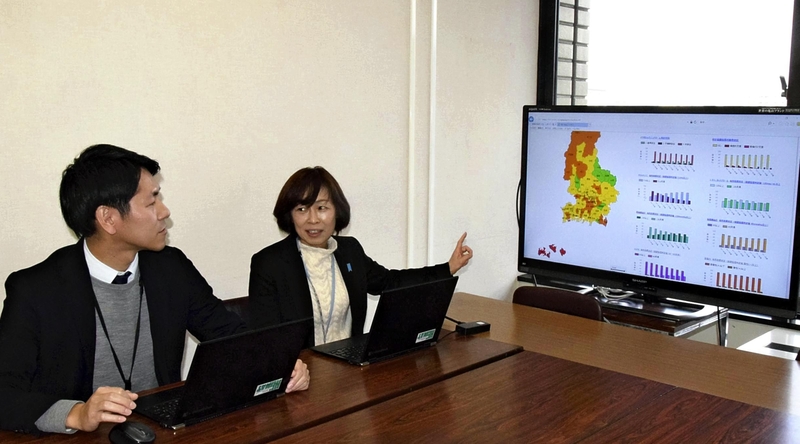
The Himeji municipal government in Hyogo Prefecture has been conducting a trial in which past special medical checkup results, among other things, are fed into the AI system to compile basic data for use in effective implementation of health measures.
The municipality launched the experiment because it was alarmed by poor numerical values of HbA1C, which is used for the diagnosis of diabetes, and it was concerned about the possibility that this would lead to a swelling of medical and nursing care costs.
Hideki Hara, official of the municipal government's information and policy section, said, "We thought about whether we could find a clue [to improve the situation] with the help of AI."
Specifically, cases in which residents developed diabetes are identified by AI after inputting data on the results of their past special health checkups and information about their households, followed by the presentation in numerical values of the risk of developing diabetes and other risks. Hara said that "[health checkup] results will be examined to promote residents' health and extend their healthy life expectancy."
If this AI application is put into practical use, it will enable implementation of such meticulous health measures as promoting dietary improvement in areas with high risks of diabetes.
In other examples of AI utilization, Aizuwakamatsu, Fukushima Prefecture, and other municipalities have been conducting trials aimed at identifying people most likely to need support as they have the possibility of becoming victims of elderly abuse and dying alone. Toyohashi, Aichi Prefecture, has adopted a system to propose nursing care plans based on nursing insurance data over the past eight years.
Overcoming staff shortages
Behind the municipalities' efforts to promote AI utilization are reductions in staffing and effects brought on by work style reforms for local government employees.
The number of employees at municipal governments across the country declined from 3.28 million in 1994 to 2.74 million in 2019. According to a projection by the internal affairs ministry, the number of employees in general administrative divisions at governments of towns and villages whose individual population is fewer than 10,000 will drop from an average of 62 in 2013 to an average of 47 in 2040. Further efforts to streamline operations will be called for on the part of municipalities.
However, the prevalence of AI still has a long way to go. According to the internal affairs ministry, as of Nov. 1, 2018, AI was introduced for at least one operation by 60% of 20 government-designated major cities and 36.2% of 47 prefectural governments. In the case of cities, wards, towns and villages, the percentage was a mere 4.5%. Many municipalities answered in a survey on AI utilization that "it's yet to be known in which operation and field AI can be utilized" and "it is unknown what effect can be expected from AI introduction."
One of the challenges to overcome is the issue of cost. If AI is introduced separately by individual municipalities, it tends to lead to custom orders, thereby requiring a larger budget.
For this reason, the internal affairs ministry has been conducting a trial aimed at developing AI services on the premise they would be used jointly by multiple municipalities. If municipalities can use a universal AI service, implementation costs will be more affordable.
Himeji's analysis of risks of developing diabetes and Aizuwakamatsu's efforts to tackle risks involving the elderly have been undertaken as part of the ministry's trial. The ministry plans to compile guidelines that showcase advanced examples of AI utilization in a move to call attention to its merits.
Data input automatically
In addition to AI, the utilization of robotic process automation (RPA), which is capable of automatically processing such operations as data input and aggregation, is expected to help enhance the work efficiency of municipalities.
In response to a questionnaire survey conducted by the internal affairs ministry, many of the municipalities that have adopted AI and RPA answered that the introduction had contributed toward promoting work style reforms such as the reduction of overtime as well as boosting work efficiency.
Takamatsu has adopted AI for screening of applicants for day care centers. It is possible to allocate applicants, who are ranked in terms of given scores, instantly to day care centers with the use of AI by taking into account elements such as the order of priority. The work, which previously took up about 600 man-hours involving four employees before AI, can be finished in several seconds now, the municipal government said.
Tsukuba, Ibaraki Prefecture, has adopted RPA for processing such operations as the acceptance of resident move notifications. During the peak moving period from mid-March to mid-April, there is an enormous amount of work to be done. This was a burden on municipal government employees. In an AI demonstration, the annual work hours spent for this job shortened from about 85 hours to about 14 hours.
Comments by Yoshikazu Aoki, chief research fellow of Mitsubishi Research Institute Inc.:
"Municipalities are pressed to promote work style reforms for their employees while administrative needs have become more complicated. To reduce the work volume, it is imperative to introduce AI and promote operational reforms. It will become important for each municipality to work out a road map for AI adoption involving all municipal offices and tackle tasks through efforts by all employees.
The central government is urged to explain comprehensibly to municipalities that work volume can be reduces through the introduction of AI. The joint use of AI systems and fiscal support are necessary to rein in expenses."
Read more from The Japan News at https://japannews.yomiuri.co.jp/













