Local governments are setting their own rules for COVID-19 vaccinations of members of the public aged under 65, allowing some groups of people, such as nursery school teachers and those in their 20s and 30s, to get preferential access to vaccines.
The central government has requested them to be flexible with the vaccination schedule depending on the situation in each community. An expert has pointed out that sufficient explanations are necessary to prevent any sense of unfairness or confusion.
-- Vaccinated at night
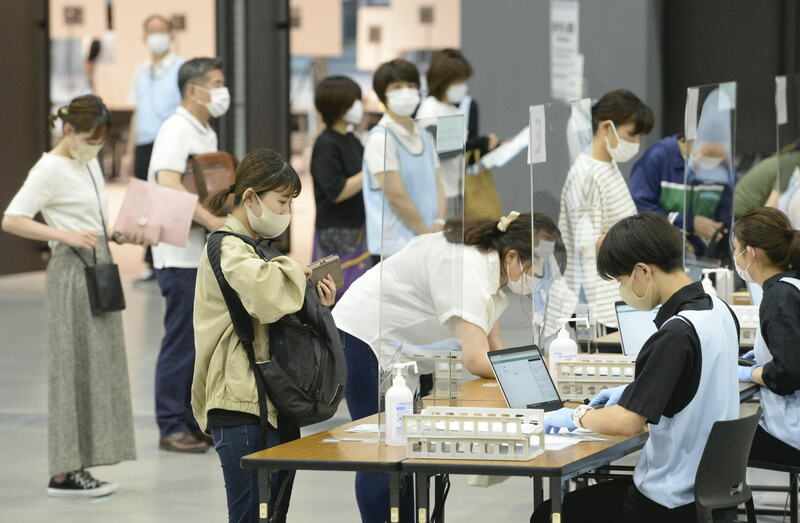
"For the past year, I was worried that I might infect children. So, I'm relieved to be vaccinated now," a 45-year-old nursery school teacher said after getting a shot at a Fukuoka convention facility on Monday night.
On that day, the Fukuoka city government began giving priority vaccinations to nursery school and kindergarten teachers. It plans to vaccinate about 11,000 people by June 21. In the city, vaccinations have already been well underway for people such as those working in elderly nursing care, and will soon be expanded to elementary and junior high school teachers.
Fukuoka decided on this procedure in February. Its reasoning was that if nurseries and schools were to be closed due to an infection cluster, it would force working parents to take days off from their jobs, which would have a major social impact.
The city began its priority vaccinations for under-65s on May 28, along with an increase in the vaccine supply. To avoid disrupting vaccinations for the elderly, the priority vaccinations have been provided from 5 p.m. to 10 p.m., after the day's shots for the elderly have ended. Employers provided the city with lists of workers to be inoculated.
"We haven't received any complaint from citizens. We want to proceed as planned and keep infections under control," an official said.
-- To curve group infection
The central government launched a scheme to vaccinate several groups in order, starting with medical workers and followed by the 36 million people who are 65 or older. Next came 10.3 million people with existing diseases, 2 million nursery care facility workers and 7.5 million people aged 60 to 64.
Vaccine supplies began flowing to municipalities in May. Health, Labor and Welfare Minister Norihisa Tamura said on May 30 that vaccination procedures and schedules would be up to municipalities.
As a result, the Shinjuku ward office, which has jurisdiction over a major entertainment district, has decided to prioritize reservations for people in their 20s and 30s for group vaccinations starting July 7.
In PCR testing that the office conducted in May, about 60% of those who tested positive were in their 20s and 30s. A series of infection clusters among young people has been reported in the nightlife district, and the office decided that it was important to first vaccinate young people, who often do not have primary care doctors.
About 25% of the 69,400 people aged 65 or older in Shinjuku Ward had received their first shot as of Friday.
"Dissatisfaction can occur from any generation," Shinjuku Mayor Kenichi Yoshizumi said. "We mention to the citizens that we have enough vaccine [for everyone]."
-- Essential workers
Many municipalities are giving priority to essential workers, too.
On June 1, the Nara city government announced it would start group vaccinations on June 14 for about 7,000 essential workers, including bus and taxi drivers and hotel staff.
"Infection clusters among essential workers would have a crucial impact on society," a Nara city official said, adding that more target occupations may be added if necessary.
In Tokyo's Minato Ward, the ward government announced that teachers at nursery schools and municipal elementary and junior high schools will be vaccinated from early July along with people who have an existing illness. In Oga, Akita Prefecture, school cooks and dietitians, in addition to teachers at nursery and elementary schools, will be on the list for priority vaccinations that start in August after vaccination of the elderly is finished.
Priority vaccinations could cause confusion, says Tokai University Prof. Yasuhiro Kanatani.
"It is effective for local governments to prioritize vaccinations in accordance with local conditions. On the other hand, they must explain [their decisions] thoroughly and repeatedly so that people will not feel worried about being left behind or confused by differences in the order of those being inoculated from one area to another."
Read more from The Japan News at https://japannews.yomiuri.co.jp/