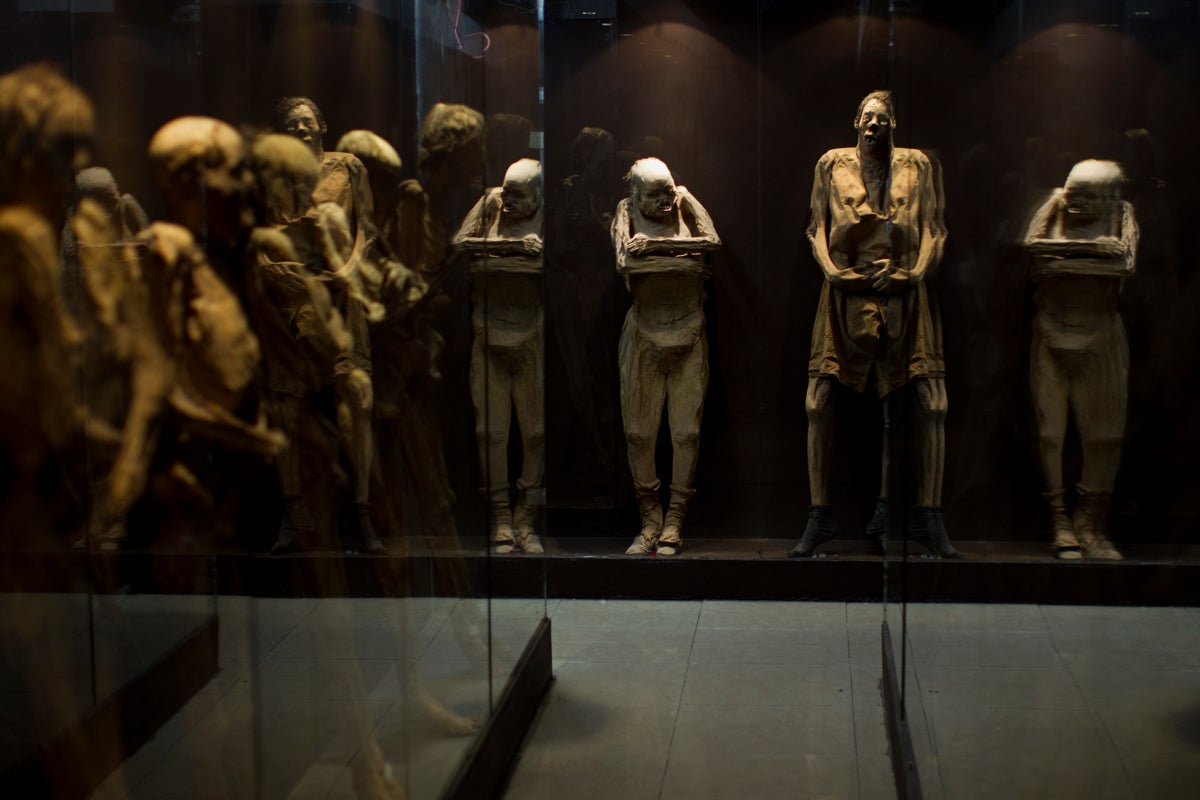
A display of mummies dating back to the 1800s could pose a risk to the public on account of “fungal growths”, experts have warned.
The corpses were unintentionally mummified after they were buried in crypts in dry, mineral-rich soil in Guanajuato in central Mexico, with some still exhibiting hair and the original clothing they were buried in.
The cause of the preservation remains unclear, though some attribute it to the climate, the mineral-rich environment or the sealed crypts.
However, one exhibited mummy has caused concern among experts. The National Institute of Anthropology and History confirmed that it appears to have fungal growths which, since it is not clear whether the cases are air-tight, could pose a health risk to the visiting public.
The federal institute distanced itself from a state government decision to display six of the mummies in glass cases at a tourism fair in Mexico City. It is unclear if the cases are air-tight and the institute said it has not been consulted about the display.
"It is even more worrisome that they are still being exhibited without the safeguards for the public against biohazards," the institute said.
"From some of the published photos, at least one of the corpses on display, which was inspected by the institute in November 2021, shows signs of a proliferation of possible fungus colonies.
"This should all be carefully studied to see if these are signs of a risk for the cultural legacy, as well as for those who handle them and come to see them."
With increasingly little information about their identity, guides and locals alike speculated about the mummies through storytelling, instead. One body was later termed The Witch, and another The Drowned Man.
The mummies are usually on display in the Guanajuato state capital. But they have travelled before, and some were exhibited in the United States in 2009.
They were dug up starting in the 1860s, because their families could no longer pay burial fees, and put on display.