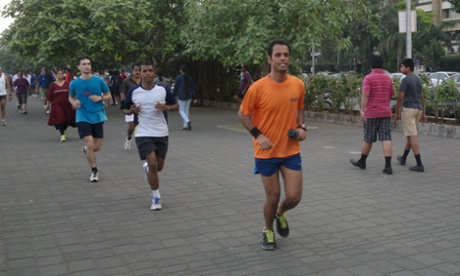
Space is at an absolute premium in Mumbai. The city – nearly bereft of open spaces, and crammed with buildings and shanty towns – wakes up early. So do its runners.
Many runners hit the streets around 5am to escape the onslaught of congestion and crowds – and the majority of weekday runs are wound up by 8am. Relentless traffic and heat make afternoon runs impossible, while very few runners opt for late evening runs because of the number of vehicles on the roads.
But recreational running is slowly but steadily gaining popularity in Mumbai. From this month on, the city will see a surge of runners stepping up training for January’s Mumbai Marathon. The weather too plays its part, with heat and humidity easing considerably at this time of year.
The Mumbai Marathon, also known as the SCMM, was first held in 2004, when 22,000 runners took part. By 2014 the event had ballooned into a running festival offering everything from 2.4km through half marathon to the full 26.2-mile marathon distance. Earlier this year 39,510 runners toed the line at the event, which ranks as an International Amateur Athletic Federation gold standard race, for the 5.30am start.
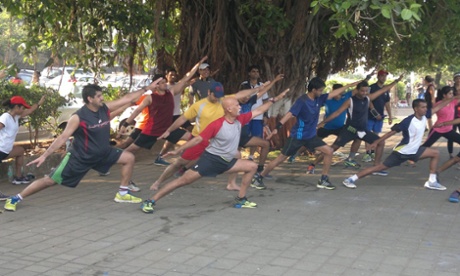
At 5am on the first Sunday of November, the Mumbai Road Runners – a motley group of recreational long-distance runners from across the city – converge near Otters Club in Bandra.
The morning nip prompts some chatter about the weather, while most participants are lost in their pre-run stretching. At 5:30am sharp they set off in groups on their monthly 21km long run, much of which mimics the SCMM course: taking in Shivaji Park, the Siddhivinayak Temple, Haji Ali, and the seafronts at Worli and Marine Drive, ending at the NCPA.
This Sunday, four runners have kindly volunteered to be on water duty – handing out hydration at the 10km mark in Worli, and at the finish.
The monthly Bandra-NCPA practice run is now in its fifth year. “It offers a great psychological advantage if your marquee event is the Mumbai Marathon,” says Ram Venkatraman, one of founder members of Mumbai Road Runners.
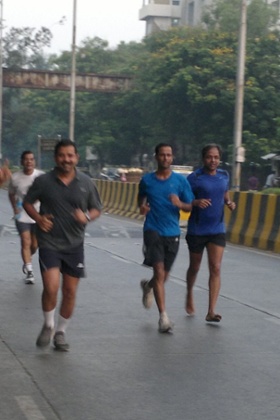
What makes the run interesting is meeting runners of varying abilities and connecting to discuss topics such as pacing, hydration, nutrition, cadence, shoes, stretches, barefoot running and injuries, says participant Viv Menon.
Seeing so many runners on the streets of Mumbai is so motivating, adds Rupal Shah, an artist and marathoner.
This Sunday, the route beyond the 10km-mark is chock-a-block with runners. As the season inches closer to the Mumbai Marathon date, the number of runners crowding this stretch will swell further, says Bijay Nair, a naval officer who took up distance running to combat his thyroid problem. Nair is on water duty today, as is Samuel Chettiar, for whom running has helped prove that there is life after cancer.
By 8am, the NCPA promenade resembles the finish line of a big city marathon with runners milling around, happy to have finished their long run. Coach Giles Drego will soon engage them in post-run stretches.
The number of women joining the ranks of recreational runners is slowly swelling – and barring occasional incidents of ‘eve-teasing’ (a euphemism for sexual harassment) most female runners find the Mumbai streets safe. Mumbai is a relatively danger-free city for women to run in, says Shah. “When I run, I am with myself and it helps me to unwind,” she adds.
“I am feeling strong after today’s run. Way better than my expectation,” says Avani Patel. She echoes Shah’s comments about Mumbai being a safe city for women. “I really enjoy this run. You meet so many runners,” says Bansuri Bharadwaj, an architect who has been running half, full and ultra marathons for two and a half years. As a female runner, it is good to connect with other runners, she adds.
Recreational running provides an impetus to improve lifestyles and diets the world over – and in Mumbai this means cutting down on vada pav (spicy deep-fried potatoes in a bread roll), samosas (fried pastries), pizza, sugary snacks and various kinds of chaat (roadside savoury bites); replacing them with healthier foods such as boiled sweet potatoes, boiled and raw vegetables, fruits and snacks made from cereals, seeds and pulses.
Today, many of the practice-run runners move on to Cafe Mondegar at Colaba for breakfast, while others head to the Stadium Restaurant near Churchgate Railway Station for omelette or scrambled eggs with pav bread. Henceforth, the conversation is no longer restricted to running.
This article was commissioned as part of the Guardian’s Citizen Reporting Programme