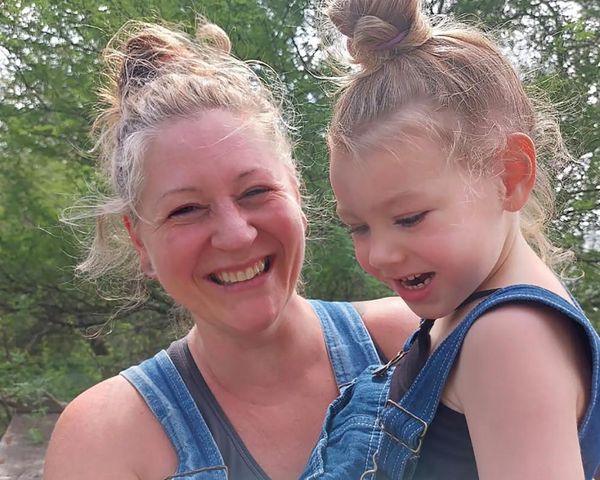
A loving mum is suing the NHS over the “wrongful birth” of her daughter after medics failed to detect she was missing part of her brain.
Lindsey Shaw, 32, would not have continued with the pregnancy of her ‘beloved’ little girl Emily if she had known of her rare and crippling disabilities.
But she described that as the ‘most difficult decision for a mother to make’.
Now four, Emily will live in a wheelchair for the rest of her life, is unable to laugh, and can ‘just about smile’.

The legal action could award millions in damages which would be used to improve her quality of life.
Miss Shaw, 32, had an ultrasound scan to check for abnormalities in her baby at 21 weeks pregnant.
Medics at Middlesbrough’s James Cook Hospital reported that everything was “normal”, London’s High Court heard.
After she gave birth to Emily in October 2014, it became clear that ‘something was desperately wrong’.
A series of tests confirmed that she has Aicardi Syndrome - an extremely rare genetic condition.
It involves the “complete or partial absence” of the structure connecting the two spheres of the brain.
Miss Shaw is now suing the South Tees Hospitals NHS Foundation Trust for compensation.
It centres on a claim that the doctor who carried out the June 2014 scan should have picked up that something was amiss.
It is legally termed a “wrongful birth” case because, although devoted to Emily, Miss Shaw would not have continued with the pregnancy had she been warned of the brain condition.

The NHS denies liability, pointing out that the doctor had taken several scans which showed features which looked like the missing element of the brain.
After her birth, within two weeks of life, Emily began having choking episodes and seizures.
Aicardi Syndrome affects just 4,000 sufferers around the world and has a massive impact on development.
It has left Emily partially blind, stricken by learning difficulties,
unable to speak or walk, and having to eat through a tube.
Miss Shaw explained: “She can’t walk and she can’t sit up, she has no body strength.
“We try to keep her as healthy as possible,” but she added, “she gets a lot of chest infections which have taken a lot of kids’ lives.”
Miss Shaw’s barrister, Julian Matthews, told Judge Jonathan Simpkiss that the medic conducting the ultrasound had wrongly reported the presence of a “fluid filled space” within the baby’s brain, which suggested normal brain development.
In fact this feature was missing.
Had its absence been properly detected, it would have rang sufficient alarm bells to prompt further tests, such as an MRI scan, he told the court.
An MRI would have confirmed the brain was drastically underdeveloped due to lack of the vital structure dividing its two spheres, said Mr Matthews.

“Miss Shaw would have been offered termination of the pregnancy, which she would have accepted,” added the barrister.
Miss Shaw, not in court due to caring for Emily, is claiming damages for the costs of bringing up her disabled daughter.
She has a healthy older daughter, aged nine.
The key issue to be decided by the judge is whether the consultant doctor who ran the scan was at fault in noting the presence of the fluid in the space within the brain ‘when none was there’, the court heard.
Jane Mishcon, barrister for the NHS Trust, pointed out that the doctor had taken six scans in an effort to gain a clear picture.
The medic believed she had identified the presence of the specific feature within the brain ‘as there were a number of images....which mimicked a normal cavum”, she explained.
The scan was carried out in line with standard guidance and correct fetal measurements were taken, she added.
The hearing ended today (Monday July 22), with judgement reserved to a later date.
In a statement afterwards, Miss Shaw said would have faced ‘the most difficult decision for a mother to make’ had she been made aware of the problems.
She added: “I would have ended the pregnancy, not because of her being disabled, not because I do not love her, but because if I knew she would suffer daily and have no quality of life, and have a shortened life, I wouldn’t have her go through that.
“I wouldn’t let my child suffer daily”.
Her solicitor, Wayne Walker, said she had pursued the case to help other mothers in future.
“The patient should have the opportunity to be told that certain structures...were not visualised, allowing mothers to make decisions about their pregnancy when all of the information is presented to them,” he said.