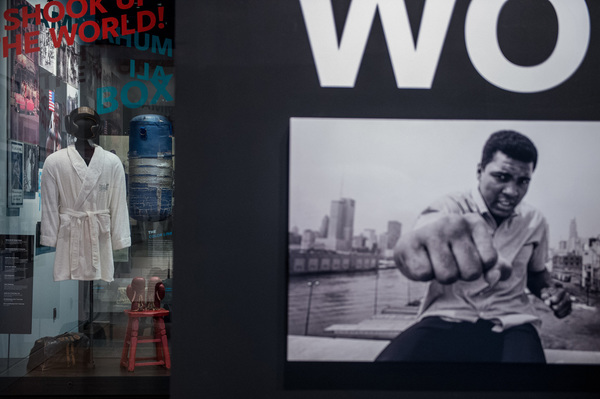
WASHINGTON _ The National Museum of African American History and Culture doesn't just pay tribute to Muhammad Ali's achievements in the boxing ring.
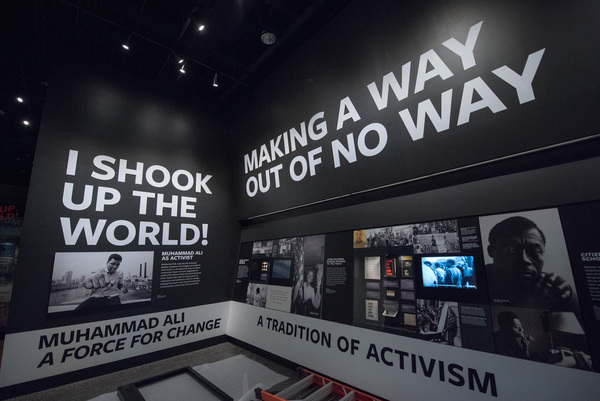
The museum's Ali exhibit, set to open to the public Saturday, also emphasizes his role as an agent of social change _ universally revered today but almost as universally reviled at the time.
The social activist side of Ali, who died in June at age 74, lives on in today's athletes who are protesting injustices in their own way.
Ali protested the Vietnam War by refusing to be drafted. Some of today's athletes are protesting the use of deadly force against black men by police by sitting or kneeling during the national anthem.
"If Ali was still alive, I imagine he would be very proud of these athletes," said Mark Anthony Neal, a professor of African and African-American studies at Duke University. "This is his legacy."
And like Ali before them, they sometimes face a strong backlash.
"America hated him," Neal said.
Ali was born Cassius Marcellus Clay Jr. in Louisville, Ky., the son of a painter and named for a 19th-century Kentucky legislator and abolitionist.
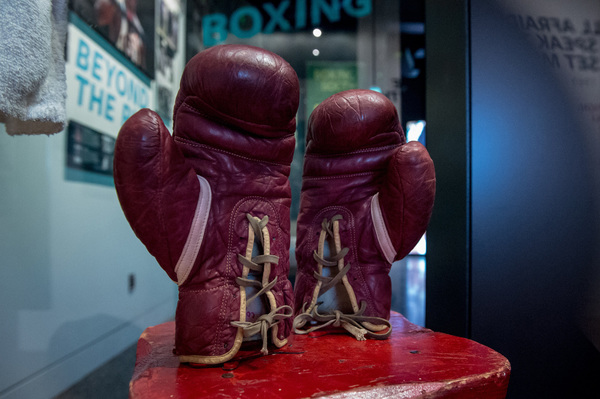
Weeks after wresting the world heavyweight champion title from Sonny Liston in 1964, Clay converted to Islam and changed his name to Muhammad Ali.
Ali had begun attending meetings of the Nation of Islam a few years before. Malcolm X became one of his mentors. They found common purpose in advocating for social justice for African-Americans.
"Ali was a radical even in a radical's time; a loud, proud, unabashedly black voice in a Jim Crow world," President Barack Obama wrote in a statement for Ali's memorial service in Louisville. "His jabs knocked some sense into us, pushing us to expand our imaginations and bring others into our understanding."
Ali's most dramatic statement came in 1967, when at age 25 he refused to be drafted for the war in Vietnam. He cited his religious convictions, as well as the belief that the North Vietnamese had done nothing to him or other black Americans and he had no reason to fight them.
He was convicted of draft evasion, sentenced to five years in prison and fined $10,000. He also was banned from boxing for three years. The U.S. Supreme Court overturned his conviction, but he was out of the ring in his prime. His protest also cost him financially.
"We know what the stakes were for Ali," Neal said.
Although deeply unpopular at the time, Ali's anti-war stance inspired other athletes to stand with him in solidarity. NBA greats Bill Russell and Lew Alcindor _ now known as Kareem Abdul-Jabbar _ and NFL legend Jim Brown risked their reputations to support Ali.
Other black athletes mounted their own protests. When Olympians Tommie Smith and John Carlos _ the winners of the gold and bronze, respectively, for the 200-meter sprint in Mexico City in 1968 _ raised their fists as the national anthem played in the medal ceremony, the U.S. Olympic Committee suspended them. Both received death threats.
Today, the Smithsonian's new museum has a bronze statue of the two with raised fists.
Neal said social media had brought these stories to a new generation of athletes.
"Social media has helped educate a generation of folks who didn't know about those stories," he said. "It has become an important teaching tool in these moments."
Since San Francisco 49ers quarterback Colin Kaepernick first refused to stand for the national anthem in August, his public reputation has taken a hit. Some fans have burned his jersey. He's received death threats. A poll conducted last week found that Kaepernick was the most disliked player in the NFL.
"Not everybody is built for this," Neal said.
But two recent killings of black men by police in Tulsa, Okla., and Charlotte, N.C., and subsequent protests have kept the issues facing African-Americans in the headlines and have inspired others to follow Kaepernick's lead.
The entire West Seattle High School football team knelt in protest during the national anthem last week. The WNBA's Indiana Fever did this week.
"They're all bowing down to the legacy of Ali, I think," Neal said.