
AHMEDABAD: Plagued by disrupted cash flow cycles and a slow recovery post pandemic, micro entreprises, vendors, small traders and seasonal businesses were among the adversely hit over the past one year.
As small businesses failed to recover post pandemic, their loan repayment capacities weakened, pushing bad loan burden under Pradhan Mantri Mundra Yojana (PMMY) up.
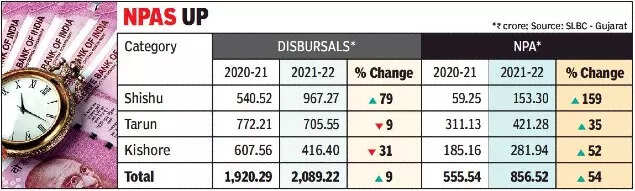
While fresh disbursal of loans under Pradhan Mantri Mudra Yojana (PMMY) increased merely by 10% from Rs 1,920.29 crore in the April to June quarter of 2020-21 to Rs 2,089.22 crore in the corresponding quarter this year, NPAs swelled from Rs 555.54 crore to Rs 856.52 crore – up 54.17%, during the same period
According to experts, micro enterprises which typically avail Mudra Yojana were the worst affected due to the pandemic-induced lockdown.
MM Bansal, convener, SLBC – Gujarat said, “Post lockdown, small businesses were adversely hit as they do not have adequate capital or contingency funds. As demand failed to revive and income was impacted, loan repayment capacity weakened and due to this, more accounts were classified as NPA.”
Echoing a similar view, Pathik Patwari, senior vice president, Gujarat Chamber of Commerce and Industry (GCCI) said, “Cashflow cycles of micro enterprises were adversely affected and many were out of the ambit of emergency credit line guarantee scheme due to the turnover limit. In some cases, adequate credit was also not available to these units as a consequence of which their bad loan burden increased.”
Industry players said that several small units and traders had shut down their businesses post lockdown. Majority of the borrowers under PMMY include small traders and people from lower income groups.
Explaining their situation, Jayshree Vyas, managing director, SEWA Bank, said, “During the lockdown, many people lost their jobs or source of income due to a slowdown-like situation as a result of which family incomes were impacted.
While businesses barely began resuming normalcy, the second wave hit, during which medical expenditures eroded savings and contingency funds. People lost earning members of their families and consequently, their loan repayment capacities weakened.”