A spaceship-like floating object suddenly appears when you go up a gentle slope between houses and fields 5 minutes from the JR Chino Station.
It looks like something you would see in a Studio Ghibli movie, but it's actually a tea room.
The "Flying mud boat" was built in 2010 in Chino, Nagano Prefecture, and was designed by architect Terunobu Fujimori who is known for designing unique buildings such as tree houses.
The roof of the flying mud boat is made of copper and the lower part is covered with red clay. The "boat" was a collaborative effort between local citizens and Fujimori, who held a special exhibition at the Chino City Museum of Art in 2010. The following year, it was relocated from the museum's plaza to its current location.
The flying mud boat is about 3.6 meters wide and hangs about 3.3 meters off the ground with the help of four strong wires.
I asked Fujimori, who is the director of the Edo-Tokyo Museum, about why he made such a strange thing.
"I wanted to have a building float in the air," he replied. "I heard it's popular now on social media, but I just made it for fun."
The tea room should ideally be viewed from a nearby road since it is on Fujimori's private property, but he basically allows anyone to walk onto his property. "They must be tempted to see it up close," Fujimori said.
Fujimori, who specialized in architectural history, created his first work in 1991 "partly in return for my hometown," which stores and exhibits the historical articles of the Moriya family, who have had a family member in the head priest position at Suwa Taisha shrine. This museum is also located near the structure.
Near the mud boat and the museum, there are two tea rooms created by Fujimori: one is called "Takasugi-an," which hangs 6 meters off the ground and looks like a secret base for kids, and the other is "Hikusugi-an," which is half-buried in the ground.
Previously, the public had not been allowed inside these three tea rooms, but with Fujimori's permission, Toshihiko Yabe, an official at the Chino Tourism Organization who manages the tea rooms, leaned a ladder against the mud boat and I climbed up.
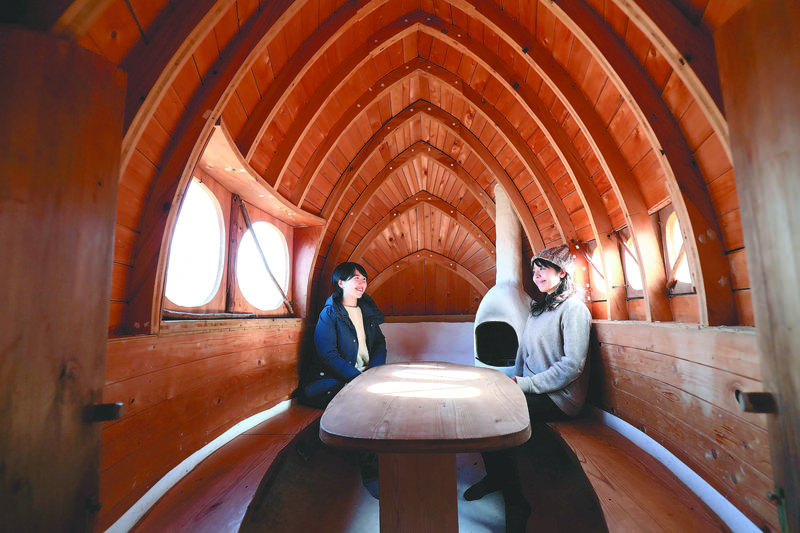
The inside is bigger than I had thought, and six to seven people are able to sit inside. Fujimori holds tea ceremonies with his friends several times a year.
It sways in the wind like a cradle, but somehow it was very relaxing.
In autumn last year, the organization offered tours about three days a month, in response to growing requests to view the inside of the tea rooms. Reservations were necessary, but the tour visited Suwa Taisha Kamisha Maemiya shrine as well as the three tea rooms and took part in a tea ceremony.
Due to its popularity, the organization will offer tours from April to November this year.
There are many tourist spots in Chino, such as Tateshina, Lake Shirakaba and buildings related to Suwa Taisha shrine, but the number of tourists has plateaued.
"We hope the works of Fujimori will encourage many people to visit the other tourist spots as well," Yabe said.
Read more from The Japan News at https://japannews.yomiuri.co.jp/