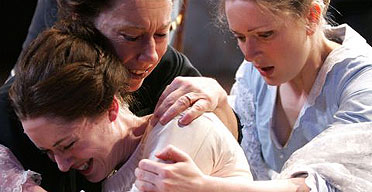
Is Much Ado really a comedy? Peter Hall's revelatory, dark-hued Bath revival this summer suggested it is more a tragedy manque. But Josie Rourke, in her elegantly pleasing Victorian staging that kicks off the new Crucible regime, offers a more traditional study of two reluctant lovers achieving self-realisation.
Claire Price's Beatrice is the more remarkable. She starts as a daughter of the Messina upper crust about whom there is an air of jaunty desperation: you feel that her sharp tongue and caustic wit camouflage a badly bruised heart. And what is wonderful is seeing how Price mellows and grows into love. The arbour-scene, where she is conned into believing in Benedick's passion, comes off excellently as she sends a basket of oranges canonading into the front row. Even that notoriously difficult injunction to her lover to "kill Claudio" is spoken with an intemperate wildness that argues a full heart.
Samuel West, the Crucible's new artistic director, also offers a well-defined Benedick. This is a man who clearly relishes military blokiness. Even when he is tricked into love, he cries: "The world must be peopled" as if it were a campaign order. But West, like Price, seems humanised by passion and shows the triumph of romantic feeling over the genial camaraderie of wit. In addition to two strong central performances, Rourke's production boasts a beautiful set by Giles Cadle imaginatively lit by Neil Austin. We are in a russet-stoned Mediterranean courtyard where washing is hung out to dry, wheelbarrows evoke bosky arbours and where the air is bathed in a smoky orange light. The feeling of an off-duty military caste is enhanced by games of shuttlecock.
But, although Rourke focuses on the play's "merry war" between its dual protagonists, there are times when her sure touch deserts her. The idea of turning Dogberry and the watch into a group of hymn-singing, umbrella-brandishing women makes little sense: the truth is that Dogberry's verbal slips are no funnier for being uttered by an imperious Joyce Grenfell-like female.
The dark undercurrents of the plot against Hero also lack emotional weight. Hall's suggestion that the machinations are driven by Don Pedro's sexual infatuation with Claudio is ignored and Don John's saturnine villainy is never given any plausible motivation. It is left to Nicholas Jones as Leonato to remind us that this is a play in which a father is driven to Lear-like madness by the accusations against his daughter's chastity. But, even if the tragedy is downplayed, Rourke has come up with a charming, handsome and basically sunny production about a post-war world in which two habitual solitaries find their hearts prised open by passion.
· Until November 5. Box office: 0114 249 6000.